

On this page
Building a quadcopter from discrete modules teaches students how flight software translates pilot commands into physical forces. For school exhibitions or entering an engineering build in the IRIS National Fair, custom builds show multidisciplinary mastery across circuits and aerodynamics. As documented in multirotor flight research (Hoffmann et al., 2007), the aircraft requires six primary components:
Airframe: A carbon-fibre or composite X-frame, typically with an 85 mm to 120 mm diagonal wheelbase for nano builds.
Brushless DC (BLDC) motors: Stators and permanent-magnet rotor bells rated by their KV value (RPM per volt).
Electronic Speed Controllers (ESCs): A 4-in-1 board using MOSFET bridges to convert DC battery current into three-phase AC pulses.
Flight controller: A 32-bit microcontroller running Betaflight, housing an Inertial Measurement Unit (IMU) with gyroscopes and accelerometers.
Radio receiver: A 2.4 GHz digital receiver (such as ExpressLRS) translating transmitter stick commands into serial packets.
LiPo battery: A 1S or 2S rechargeable battery pack with adequate continuous discharge current.
How do you calculate thrust and power for stable hover?
A common beginner mistake is designing for total thrust that merely matches vehicle weight. As Gabriel Hoffmann and colleagues showed at the AIAA Guidance, Navigation, and Control Conference, stable flight requires dynamic power reserve so inner control loops can adjust motor speeds without losing altitude. Multirotor engineering guidelines and ArduPilot copter tuning guidelines recommend a 2:1 thrust-to-weight ratio (TWR), allowing hover at 50% throttle.
Calculate your components using four steps:
All-up weight (AUW): Include the frame, motors, electronics, and battery. Suppose your nano drone weighs 180 g (0.180 kg).
Total thrust required: Weight is W = m × g = 0.180 kg × 9.8 m/s² = 1.76 N (or 180 gram-force). A 2:1 ratio requires 360 gf of total maximum thrust.
Thrust per motor: Divide 360 gf by 4 to get 90 gf peak thrust per motor. In steady hover at 50% throttle, each motor delivers 45 gf.
Battery C-rating check: If four motors draw 16 A total at full throttle, an 850 mAh (0.85 Ah) 25C LiPo pack safely supplies 0.85 Ah × 25 = 21.25 A, leaving 5.25 A of electrical headroom.
When resolving inclined vectors or checking power limits, the Fermi Problem Library offers worked problems with a step-by-step solver that explains the reasoning rather than printing an answer.
How does a quadcopter steer and balance using physics?
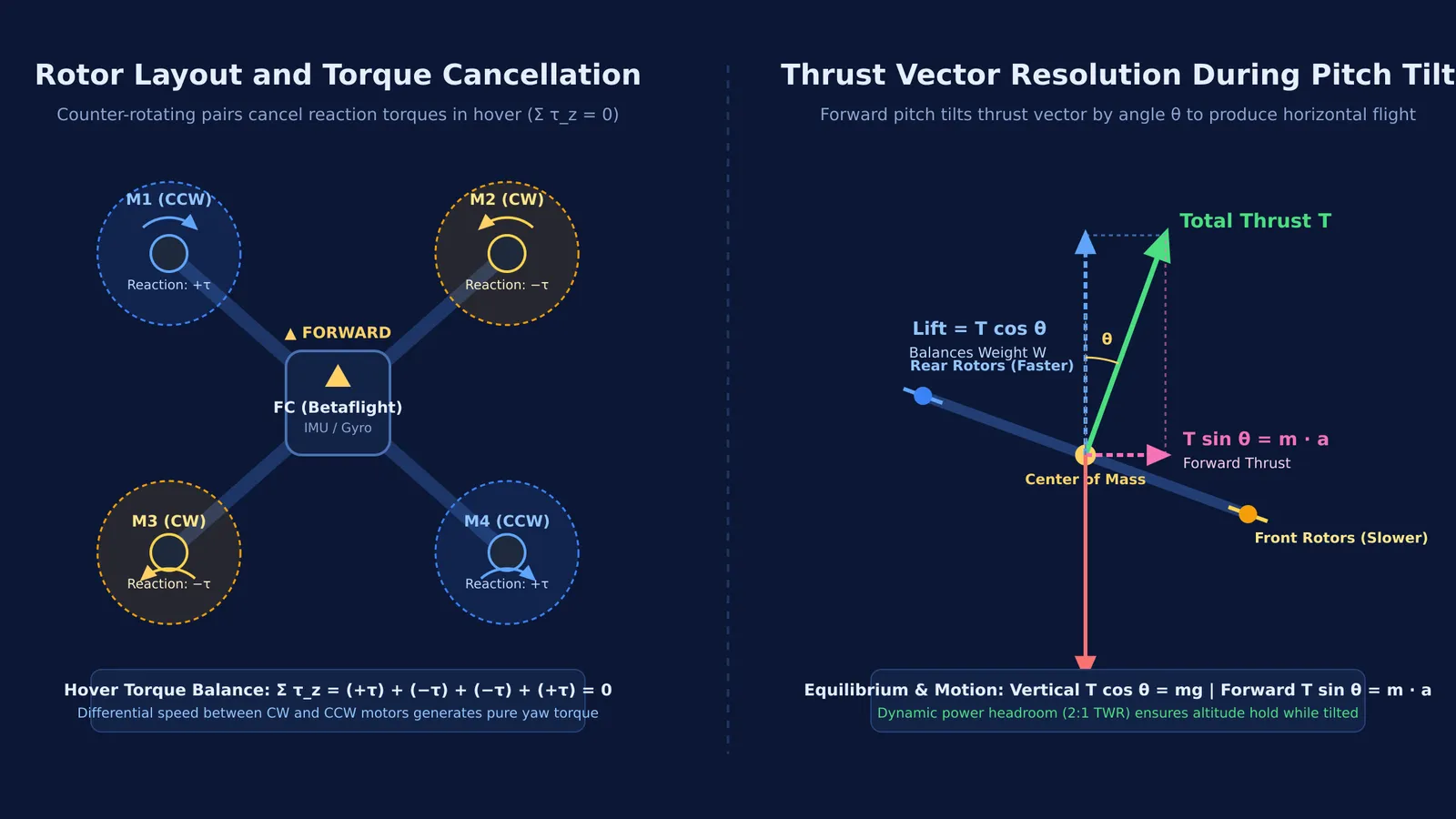
A quadcopter is underactuated: it possesses six degrees of freedom but only four motor inputs. To pitch forward, the flight controller increases rear motor speed and decreases front motor speed equally. Total upward thrust remains unchanged, but differential lift creates a pitching torque about the center of mass. This tilts the thrust vector forward by an angle θ: the vertical component T cos θ balances weight against gravity, while the horizontal component T sin θ accelerates the drone forward.
Yaw control relies on Newton's third law. While Igor Sikorsky's single-rotor helicopter design used a tail rotor to counter main rotor torque, a quadcopter cancels torque symmetrically. Two opposite motors spin clockwise (CW) and two spin counter-clockwise (CCW).
Applying torque as a cross product, each rotating propeller experiences aerodynamic drag, imparting an equal and opposite reaction torque on the frame. In hover, CW and CCW torques cancel (Σ τ_z = 0). Speeding up CCW motors while slowing CW motors creates net reactive torque, rotating the frame clockwise without changing altitude. For ideas that are easier to see than to read, the Fermi Simulation Lab provides interactive simulations to visualise how counter-rotating rotor torques cancel across an airframe.
What are India's legal rules for student drone flights?
Before flying, students and parents must understand local aviation laws. Under the Drone Rules, 2021 notified by the Ministry of Civil Aviation, unmanned aircraft are classified by weight. For student builders, the key tier is the nano category, covering drones weighing 250 grams or less. Nano drones require no Remote Pilot Certificate (pilot licence) and no type certificate. Micro drones (250 grams to 2 kilograms) flown for non-commercial purposes are also exempt from pilot licensing.
Airspace boundaries are mapped on the DGCA's DigitalSky platform. Flights in designated Green Zones require no prior permission up to 400 feet (120 metres) above ground level, or up to 200 feet between 8 km and 12 km from an airport perimeter. Yellow Zones require air traffic control clearance, and Red Zones prohibit flights. All flights must remain within visual line-of-sight during daylight hours over private grounds or school fields.
What is the pre-flight bench testing checklist?
For official airspace verification before flying, consult the DGCA's DigitalSky platform. Complete this bench checklist before your maiden flight:
Fastener security: Tighten motor screws with thread-locker and balance the center of gravity at the frame's center.
Props off for setup: Keep propellers off while flashing firmware, mapping channels, and setting failsafe modes.
Motor rotation check: Spin motors individually at low throttle to ensure diagonal pairs match their assigned CW or CCW orientation.
Failsafe bench test: Arm on the bench at low throttle without props and switch off your transmitter; the flight controller must cut motor power within 0.5 seconds.
Maiden hover test: Hover your first pack in an outdoor green zone just 30 cm over grass to confirm pitch, roll, and yaw responses.


