On this page
August Kekulé proposed in 1865 that benzene is a ring of six carbons. Chemists still could not say, for a given disubstituted benzene, whether the two groups sat next to each other, one apart, or opposite. Wilhelm Körner, a German chemist working in Milan, solved it with a counting argument you can use in JEE today: add a third group and count how many products you get. He published the full proof in 1874, in a 142-page memoir in the Gazzetta Chimica Italiana. There is a twist, though. In that memoir his "ortho", "meta" and "para" do not mean what they mean in your textbook.
Who was Wilhelm Körner?
According to the Dizionario Biografico degli Italiani) (vol. 62, 2004), he was born in Kassel on 20 April 1839, studied chemistry at Giessen and graduated in 1860. He then worked in Ghent as August Kekulé's assistant and private secretary. Severe rheumatism kept him from following Kekulé to Bonn, and at the end of 1867 he went to Palermo, to Stanislao Cannizzaro's laboratory. From 1870 he was professor of organic chemistry at the new Scuola superiore di agricoltura in Milan, and he died in Milan on 28 March 1925.
In 1910 colleagues reprinted his papers as La determinazione del luogo chimico, opened by a speech from the chemist Giacomo Ciamician. Ciamician teased Körner for "the curious bad habit" of not bothering to publish. His 1869 proof that all six hydrogens of benzene are equivalent was, Ciamician said, "pubblicata, o meglio seppellita" (published, or rather buried) in the Giornale di Scienze Naturali ed Economiche of Palermo, so it stayed unknown. (All translations from Italian in this post are ours.)
What was Körner's absolute method?
Körner called the problem "la determinazione del luogo chimico", finding the chemical place of each group. His idea uses only the symmetry of the ring.
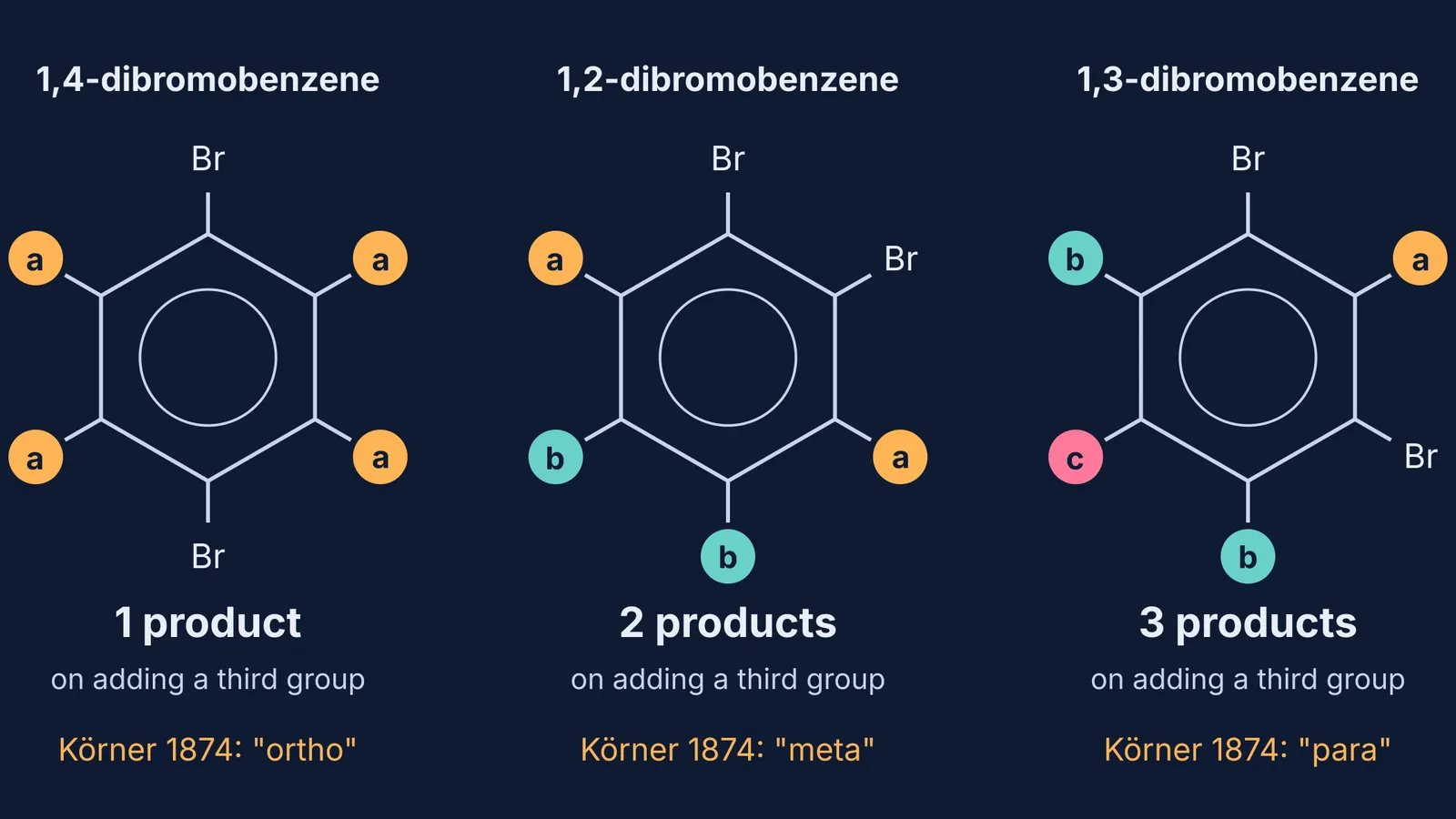
Take a benzene with two identical groups, X. Now ask which of the four remaining hydrogens are equivalent by symmetry:
1,4 (opposite): all four H are equivalent. Replacing any one gives the same compound, so you get 1 product.
1,2 (next to each other): the four H form two equivalent pairs. You get 2 products.
1,3 (one apart): one H sits between the X groups, one sits opposite it, and two are equivalent. You get 3 products.
So if you make the trisubstituted derivatives of an unknown disubstituted benzene and count them, the count tells you its structure directly. Ciamician's introduction states it the same way: one compound for para, two for ortho, three for meta, "sei" (six) isomers in total for a different third group, and "tre" (three) when all three groups are the same. That is the counting rule you meet in isomers of trisubstituted benzenes: why the answers are 3, 6, 10.
How did he prove it with the dibromobenzenes?
Körner used the three dibromobenzenes and put a third bromine, a nitro group or an amino group on each. In the section "Costituzione dei derivati bisostituiti" (pp. 241–242 of the 1910 reprint) he writes that "quella bibromobenzina la quale per l'aggiunta d'un terzo atomo di bromo fornisce la tribromobenzina simmetrica 1,3,5, è necessariamente la modificazione 1,3": the dibromobenzene that gives symmetrical 1,3,5-tribromobenzene when a third bromine is added is necessarily the 1,3 form.
That same dibromobenzene could be turned into all three tribromobenzenes, and it gave three mononitro derivatives. A second dibromobenzene gave two tribromobenzenes, 1,2,3 and 1,2,4 (he wrote 1,3,4, the same compound numbered differently), so it was 1,2. The third had to be 1,4. We checked each count by computer, removing arrangements that match after any of the ring's 12 rotations and reflections:
1,3-dibromobenzene + Br gives 3 tribromobenzenes: 1,2,3, 1,2,4 and 1,3,5.
1,2-dibromobenzene + Br gives 2: 1,2,3 and 1,2,4.
1,4-dibromobenzene + Br gives 1: 1,2,4.
Why were Körner's ortho and para the other way round?
This is where you need to be careful. In the 1874 memoir Körner used ortho, meta and para as names for three families of compounds, not for positions. By his own account he chose the names in a note in the Comptes rendus (vol. 63, which is 1866; the 1910 reprint prints the year as 1886, a misprint). Ortho meant the hydroquinone family, meta the catechol (pyrocatechin) family and para the resorcinol family.
Around 1869, after work by Adolf Baeyer and Carl Graebe, many chemists began to say ortho = 1,2, meta = 1,3 and para = 1,4. Körner refused. He wrote: "in nessun modo va attribuito ai derivati orto, meta e para la rispettiva posizione 1 2, 1 3, e 1 4", that is, in no way should ortho, meta and para derivatives be given the positions 1,2, 1,3 and 1,4. His experiments showed that his ortho compounds were 1,4, his para compounds 1,3 and his meta compounds 1,2.
So in Körner's 1874 language, hydroquinone was an "ortho" compound. He complained that if chemists kept the new meaning, nearly every compound Kekulé's textbook called ortho, meta or para would have to be renamed. That is what happened. The prefixes kept their positional meaning, and the compounds were renamed around them. The Dizionario Biografico adds that Körner did not in the end oppose the change and preferred to write the numbers. Numbers are still the safe choice, as naming disubstituted benzene compounds in IUPAC explains. In this post's worked example and checklist, ortho, meta and para always have today's meaning.
Worked example: identifying the three xylenes
A JEE-style question: three isomers A, B and C have formula C₈H₁₀ and each is a dimethylbenzene. On mononitration (ring substitution only), A gives one product, B gives two and C gives three. Identify them.
Label equivalent H in 1,4-dimethylbenzene. All four ring H are related by the ring's symmetry: one kind. One nitro product. So A is 1,4-dimethylbenzene (p-xylene).
Label 1,2-dimethylbenzene. H-3 matches H-6, and H-4 matches H-5: two kinds. Two products, 3-nitro and 4-nitro-1,2-dimethylbenzene. So B is o-xylene.
Label 1,3-dimethylbenzene. H-2 is between the methyls, H-5 is opposite it, and H-4 matches H-6: three kinds. Three products. So C is m-xylene.
Check the total. 1 + 2 + 3 = 6, the number of ring isomers of C₆H₃X₂Y. It matches the 3, 6, 10 rule.
The count says which products can exist, not which forms fastest. For more isomer-counting problems with each step explained, try the Fermi Problem Library, a step-by-step solver that explains the reasoning.
What did Körner leave for later chemists?
His method proved positions without assuming anything about how substitution happens. Ciamician says it also confirmed Kekulé's ring and showed how reliably structural formulas predict the number of possible compounds. Kekulé's side of the story is in August Kekulé and the ring structure that explained benzene. Ciamician also notes that Albert Ladenburg proved the equivalence of the six hydrogens independently in 1874; we have not read Ladenburg's paper.
If you are revising aromatic isomerism for the exam, Fermi Test Prep for JEE Main and Advanced pairs practice with an AI tutor.
Quick checklist
Two identical groups: 1,4 gives 1 product, 1,2 gives 2, 1,3 gives 3 on adding a different group.
With a third identical group: 1,3 gives all three trisubstituted isomers, 1,2 gives two, 1,4 gives one.
Mark equivalent H with the same letter before counting.
In Körner's 1874 memoir, ortho meant 1,4, meta 1,2 and para 1,3. Today ortho is 1,2, meta 1,3, para 1,4.
When in doubt, write the numbers.