

On this page
JEE often asks how many isomers C₆H₃Cl₂Br has, or how many dinitrotoluenes exist. You can try drawing them all and hoping you catch the duplicates, or you can use a short counting rule. Three groups on a benzene ring can only sit in three patterns. Count how many ways each pattern can be filled, add them up, and you get 3, 6 or 10 depending on how many of the three groups are the same.
What are the three ways to place three groups on a benzene ring?
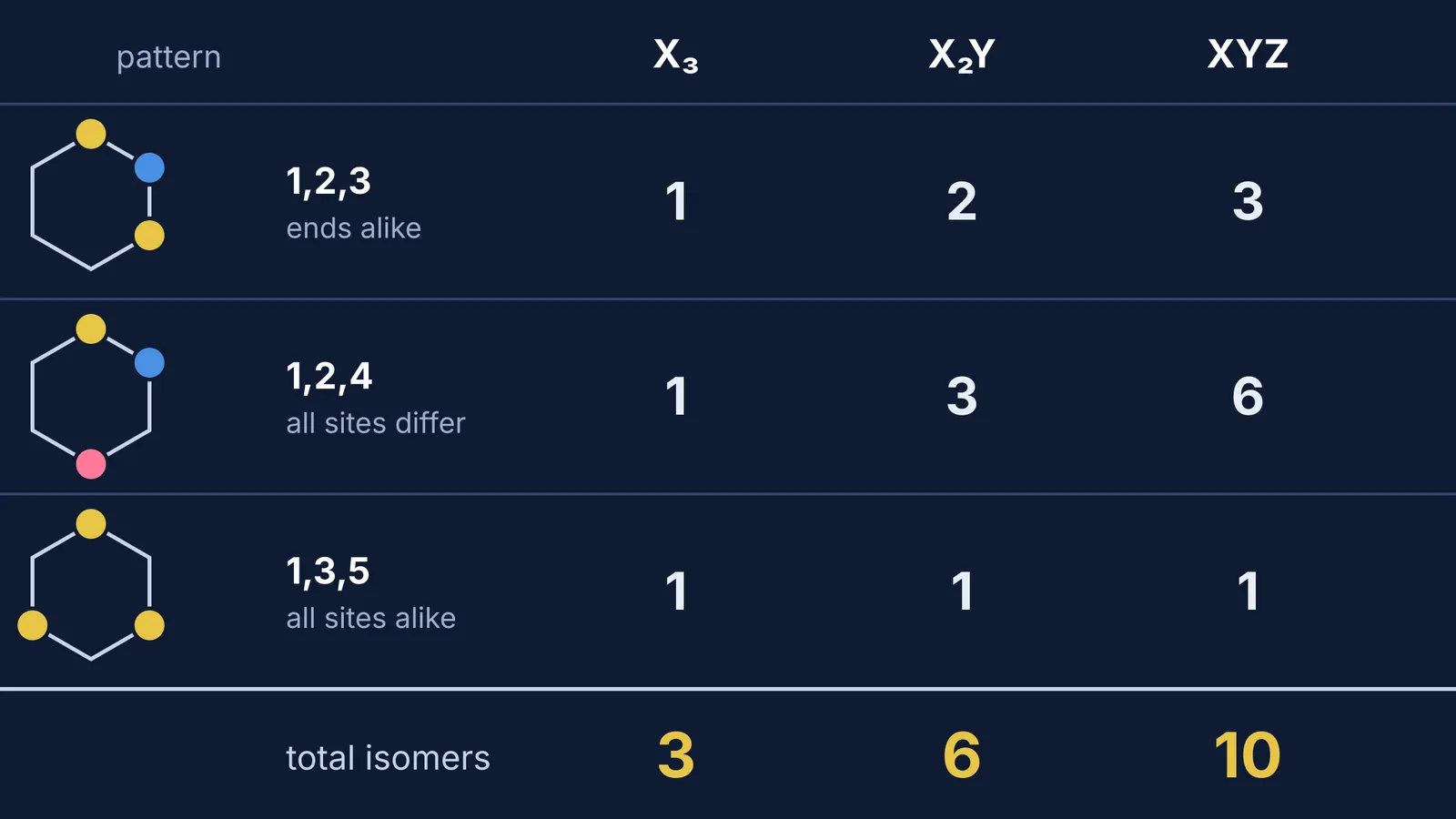
Benzene has six equivalent carbons. Put substituents on three of them and the remaining three carry H. Up to rotation and flipping the ring over, there are only three arrangements:
1,2,3: all three next to each other (vicinal).
1,2,4: two next to each other, the third one further round the ring (unsymmetrical).
1,3,5: every other carbon (symmetrical).
Any other numbering you draw, such as 1,2,5 or 1,3,4, is one of these three after you rotate or renumber the ring. For example, 1,3,4 is the same as 1,2,4 numbered from a different carbon.
When all three groups are the same, each pattern gives exactly one compound. That is why there are 3 trichlorobenzenes and 3 trimethylbenzenes. The trimethylbenzenes are the same three you meet when you draw all eight aromatic isomers of C₉H₁₂.
How many sites in each pattern are really different?
This is the key step. Within each pattern, ask which of the three occupied positions are equivalent by the ring's symmetry.
1,2,3: positions 1 and 3 are equivalent. Both are ends with one neighbour in the group. Position 2 is the middle one. So there are two kinds of site: end and middle.
1,2,4: all three positions are different. Position 1 is next to 2 and para to 4. Position 2 is next to 1 and meta to 4. Position 4 has no substituent neighbour. So there are three kinds of site.
1,3,5: all three positions are equivalent. There is one kind of site.
Students most often go wrong on 1,2,4. It looks as if 1 and 2 should match because they sit side by side, but they do not. One of them is para to the third group and the other is meta to it.
Why does X₂Y give 6 isomers?
Take two identical groups X and one different group Y, as in C₆H₃Cl₂Br. In each pattern, only the position of Y matters, since the two X groups fill whatever is left.
1,2,3 pattern: Y can be in the middle or at an end. Both ends are equivalent, so that is 2 isomers.
1,2,4 pattern: Y can go on any of the three different sites. That is 3 isomers.
1,3,5 pattern: every site is the same, so there is 1 isomer.
Total: 2 + 3 + 1 = 6.
Why does XYZ give 10 isomers?
Now all three groups differ, as in bromochloroiodobenzene, C₆H₃BrClI.
1,2,3 pattern: choose which group sits in the middle. Three choices. The other two fill the ends, and swapping them is the same as flipping the ring. So 3 isomers.
1,2,4 pattern: three different groups on three different sites. That is 3 × 2 × 1 = 6 isomers.
1,3,5 pattern: all sites are equivalent, so any arrangement can be rotated or flipped into any other. 1 isomer.
Total: 3 + 6 + 1 = 10.
We checked all three totals by computer, by placing the groups on a six-membered ring in every possible order and removing arrangements that match after any of the ring's 12 rotations and reflections. The program gave exactly 3, 6 and 10.
Worked example: how many isomers of dinitrotoluene are there?
Dinitrotoluene is C₆H₃(CH₃)(NO₂)₂, so it is the X₂Y case with X = NO₂ and Y = CH₃. The rule says 6. Name them by numbering from the methyl carbon as C-1:
1,2,3 pattern, CH₃ at an end: 2,3-dinitrotoluene.
1,2,3 pattern, CH₃ in the middle: 2,6-dinitrotoluene.
1,2,4 pattern, CH₃ on the site para to the lone group: 2,4-dinitrotoluene.
1,2,4 pattern, CH₃ on the site meta to the lone group: 2,5-dinitrotoluene.
1,2,4 pattern, CH₃ as the lone group: 3,4-dinitrotoluene.
1,3,5 pattern: 3,5-dinitrotoluene.
These six, 2,3-, 2,4-, 2,5-, 2,6-, 3,4- and 3,5-, are the six dinitrotoluenes that are known. If you list them by trying every pair of positions from 2 to 6, you get ten pairs, but 2,3 and 5,6 are the same molecule, as are 2,4 and 4,6, 2,5 and 3,6, and 3,4 and 4,5. That leaves six, which matches the rule.
Which of these forms faster when you actually nitrate toluene is a separate question about reactivity, covered in where a third group goes on a disubstituted benzene ring. This post only counts what can exist.
For more isomer-counting problems with the reasoning shown at each step, try the Fermi Problem Library, which has a step-by-step solver that explains the reasoning.
What about four or five groups on the ring?
Turn it around and count the hydrogens instead.
C₆H₂X₄: the two H atoms can be ortho, meta or para to each other, so there are 3 isomers. For example, the tetrachlorobenzenes are 1,2,3,4-, 1,2,3,5- and 1,2,4,5-.
C₆HX₅: there is only one H, and every position is the same, so there is 1 isomer.
C₆H₄X₂ and C₆H₄XY: ortho, meta and para, so 3 each.
The same idea, finding which positions are equivalent by symmetry and then counting, works on other rings too. Naphthalene is a good test; see why there are ten dichloronaphthalenes.
Where does the rule stop working?
The rule counts only isomers in which all the groups are on the benzene ring. If the question gives just a molecular formula, other structures may also fit.
For example, C₇H₆Cl₂ has the 6 dichlorotoluenes from the rule. It also has 3 chlorobenzyl chlorides, ClC₆H₄CH₂Cl (ortho, meta and para), and benzal chloride, C₆H₅CHCl₂, where both chlorines are on the side chain. That makes 10 aromatic isomers, not 6. Always check whether the question says "ring-substituted" or "isomers of the formula".
Quick checklist
Three groups on benzene: patterns 1,2,3; 1,2,4; 1,3,5.
Distinct sites: 1,2,3 has 2, 1,2,4 has 3, 1,3,5 has 1.
X₃ gives 3. X₂Y gives 2 + 3 + 1 = 6. XYZ gives 3 + 6 + 1 = 10.
Dinitrotoluene has 6 isomers; trimethylbenzene has 3.
C₆H₂X₄ gives 3; C₆HX₅ gives 1.
A flipped drawing is the same molecule; none are chiral.
For a bare formula, add the side-chain isomers.


