

On this page
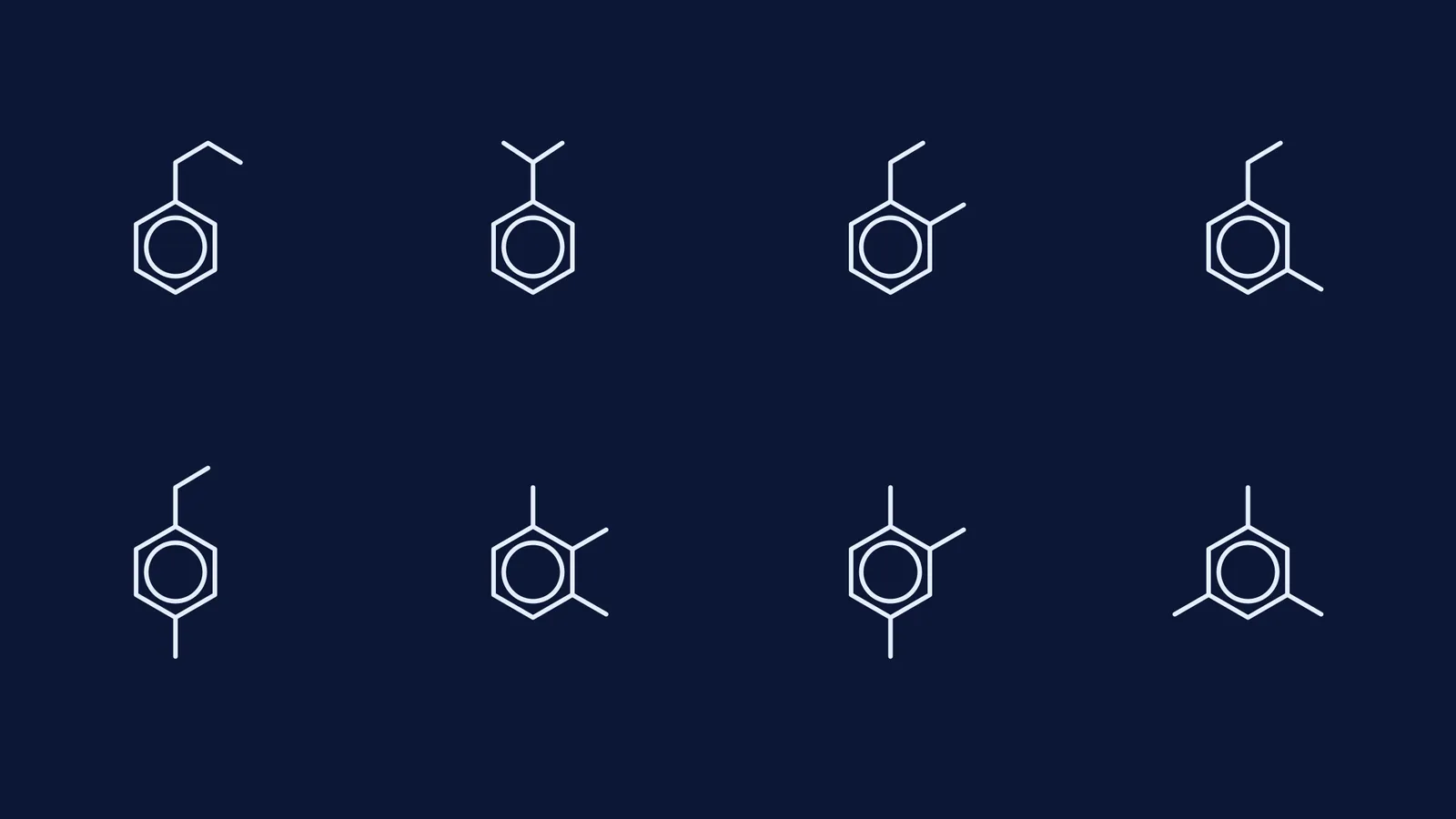
If you are asked to draw all the aromatic isomers of C9H12, you are looking for every stable molecule that pairs a six-carbon benzene ring with a three-carbon side chain system. The formula C9H12 yields exactly eight aromatic isomers, according to the NIST Chemistry WebBook.
Systematically finding them is a common exercise in identifying structural isomers. If you simply start drawing methyl groups at random, you are likely to draw the same molecule twice under different rotations. The key framework is to start with the longest possible side chain and then progressively chop it into smaller, more numerous substituents scattered around the ring.
What makes a C9H12 isomer aromatic?
An aromatic isomer of C9H12 must contain a benzene ring, which inherently accounts for six carbon atoms and five or fewer hydrogen atoms. This leaves exactly three carbons and seven hydrogens (a C3H7 group in total) to arrange around the rigid hexagonal ring.
To find every unique isomer, you must partition these three remaining carbon atoms into substituent groups. The three carbons can form:
One three-carbon substituent (a propyl or isopropyl group).
One two-carbon substituent and one one-carbon substituent (an ethyl and a methyl group).
Three one-carbon substituents (three distinct methyl groups).
By going through these three cases one by one, you guarantee that you will never miss a structure or accidentally duplicate one. If you are learning how to systematically build and name these structures for an exam, you can explore the rules of nomenclature in the Fermi Concept Library.
How do you draw the mono-substituted benzenes?
When all three substituent carbons are connected in a single unbroken chain, you only have one position occupied on the benzene ring. There are exactly two ways to attach a three-carbon alkyl group to a larger molecule:
n-Propylbenzene: The three carbons form a straight line attached to the ring by the first carbon.
Isopropylbenzene (Cumene): The ring attaches to the middle carbon of the three-carbon chain, creating a branched Y-shape. Cumene is an industrial chemical used to manufacture phenol and acetone.
Because there is only one group sitting on the ring, positional isomerism does not apply here. A mono-substituted benzene has only one unique position, so there is no ortho, meta, or para version of propylbenzene.
How many di-substituted isomers exist for C9H12?
If you split the three substituent carbons into an ethyl group (two carbons) and a methyl group (one carbon), you get a di-substituted benzene. Because there are two distinct groups on the ring, their relative positions matter immensely. Moving the methyl group around the ring gives you three unique molecules, collectively known as the ethyltoluenes:
1-Ethyl-2-methylbenzene (o-ethyltoluene): The ethyl and methyl groups sit on adjacent carbons. This 1,2-relationship is known as the *ortho* position.
1-Ethyl-3-methylbenzene (m-ethyltoluene): The two groups are separated by one empty, unsubstituted ring carbon. This 1,3-relationship is the *meta* position.
1-Ethyl-4-methylbenzene (p-ethyltoluene): The groups sit directly opposite each other across the ring. This 1,4-relationship is the *para* position.
What are the tri-substituted isomers of C9H12?
Finally, you can divide the three carbons into three separate methyl groups, creating the trimethylbenzenes. Finding all the unique positions for three identical groups on a hexagon yields three more structures:
1,2,3-Trimethylbenzene (Hemimellitene): All three methyl groups sit in a neat row on adjacent ring carbons.
1,2,4-Trimethylbenzene (Pseudocumene): Two methyls are adjacent to one another, and the third is separated by a single gap.
1,3,5-Trimethylbenzene (Mesitylene): The three methyl groups are spaced out perfectly evenly around the ring, with exactly one gap between each. Mesitylene is a highly symmetrical molecule, which gives it a distinct signature in a laboratory setting.
How do chemists tell these isomers apart?
In a laboratory, chemists do not just draw these molecules; they must identify them in a flask. While they all share the exact same molar mass and similar boiling points, their symmetry gives them away under Nuclear Magnetic Resonance (NMR) spectroscopy.
Because Mesitylene (1,3,5-trimethylbenzene) is perfectly symmetric, it produces very few signals on an NMR scan. In contrast, an asymmetrical molecule like 1,2,4-trimethylbenzene produces a much more complex scan with many different peaks.
Counting them all up, we have two propylbenzenes, three ethyltoluenes, and three trimethylbenzenes—making eight aromatic isomers in total. The strategy of moving systematically from the fewest substituents to the most is the exact same method you should use to find all the isomers of C4H10O.
If you want to test your ability to spot duplicate structures, navigate symmetry, or name complex hydrocarbons under pressure, the Fermi Problem Library has worked problems with a step-by-step solver that explains the chemical reasoning rather than just printing a final answer.


