

On this page
Naphthalene, C10H8, is two benzene rings sharing one edge. That leaves eight carbons that carry a hydrogen, and swapping two of those hydrogens for chlorine gives a dichloronaphthalene. Isomer questions ask how many different ones exist, and sorting by symmetry gets you the answer, ten, every time.
Why does naphthalene have only two kinds of position?
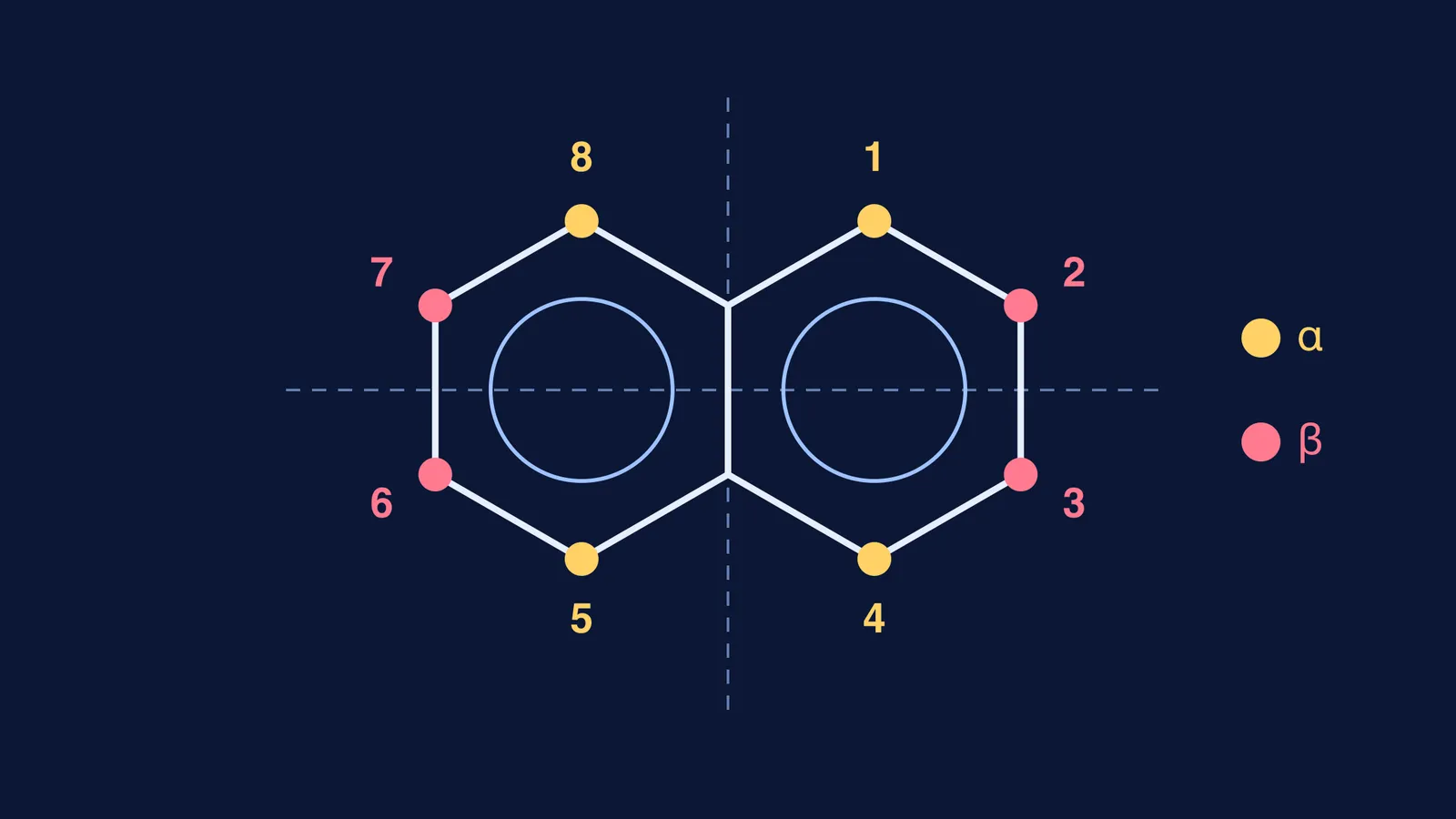
Picture the molecule with the shared bond upright in the middle. It has a mirror line through that bond, a second mirror line across it, and a half-turn about its centre, so positions that look different on paper can be the same.
The eight hydrogen-bearing carbons fall into two sets: the alpha positions 1, 4, 5 and 8, and the beta positions 2, 3, 6 and 7 (Wikipedia, Naphthalene). Alpha carbons sit next to a ring-fusion carbon; beta carbons are one step further out. The same article notes that this is why only two monosubstituted naphthalenes exist, one alpha and one beta.
The key idea: every symmetry operation sends alpha to alpha and beta to beta. So any pair of chlorines is alpha-alpha, beta-beta or alpha-beta, and you can count each type on its own.
How do you count the dichloronaphthalenes step by step?
The World Health Organization's assessment of chlorinated naphthalenes tabulates exactly ten dichloronaphthalenes (WHO CICAD 34, Chlorinated naphthalenes). To reach that number yourself, name every candidate with the lowest possible numbers, and for each one ask: can a mirror or the half-turn carry it onto one I already have?
Both chlorines on alpha positions give 3 isomers:
1,4: same ring, opposite each other (also written 5,8)
1,5: different rings, diagonally opposite (also 4,8)
1,8: different rings, side by side across the shared bond, the peri pair (also 4,5)
Both chlorines on beta positions give 3 isomers:
2,3: same ring, neighbours (also 6,7)
2,6: different rings, diagonally opposite (also 3,7)
2,7: different rings, mirror images across the shared bond (also 3,6)
One alpha and one beta give 4 isomers. Put one chlorine at position 1; symmetry can move any alpha position there. The second chlorine then goes to 2, 3, 6 or 7:
1,2: neighbours in the same ring
1,3: same ring, one carbon apart
1,6: different rings
1,7: different rings
Total: 3 + 3 + 4 = 10. That is the same set the WHO table lists: 1,2-, 1,3-, 1,4-, 1,5-, 1,6-, 1,7-, 1,8-, 2,3-, 2,6- and 2,7-.
How can you check you have not missed or repeated one?
Naphthalene's eight hydrogen-bearing positions (Wikipedia, Naphthalene) give 8 x 7 / 2 = 28 ways to pick two of them on paper. Every one of those 28 must land in exactly one of your ten boxes:
Alpha-alpha: 6 pairs, in 3 isomers of 2 spellings each
Beta-beta: 6 pairs, in 3 isomers of 2 spellings each
Alpha-beta: 4 x 4 = 16 pairs, in 4 isomers of 4 spellings each
6 + 6 + 16 = 28. If your totals do not reach 28, you have left a pair out; if they overshoot, you have counted one twice.
Why do alpha-beta isomers have four spellings and the others only two? For an alpha-alpha or beta-beta pair, one symmetry operation swaps the two chlorines and hands back the same spelling. An alpha-beta pair can never be swapped onto itself, because alpha never turns into beta. If you later meet group theory, this is Burnside's lemma in miniature: (28 + 4 + 4 + 4) / 4 = 10.
What mistakes cost marks on this question?
Run this checklist before you write your answer:
Did you count 1,4 and 5,8 (or 2,3 and 6,7) as two isomers? They are one.
Did you include 2,5 or 2,8? Rename them 1,6 and 1,7.
Did you forget the peri isomer, 1,8? Its two chlorines sit side by side across the shared bond, which makes it easy to overlook.
Did you merge 2,6 and 2,7? They differ: the half-turn maps 2,6 onto itself, the mirror through the shared bond maps 2,7 onto itself.
Does every name use the lowest locants, starting with 1 whenever an alpha position is involved?
If your answer still comes out different and you cannot find the stray pair, the Fermi Problem Library has worked problems with a step-by-step solver that explains the reasoning rather than printing an answer.
Where else does the alpha-beta method work?
Any two identical substituents on naphthalene give the same count. Wikipedia lists ten dihydroxynaphthalenes, with the same locants as the dichloro set (Wikipedia, Dihydroxynaphthalene). More chlorines follow the same logic but the numbers grow fast: the WHO notes there are 75 possible chlorinated naphthalenes, from one chlorine up to eight (WHO CICAD 34).
Sorting positions by symmetry first is the same habit that helps with counting the aromatic isomers of C8H10 and listing the dichloropropane isomers of C3H6Cl2. For the parent compound's everyday side, read why naphthalene balls disappear.
To revise alpha and beta positions alongside the rest of aromatic chemistry, the Fermi Concept Library gives each concept its own lesson and its place in the map.


