

On this page
What causes naphthalene balls to shrink and disappear?
Every winter across India, families unpack woollen blankets and shawls from steel trunks, greeting a pungent, familiar scent. Solid white naphthalene balls, placed between garments months earlier to protect woollens, shrink to tiny specks or vanish entirely without leaving a damp stain or residue.
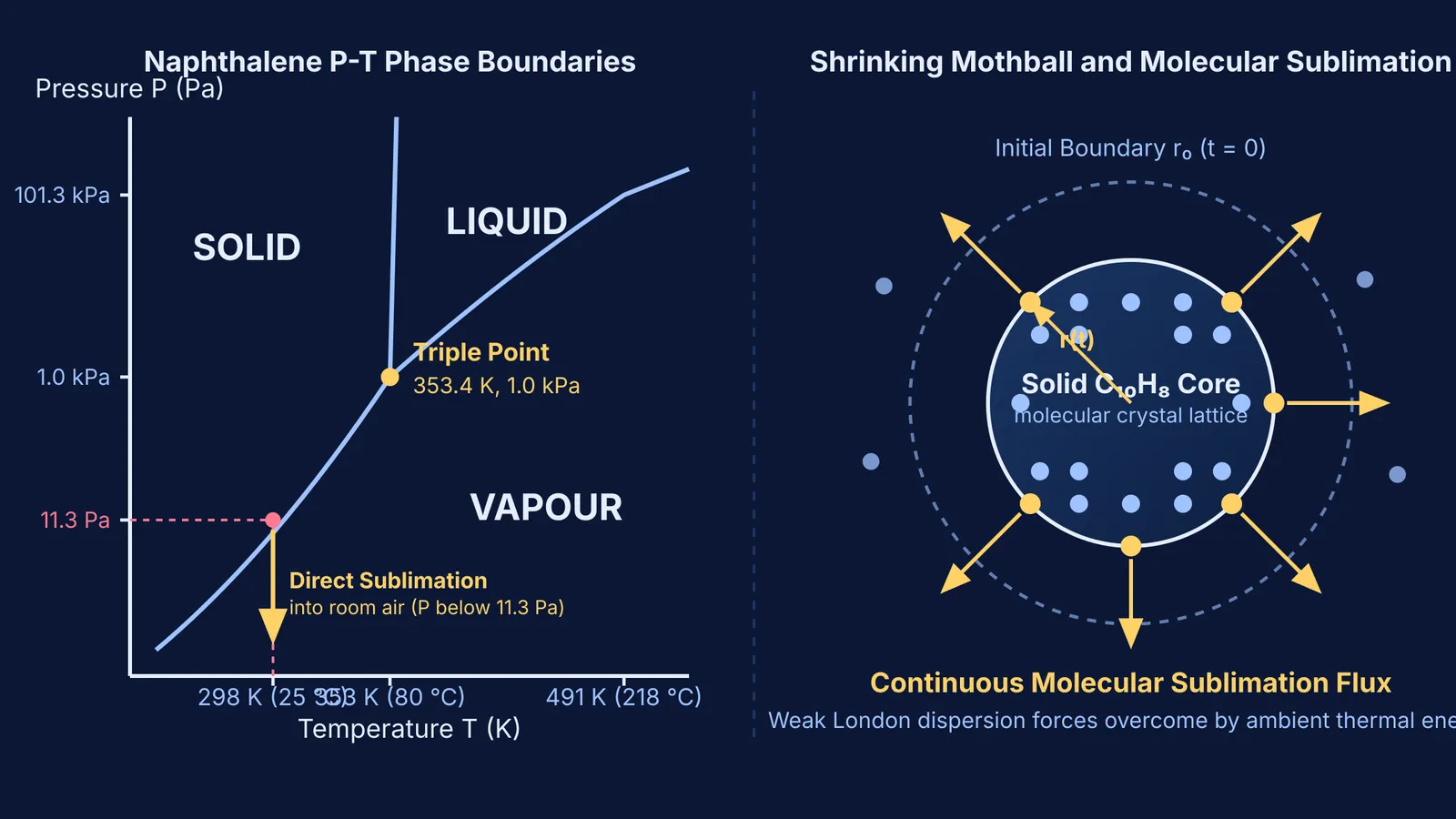
This disappearance is caused by sublimation, where a solid transitions directly into a gas without melting into a liquid. Naphthalene consists of bicyclic aromatic hydrocarbon molecules (C₁₀H₈) with a molar mass of 128.17 g/mol, as catalogued in the PubChem Compound Summary. In the solid crystal, these non-polar molecules are held together only by weak London dispersion forces. Because these intermolecular attractions are relatively frail, surface molecules absorb thermal kinetic energy from the ambient air, break free from the lattice, and escape into the room as vapour. This continuous molecular loss steadily shrinks the solid sphere, illustrating fundamental Class 9 states of matter in our surroundings concepts.
Why does naphthalene skip the liquid state at room temperature?
While ice melts into water before boiling, naphthalene skips the liquid phase in open air because of its phase boundaries. According to thermochemical records in the NIST Chemistry WebBook, naphthalene has a normal melting point of 80.26 °C and a boiling point of 217.9 °C at 1 atmosphere (101.3 kPa).
At standard room temperatures (20 °C to 25 °C), the room remains far below the 80.26 °C melting point, preventing any liquid puddle from forming. However, solid naphthalene maintains a measurable vapour pressure. In *The Journal of Chemical Thermodynamics*, Ambrose, Lawrenson, and Sprake (1975)90038-5) measured naphthalene's vapour pressure from 263 K to 343 K, showing that solid naphthalene exerts a saturation vapour pressure of 11.3 Pa (0.085 mmHg) at 25 °C (298.15 K).
In an open cupboard, ambient air currents continuously carry naphthalene vapour away, keeping the local partial pressure near 0 Pa. Because this falls well short of the 11.3 Pa saturation limit, dynamic equilibrium is never established, and surface molecules continuously sublime until the ball vanishes.
How does sublimation work in Class 9 science?
In the CBSE syllabus outlined in NCERT Class 9 Science Chapter 1, students study how matter changes state when temperature or pressure shifts. The textbook demonstrates sublimation with camphor and ammonium chloride heated in an inverted funnel. Naphthalene behaves similarly: its molecules vibrate with thermal energy, and those at the surface possessing kinetic energy above the lattice binding threshold break free directly into the air.
Unlike melting ice, which absorbs a latent heat of fusion before vaporising, solid naphthalene absorbs its latent heat of sublimation in a single transition from ambient air, linking to broader principles of enthalpies of sublimation and phase changes.
Visualising how thermal vibrations overcome lattice bonds can be challenging from static textbook diagrams. In the Fermi Simulation Lab, students can explore interactive simulations for ideas that are easier to see than to read, adjusting temperature controls to observe how simulated molecular lattices break apart into free gas particles.
What factors control the speed of sublimation?
The rate at which naphthalene balls shrink depends on three main variables:
Temperature: Warmer ambient air raises particle kinetic energy. In vapour pressure measurements by Ambrose et al. (1975)90038-5), naphthalene's sublimation pressure increases more than ten-fold between 23 °C and 50 °C, making mothballs vanish much faster in summer.
Surface Area: Sublimation occurs exclusively at the outer surface. As the sphere's radius decreases, its surface area (4πr²) contracts, reducing the mass lost per hour.
Air Circulation: In a sealed container, vapour accumulates until reaching the 11.3 Pa saturation limit at 25 °C, pausing sublimation. In an open wardrobe, ventilation sweeps vapour away, maintaining continuous loss.
These environmental dynamics follow the same thermodynamic rules explored in heating curves and latent heat.
How do you solve sublimation and phase change problems?
To calculate the energy absorbed during sublimation, consider this standard numerical problem:
Worked Example: Calculate the heat absorbed when a 5.00 g naphthalene ball sublimes completely at 25 °C.
Find moles: With molar mass M = 128.17 g/mol (catalogued in PubChem), n = 5.00 g / 128.17 g/mol = 0.03901 mol.
Find sublimation enthalpy: In the *Journal of Physical and Chemical Reference Data*, researchers Chickos and Acree (2002) reported that solid naphthalene has a standard sublimation enthalpy Δ_sub H° of 72.6 kJ/mol at 298.15 K.
Calculate heat: Q = n × Δ_sub H° = 0.03901 mol × 72.6 kJ/mol = 2.83 kJ. The ball absorbs 2.83 kJ from surrounding air.
For revision, remember three key rules: verify whether ambient pressure permits direct solid-to-gas transition, check if ventilation prevents saturation equilibrium, and account for sublimation being endothermic.
For step-by-step guidance on calculating phase change enthalpies, the Fermi Problem Library explains the underlying chemical reasoning rather than printing an answer. To explore how intermolecular forces govern phase boundaries, the Fermi Concept Library maps every concept across physics and chemistry with its own lesson.


