

On this page
Finding all the isomers for a given chemical formula is a standard challenge in organic chemistry. For the formula C₃H₆Cl₂ (dichloropropane), the task is to place two chlorine atoms on a three-carbon chain without duplicating any structures.
The short answer is that there are four structural isomers, and one of them is chiral. This means there are five stereoisomers in total.
Here is exactly how those structures break down, which ones are geminal or vicinal, and how to spot the chiral centre.
How many structural isomers of C₃H₆Cl₂ are there?
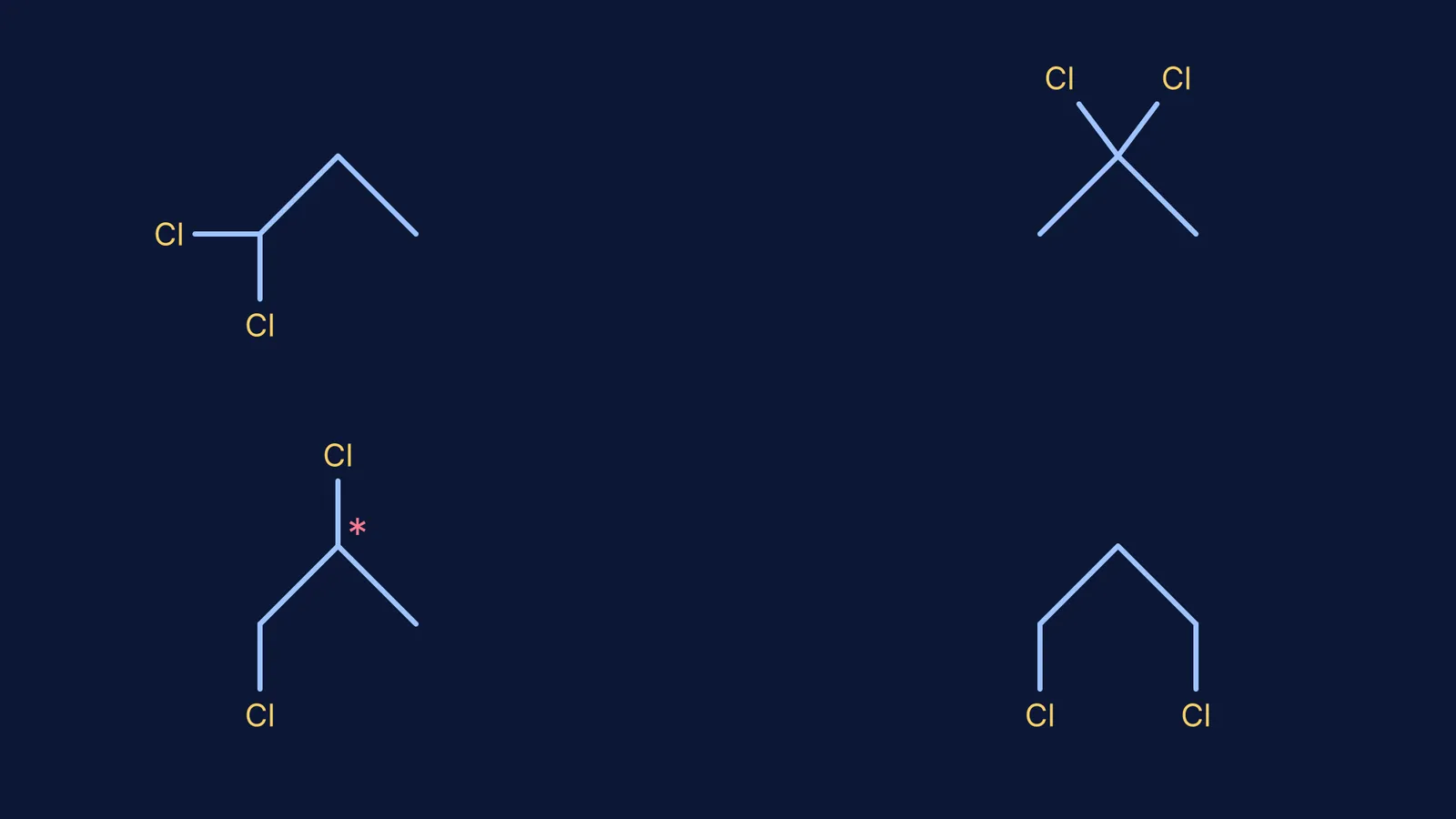
There are exactly four distinct ways to connect two chlorine atoms to a propane chain:
1,1-dichloropropane
2,2-dichloropropane
1,2-dichloropropane
1,3-dichloropropane
Each of these is a constitutional isomer, meaning the atoms are connected in a different order despite sharing the same formula.
Geminal vs vicinal dichloropropanes
When dealing with dihalides (molecules with two halogen atoms), chemists group them by how close the halogens are to each other.
Geminal dihalides: Both chlorine atoms are attached to the exact same carbon atom. In C₃H₆Cl₂, there are two geminal isomers: 1,1-dichloropropane and 2,2-dichloropropane.
Vicinal dihalides: The chlorine atoms are attached to adjacent carbon atoms. There is only one vicinal isomer here: 1,2-dichloropropane.
Terminal (isolated) dihalides: The halogens are separated by one or more carbon atoms. 1,3-dichloropropane falls into this category, as the chlorines sit on the two opposite ends of the chain.
Which isomer of C₃H₆Cl₂ is chiral?
To be chiral, an organic molecule typically needs a chiral centre: a carbon atom bonded to four different groups.
Let us test the four structural isomers:
1,1-dichloropropane: Carbon-1 is attached to two identical chlorine atoms. Not chiral.
2,2-dichloropropane: Carbon-2 is attached to two identical methyl (−CH₃) groups and two identical chlorine atoms. Not chiral.
1,3-dichloropropane: Both Carbon-1 and Carbon-3 have two identical hydrogen atoms. Not chiral.
1,2-dichloropropane: Carbon-2 is attached to a hydrogen atom (−H), a chlorine atom (−Cl), a methyl group (−CH₃), and a chloromethyl group (−CH₂Cl). Because these four groups are completely different, Carbon-2 is a chiral centre.
Because 1,2-dichloropropane is chiral, it exists as two non-superimposable mirror images (enantiomers): (2R)-1,2-dichloropropane and (2S)-1,2-dichloropropane. This brings the total number of stereoisomers for C₃H₆Cl₂ to five. You can explore the rules of stereochemistry in the Fermi Concept Library, where you can find every concept in physics, chemistry, biology, mathematics and computing, each with its own lesson and its place in the map.
A systematic plan for drawing isomers
Finding all isomers without missing any—or accidentally drawing the same one twice backwards—is a classic exam trap. If you find yourself drawing molecules randomly, the Fermi Problem Library has worked problems with a step-by-step solver that explains the reasoning rather than printing an answer.
When faced with a formula like C₃H₆Cl₂, use this checklist to exhaust all possibilities safely:
Draw the longest carbon skeleton. For propane, it is a simple three-carbon chain (C–C–C).
Start with the geminal positions. Place both halogens on the first carbon (1,1). Then move them both to the second carbon (2,2). Moving them to the third carbon would just be 1,1 backwards, so stop here.
Move to vicinal positions. Place one halogen on carbon-1 and the other on the adjacent carbon-2 (1,2). Moving them to carbon-2 and carbon-3 is identical to 1,2, so stop.
Test non-adjacent positions. Place one halogen on carbon-1 and skip a carbon to place the next on carbon-3 (1,3).
Check for chirality. Inspect every carbon atom in the structures you just drew. If any carbon has four different groups attached, mark it with a star (*) and count it twice for total stereoisomers.
If you are practicing isomer drawing, try finding the C4H10O isomers: telling the four alcohols and three ethers apart or reviewing Structural isomers in Class 10: butane and pentane drawn out.


