On this page
Cashew factories crack open shells to get the kernel, and inside each shell is a dark, sticky liquid. Cashew nut shell liquid (CNSL) is mostly long-chain phenols, and its main compound depends on how it was taken out. Extract it cold and it is mostly anacardic acid, a salicylic-acid-type compound with a carboxyl group. Extract it hot and most of that acid has lost carbon dioxide and become cardanol, a phenol. That one decarboxylation connects four syllabus skills: balancing, IUPAC locants, acid value and mass calculations.
What is cashew nut shell liquid?
A 2003 project profile from the Small Industries Service Institute, Chennai (DC-MSME) describes it as a dark reddish brown viscous liquid held in a soft honeycomb inside a shell about 1/8 inch thick. Raw shells contain over 20% CNSL, and the common oil-bath process recovers about 10% by weight. The same profile estimates India's raw cashew production at up to 2 lakh tonnes, giving a potential of about 20,000 tonnes of CNSL a year, used in friction linings, paints, varnishes and resins.
The profile also warns that the liquid as extracted is a strong vesicant: it blisters skin. So it is handled with care, and this post covers the chemistry only, not any way of extracting it.
A review by Hamad and Mubofu (International Journal of Molecular Sciences, 2015) gives the two compositions:
Natural CNSL (cold, solvent-extracted): about 60-65% anacardic acid, 15-20% cardol, 10% cardanol.
Technical CNSL (hot-oil or roasting): about 60-65% cardanol, 15-20% cardol, 10% polymeric material. In the review's words, "the heating process leads to decarboxylation of the anacardic acid to form cardanol".
All of these carry a 15-carbon side chain. The review gives the chains as roughly 5-8% saturated, 48-49% with one C=C, 16-17% with two and 29-30% with three.
Why does heat turn anacardic acid into cardanol?
Take the saturated member to keep the numbers clean:
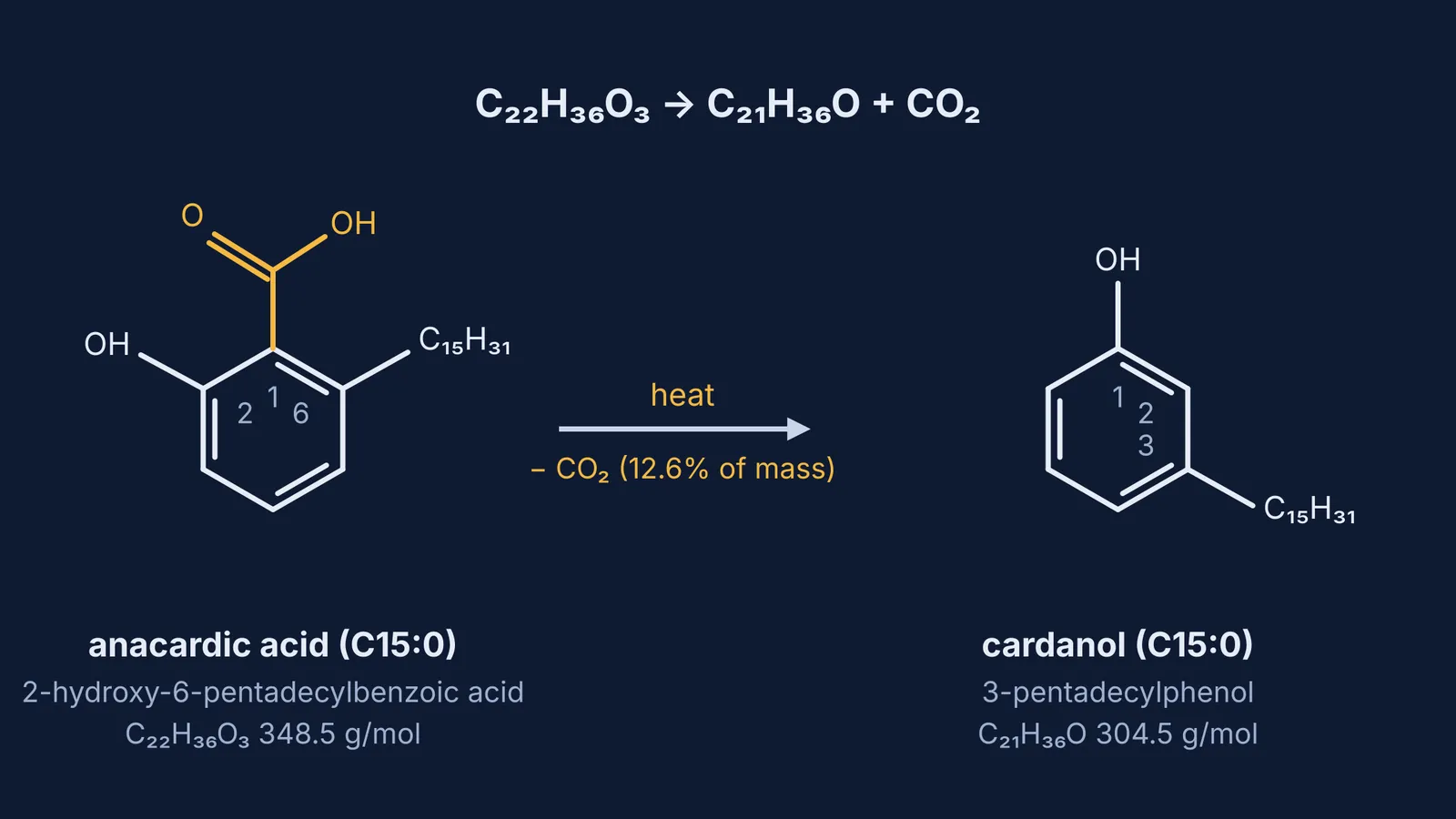
C₂₂H₃₆O₃ → C₂₁H₃₆O + CO₂
Check: C 22 = 21 + 1; H 36 = 36; O 3 = 1 + 2. Anacardic acid (348.53 g/mol) gives cardanol (304.52 g/mol) and CO₂ (44.01 g/mol). CO₂ is 44.01 / 348.53 = 12.6% of the acid's mass.
How is this different from the decarboxylation in NCERT?
Soda-lime decarboxylation (Class 11 and 12) heats the sodium salt of an ordinary carboxylic acid with NaOH and CaO: RCOONa + NaOH → RH + Na₂CO₃. The CO₂ ends up as carbonate.
β-Keto acids lose CO₂ on mild heating, with no reagent, because the β-carbonyl lets the electrons move through a six-membered cyclic transition state. See why β-keto acids decarboxylate easily.
Anacardic acid also loses CO₂ on heating alone, with no soda lime. It is a 2-hydroxybenzoic acid, like salicylic acid. The usual explanation is that the OH next to the COOH makes the ring carbon bearing the carboxyl group electron-rich, so it can take a proton while CO₂ leaves. Treat that as an analogy with salicylic acid and with β-keto acids, not as an NCERT reaction you will be asked to reproduce.
How do the IUPAC locants change from 6 to 3?
This is a neat numbering question.
Anacardic acid is named as a benzoic acid, because COOH outranks OH. The ring carbon carrying COOH is C-1. The OH and the side chain are both next to it, on C-2 and C-6. Either direction gives the set {2, 6}, so the tie goes to the substituent first in alphabetical order: hydroxy gets 2. The name is 2-hydroxy-6-pentadecylbenzoic acid.
After decarboxylation, the old C-1 carries only H. The parent is now phenol, so the carbon carrying OH (the old C-2) becomes the new C-1.
The side chain sits on the old C-6. Counting round the ring from the new C-1 through the old C-1, it is now the third carbon. Counting the other way it would be the fifth, so the lower locant wins: 3-pentadecylphenol.
The chain was never moved; only the numbering changed. The OH and the side chain are meta to each other in both compounds. Our post on naming disubstituted benzene compounds covers the priority rules.
How does the acid value show the change?
The acid value (AV) is the mg of KOH needed to neutralise the free acid in 1 g of a sample. Our post on acid value and free fatty acids explains the titration. Each anacardic acid molecule has one COOH, so pure saturated anacardic acid has:
AV = 56.106 × 1000 / 348.53 = 161 mg KOH/g
The triene member (C₂₂H₃₀O₃, 342.48 g/mol) gives 164, so the side chain changes the answer by under 2%.
Now compare with the DC-MSME profile:
Cold-pressed CNSL has an acid number of 94-107. Dividing by 161 gives about 58-66% anacardic acid, close to the 60-65% that the review gives for natural CNSL.
Treated CNSL, the grade used for resins, has a maximum acid value of 14. If all of that came from anacardic acid, it would be at most about 9%, which fits a liquid whose COOH groups have mostly gone, as in heat-extracted technical CNSL.
This is an estimate. It assumes the phenolic OH groups of cardol and cardanol add nothing to the titre, which is only roughly true, so call the percentages approximate.
Worked example: decarboxylating a kilogram of natural CNSL
Question. 1.000 kg of natural CNSL contains 62% anacardic acid (take it as C₂₂H₃₆O₃, 348.53 g/mol). It is heated until all the acid has decarboxylated. Find (a) the mass and volume of CO₂ at STP (273.15 K, 1 bar, 22.7 L/mol), (b) the mass of liquid left, (c) the acid value before heating, and (d) the volume of 0.100 M KOH that 0.500 g of the original liquid would need.
(a) CO₂.
Mass of acid: 0.62 × 1000 g = 620 g.
Moles: 620 / 348.53 = 1.779 mol.
The equation is 1 : 1, so CO₂ = 1.779 mol × 44.01 = 78.3 g.
Volume: 1.779 × 22.7 = 40.4 L.
(b) Mass left. 1000 − 78.3 = 921.7 g. Of this, cardanol formed = 1.779 × 304.52 = 541.7 g. Check: 541.7 + 78.3 = 620.0 g, the mass of acid you started with.
(c) Acid value before. 0.62 × 161 = 99.8, about 100 mg KOH/g, inside the 94-107 range for cold-pressed CNSL. After full decarboxylation the anacardic acid contribution is zero.
(d) Titre. Using AV = 100, KOH needed = 100 × 0.500 = 50 mg. Moles = 50 / 56.106 = 0.891 mmol. Volume = 0.891 / 0.100 = 8.91 mL.
To revise decarboxylation and ring numbering from first principles, the Concept Library gives each chemistry concept its own lesson. For more mass-balance and titration problems, the Fermi Problem Library has a step-by-step solver that explains the reasoning.
Quick checklist
Natural CNSL: mostly anacardic acid. Technical (heated) CNSL: mostly cardanol.
C₂₂H₃₆O₃ → C₂₁H₃₆O + CO₂; CO₂ is 12.6% of the acid's mass.
No soda lime needed: the ortho OH helps, much as the β-carbonyl helps β-keto acids.
2-hydroxy-6-pentadecylbenzoic acid becomes 3-pentadecylphenol: same atoms, new numbering.
Pure anacardic acid AV ≈ 161-164; cold-pressed CNSL 94-107 implies about 58-66% acid.
CNSL blisters skin; it is an industrial material, not something to handle at home.