

On this page
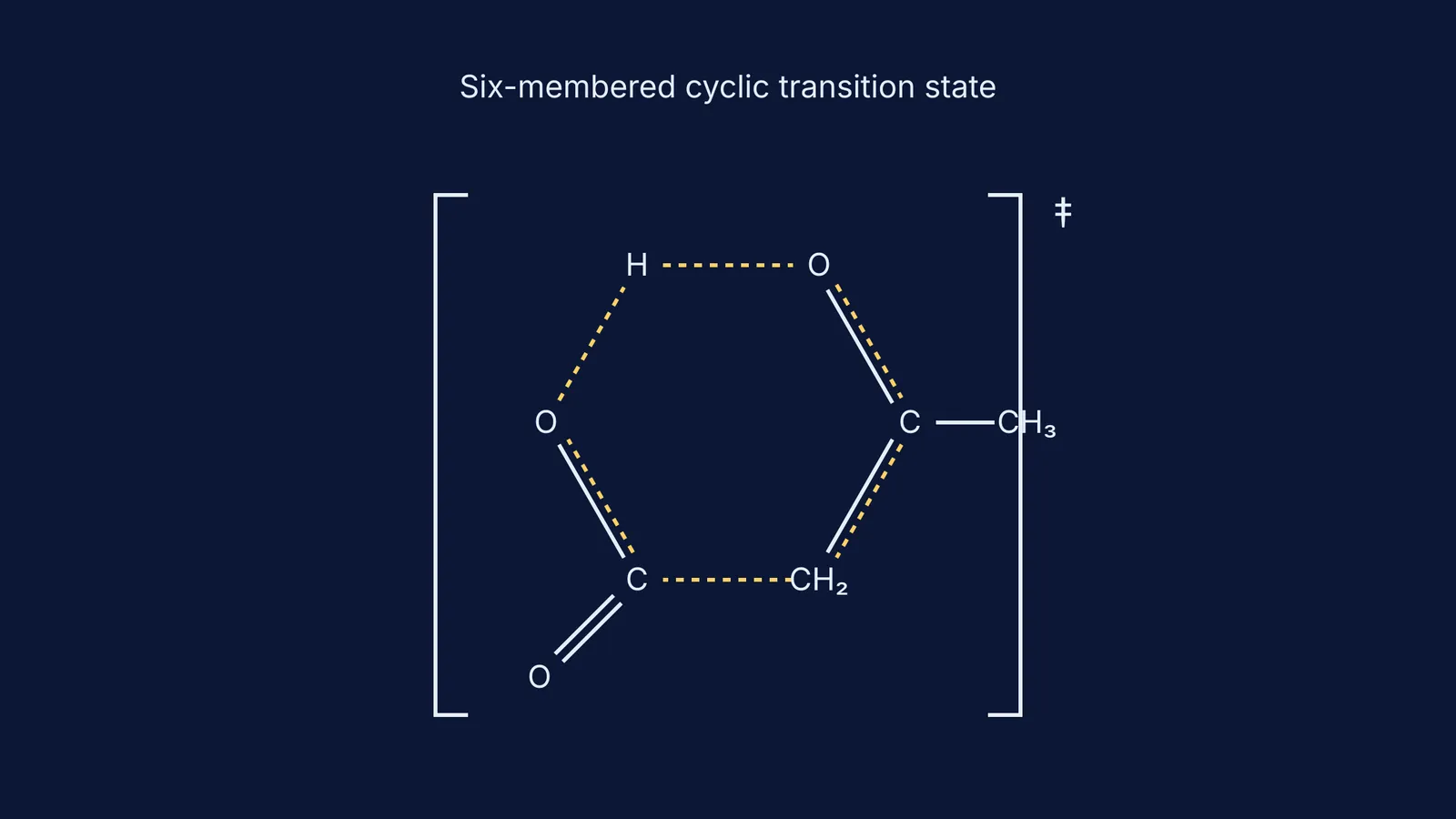
Why do beta-keto acids decarboxylate easily on heating? While most normal carboxylic acids require harsh conditions—such as temperatures above 400 °C or strong reagents like soda lime—to lose carbon dioxide (CO₂), beta-keto acids undergo decarboxylation on mild heating. They typically react between 100 °C and 150 °C (Wikipedia). The reason lies in their unique structure, which allows them to form a six-membered cyclic transition state.
Why are beta-keto acids different?
In a standard carboxylic acid like acetic acid, the carboxyl group (-COOH) is firmly attached to an alkyl chain. Breaking the carbon–carbon bond to release CO₂ requires a massive amount of energy because it forces the formation of a highly unstable carbanion intermediate.
Beta-keto acids bypass this high-energy path entirely. By definition, a beta-keto acid has a carbonyl group (C=O) attached to the beta carbon—exactly two carbons away from the carboxyl group. This beta-carbonyl acts as an internal "electron sink." It can accept the shifting electrons during the reaction, preventing the formation of an unstable carbanion and allowing a smooth, concerted bond rearrangement.
How does the six-membered cyclic transition state form?
For a molecule to lose carbon dioxide easily, the electrons must have a low-energy path to rearrange. The beta-carbonyl oxygen is perfectly positioned to reach back and grab the proton from the carboxylic acid group.
As the molecule is heated, it naturally folds into a cyclic conformation. The beta-carbonyl oxygen forms a hydrogen bond with the hydroxyl proton. A concerted shift of six electrons then takes place in a loop:
The oxygen–hydrogen bond of the acid breaks, and the proton transfers to the beta-carbonyl oxygen.
The carbon–carbon single bond between the alpha and carboxyl carbons breaks.
The remaining electrons shift to form a double bond between the alpha and beta carbons, while the carboxyl group becomes an independent CO₂ molecule.
Because the transition state involves six atoms in a ring—a very stable geometric arrangement in organic chemistry—the activation energy is significantly lowered. The immediate product of this cyclic shift is an enol. This enol intermediate then rapidly tautomerises into the more thermodynamically stable ketone form.
If you struggle to picture how electrons move in pericyclic reactions or cyclic transition states, the Fermi Problem Library has worked problems with a step-by-step solver that explains the reasoning rather than printing an answer, walking you through organic mechanisms atom by atom.
How do malonic acid and acetoacetic acid react?
The ease of decarboxylation depends on how readily the six-membered cyclic transition state can form in a given molecule.
Acetoacetic acid, the simplest beta-keto acid, is so unstable that it decarboxylates even at body temperature. In water at 37 °C, the acid form has a half-life of just 140 minutes, spontaneously breaking down into acetone and carbon dioxide (Wikipedia).
Malonic acid is a dicarboxylic acid, but it behaves exactly like a beta-keto acid because one of its carboxyl groups acts as the beta-carbonyl for the other. When malonic acid is heated to its melting point of 135–137 °C, it undergoes rapid decarboxylation to form acetic acid (Wikipedia). This unique property makes malonic ester synthesis a powerful laboratory tool for building substituted acetic acids from simple starting materials.
How do you spot beta-keto decarboxylation in exams?
Examiners frequently test this concept by hiding beta-keto acids inside long, multi-step reaction sequences. When you see a heating symbol (Δ) applied to a carboxylic acid without any soda lime (NaOH/CaO), check the beta position immediately. If there is a ketone, an aldehyde, or a second carboxyl group, a six-membered cyclic transition state is possible, and the molecule is meant to decarboxylate.
Many students memorise the products without understanding the electron flow. As you revise, try drawing the six-membered ring yourself for every problem you encounter. If you get stuck on why a specific bond breaks, it is useful to ask a tutor. Fermi's AI tutor can work out what you already know and build a plan for the session, writing on a board and drawing the figure to show exactly how the transition state forms. You can also read more about asking AI the 'why' behind named organic reactions to strengthen your mechanism skills.
Understanding the underlying *why*—the stability of the six-membered cyclic transition state—turns a confusing organic exception into a predictable, logical rule. It is the exact same principle you apply when deciding leaving group ability in organic chemistry: molecules will always take the lowest-energy path available to them.


