On this page
A hospital autoclave kills microbes with steam at about 121 °C, held under pressure. The gauge on the front tells you the pressure. It does not tell you the temperature of the steam touching the instruments. If some of the original air is still inside, it takes a share of that pressure, and the steam is cooler than the gauge suggests. This is Dalton's law of partial pressures at work, and it is the reason steam sterilisers remove air before they start timing.
Autoclaves are run only by trained staff following the maker's instructions and hospital procedures. This post explains the physics only and gives no operating steps.
Why does steam under pressure get hotter than 100 °C?
Water boils when its vapour pressure equals the pressure above it. Raise the pressure and the boiling point rises. The Clausius-Clapeyron equation gives the shape of that curve. For real numbers, engineers use steam tables. The values below come from the IAPWS-IF97 saturation equation, the industrial standard published by the International Association for the Properties of Water and Steam, and they agree with the NIST Chemistry WebBook water data:
1.01 bar (one atmosphere): 100 °C.
1.55 bar: 112.3 °C.
1.80 bar: 116.9 °C.
2.05 bar: 121.0 °C.
A gauge reading of 15 psi is 1.03 bar above the atmosphere. Add the 1.01 bar of the atmosphere and the absolute pressure inside is about 2.05 bar, which is why "15 psi" and "121 °C" go together. The difference between gauge and absolute pressure is explained in why a pressure cooker whistles. Every steam-table calculation needs the absolute value.
What does trapped air do to the steam temperature?
In a mixture of gases, each gas contributes its own partial pressure, and the total is the sum. That is the law John Dalton reached in 1801, told in the discovery behind Dalton's law of partial pressures:
p_total = p_steam + p_air
Steam condenses on a cooler surface until that surface reaches the saturation temperature for the steam's partial pressure, not for the total. So the temperature that matters is T_boil(p_steam), not T_boil(p_total). The gauge measures p_total and cannot tell steam from air.
Worked example: how much cooler is the steam?
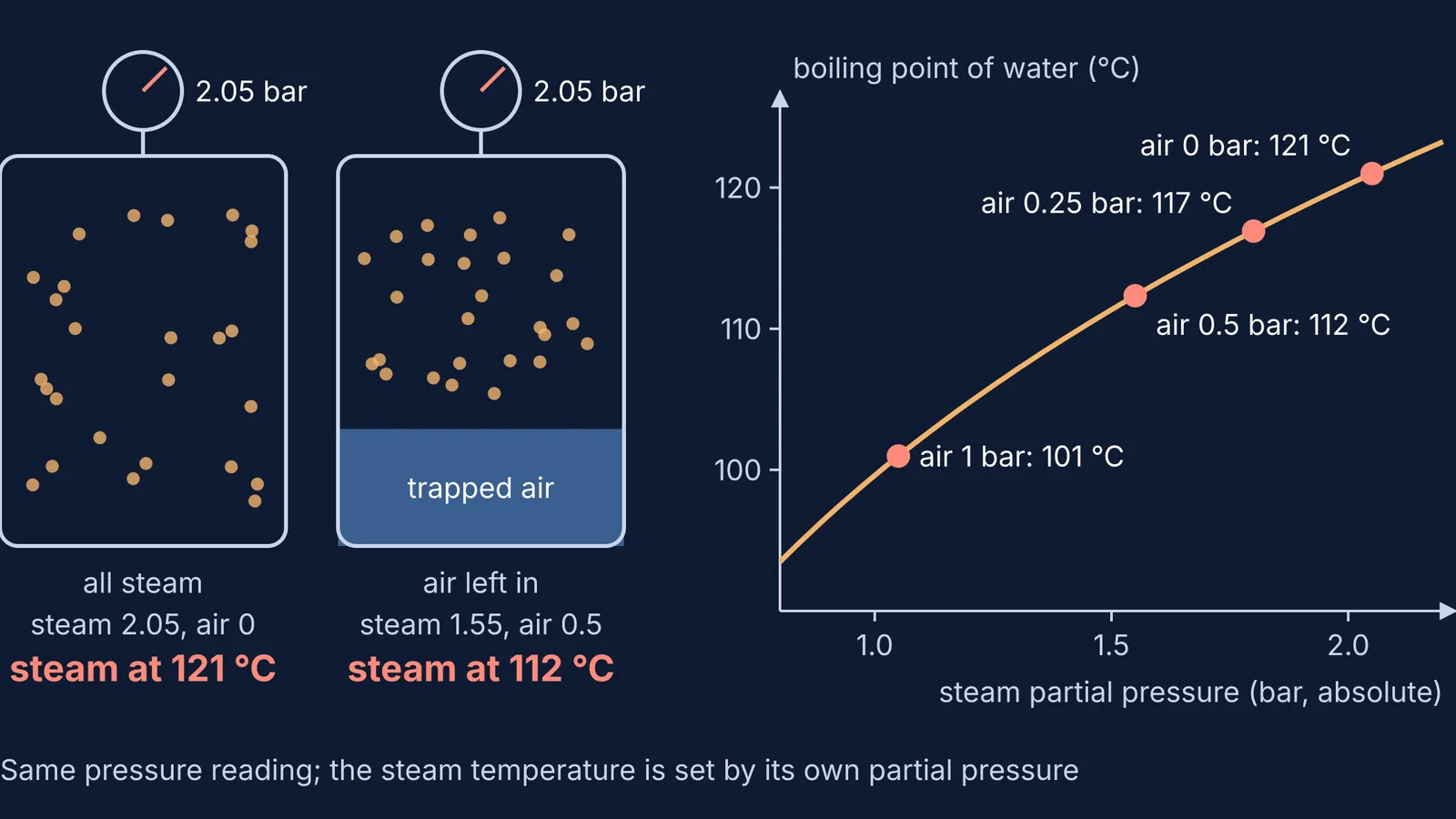
Question. Two chambers both show 2.05 bar absolute. One holds only steam. The other still contains some air. Find the steam temperature for 0, 0.25, 0.5 and 1.0 bar of air, assuming the gas is evenly mixed.
Steam partial pressure. p_steam = 2.05 − p_air. This gives 2.05, 1.80, 1.55 and 1.05 bar.
Read the saturation curve. From IAPWS-IF97: 121.0 °C, 116.9 °C, 112.3 °C and 101.0 °C.
Temperature shortfall. 0, 4.1, 8.7 and 20.0 °C below the pure-steam value.
So a quarter of the pressure taken by air costs about 4 °C, and half a bar costs nearly 9 °C, while the gauge reads the same in every case.
What if no air is removed at all?
Suppose the chamber starts full of air at 1.01 bar and 20 °C and is simply sealed and heated. The air cannot leave, so its pressure rises with temperature (p ∝ T at fixed volume). Solving p_air + p_steam = 2.05 bar with both at the same temperature gives about 93 °C: steam at 0.78 bar and air at 1.27 bar. The gauge still reads 2.05 bar, but the load never even reaches 100 °C.
How much longer would sterilising take?
Microbiologists describe how killing time changes with temperature using the z-value: the temperature change that makes the killing time ten times shorter or longer. Sterilisation calculations conventionally use z = 10 °C with a reference of 121.1 °C, as discussed by I. J. Pflug in PDA Journal of Pharmaceutical Science and Technology (1996). On that rule, the factor is 10 raised to (shortfall ÷ 10):
4.1 °C cooler: 10^0.41 = 2.6 times as long.
8.7 °C cooler: 10^0.87 = 7.4 times as long.
20.0 °C cooler: 10^2.0 = 100 times as long.
The US CDC guideline on steam sterilisation gives 30 minutes at 121 °C as a minimum for wrapped items in a gravity-displacement steriliser. At 112 °C, the same killing would need roughly 7.4 × 30 = 220 minutes. Pflug also notes that heat-resistant thermophilic spores such as Bacillus stearothermophilus have a z-value nearer 7 to 8 °C in the 120 to 140 °C range, so for them the penalty of a cooler load is even larger. Treat these factors as rough pointers, not as cycle times.
Why is the cold spot worse than the average?
Air (molar mass 29 g/mol) is about 1.6 times as dense as steam (18 g/mol) at the same temperature and pressure. So air does not stay mixed. It sinks to the bottom of the chamber and stays trapped inside wrapped packs, tubing and the folds of cloth. Locally the air share can be far higher than the average used above, and that spot is where the steam is coolest.
That is why the CDC guideline says that air not removed from the chamber "will interfere with steam contact". Gravity-displacement sterilisers let the heavier air drain out of the bottom as steam enters from the top. Prevacuum sterilisers pump the air out before steam is let in, which the same guideline says gives nearly instant steam penetration even into porous loads, and allows a shorter 4-minute hold at 132 °C. A daily Bowie-Dick test pack checks the air removal: according to the CDC, trapped air leaves a spot on the test sheet instead of a uniform colour change.
If you want to see how a Dalton's-law or steam-table problem is set up step by step, the Fermi Problem Library has a solver that explains the reasoning, and the Concept Library covers partial pressures and vapour pressure from the basics.
Quick checklist
A pressure gauge shows total pressure; the steam's temperature follows only its partial pressure.
p_total = p_steam + p_air, and T = T_boil(p_steam).
2.05 bar absolute (15 psi gauge) is 121 °C for pure steam.
With 0.5 bar of air, the steam has 1.55 bar and is at about 112 °C.
On z = 10 °C, an 8.7 °C shortfall means about 7.4 times the holding time.
Air is denser than steam, so it pools low and inside packs, making local cold spots.
Convert gauge to absolute pressure before using a steam table.