On this page
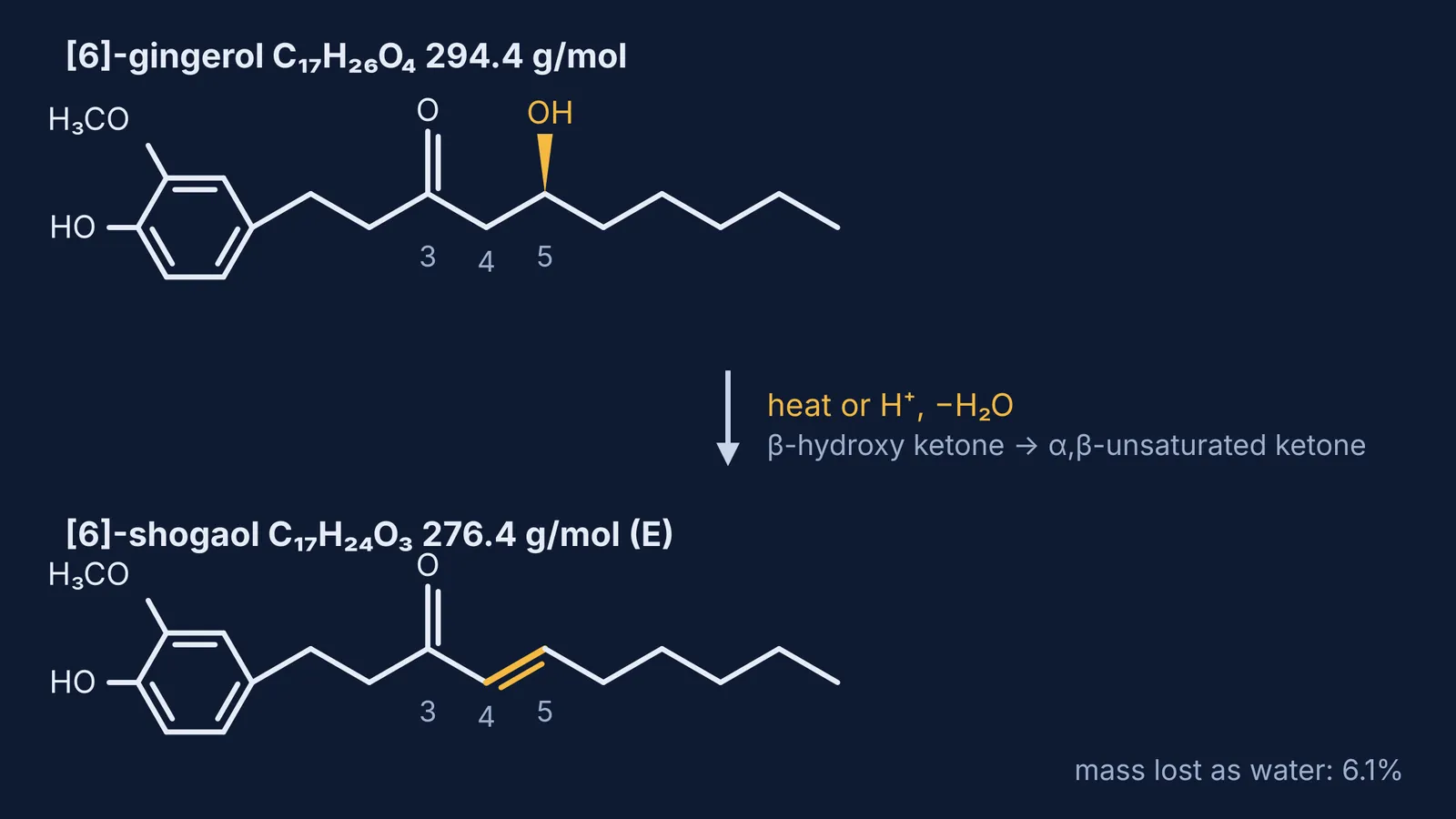
Fresh ginger and dry ginger (sonth in Hindi, chukku in Malayalam) do not taste the same, and part of the reason is a reaction you already study in Class 12. The main pungent compound of fresh ginger, [6]-gingerol, is a β-hydroxy ketone: an aldol product. When ginger is dried or heated, especially with acid present, gingerol loses a molecule of water and becomes [6]-shogaol, an α,β-unsaturated ketone. That is the dehydration step of aldol condensation, happening inside a spice.
What changes chemically when fresh ginger becomes dry ginger?
Two different things are called "dehydration" here. Keep them apart.
Drying removes moisture. The ICAR-Indian Institute of Spices Research ginger pamphlet gives fresh ginger at harvest as about 80-82% water, dried to 10% for safe storage. In the open sun this takes about 8 to 10 days, and the yield of dry ginger is about 19-25% of the fresh weight.
Chemical dehydration removes the elements of water from inside one molecule. Gingerol, C₁₇H₂₆O₄, becomes shogaol, C₁₇H₂₄O₃.
The first is physical and removes about four-fifths of the mass. The second is a reaction that removes only about 6% of the mass of the gingerol that reacts.
Why is gingerol called an aldol product?
Write gingerol as a chain: Ar–CH₂–CH₂–CO–CH₂–CH(OH)–C₅H₁₁, where Ar is the 4-hydroxy-3-methoxyphenyl ring. Its IUPAC name is (S)-5-hydroxy-1-(4-hydroxy-3-methoxyphenyl)decan-3-one. Number from the ring end: C-3 carries the C=O, C-4 is the α-carbon and C-5, which carries the OH, is the β-carbon. A β-hydroxy ketone is exactly what an aldol addition makes. If this pattern is new to you, the four steps are set out in our post on the aldol condensation mechanism.
To find the aldol "parents", cut the bond between the α- and β-carbons (C-4 to C-5):
The α side keeps the C=O. It becomes CH₃ again: Ar–CH₂–CH₂–CO–CH₃, which is zingerone, C₁₁H₁₄O₃ (194.23 g/mol). Its enolate is the nucleophile.
The β-carbon becomes a C=O again: C₅H₁₁–CHO, which is hexanal, C₆H₁₂O (100.16 g/mol). It is the electrophile.
Check the atoms: C₁₁H₁₄O₃ + C₆H₁₂O = C₁₇H₂₆O₄, and 194.23 + 100.16 = 294.39 g/mol, the molar mass of gingerol.
Aldol addition is reversible, so heat can in principle also run it backwards (a retro-aldol reaction) and split gingerol into zingerone and hexanal. Several reviews of ginger chemistry say this happens when ginger is cooked. We could not read a primary study that measured it during cooking, so treat that as reported rather than settled. The disconnection itself does not depend on it.
How does gingerol lose water to become shogaol?
The reaction is the last step of aldol condensation: the H on the α-carbon (C-4) and the OH on the β-carbon (C-5) leave together.
In base, a hydrogen on C-4 is removed to give an enolate, which pushes out OH⁻ from C-5. This is the E1cB route used for aldol dehydration.
In acid, the C=O is protonated, the compound tautomerises to its enol (C-3 to C-4), and the protonated OH on C-5 leaves as water while the new C=C forms between C-4 and C-5.
The product is (E)-1-(4-hydroxy-3-methoxyphenyl)dec-4-en-3-one, [6]-shogaol. The C=C is conjugated with the C=O.
Three points earn marks.
The new double bond is C-4=C-5, not C-5=C-6. In a simple alcohol, the carbocation route and Saytzeff's rule pick the more substituted alkene, as in our post on dehydration of alcohols. Here the mechanism runs through the enol or enolate, so the double bond can only form next to the carbonyl, and the conjugated enone is the more stable product anyway.
The stereocentre disappears. Gingerol has one stereocentre, C-5 (S). In shogaol C-5 is sp², so shogaol is not chiral. Instead it shows geometrical isomerism, and the natural compound is the E isomer, with the acyl group and the pentyl chain on opposite sides of the C=C.
The equation balances: C₁₇H₂₆O₄ → C₁₇H₂₄O₃ + H₂O. Atoms: C 17 = 17; H 26 = 24 + 2; O 4 = 3 + 1.
How much do heat and acid speed up the change?
Two open studies measured it with HPLC.
Ghasemzadeh and co-workers (Molecules, 2018) dried ginger slices three ways. Open sun drying (9 days, 23-34 °C) left the most gingerol; hot-air drying produced the most shogaol, with the highest amounts at 150 °C for 6 hours. From their table, the [6]-shogaol to [6]-gingerol ratio was about 0.11 after sun drying and about 0.80 after hot-air drying at 150 °C. At 180 °C both compounds fell, which the authors put down to degradation and polymerisation of shogaol. They describe it as thermal dehydration of the β-hydroxy ketone group, helped by acid.
Ok and Jeong (Preventive Nutrition and Food Science, 2012) extracted dried ginger with 95% ethanol. Extraction at room temperature gave about 3-5 mg of [6]-shogaol per gram of extract; drying and extracting at 80 °C gave about 22 mg/g. Adjusting the solvent to pH 1 raised it to about 57 mg/g, roughly 2.6 times the 80 °C value.
So sun-dried ginger has some shogaol, but heat and acid, the conditions that speed up any aldol dehydration, make far more.
Worked example: how much water leaves, and from where?
Question. A farmer sun-dries 100 kg of fresh ginger with 81% moisture down to 10% moisture. (a) What mass of dry ginger is obtained? (b) How much water evaporates? (c) If 1.000 g of pure [6]-gingerol were completely dehydrated to [6]-shogaol, what masses of shogaol and water would form? Use C 12.011, H 1.008, O 15.999.
(a) Dry ginger.
Dry matter does not evaporate: 19% of 100 kg = 19.0 kg, which is 90% of the dried product.
Mass of dry ginger = 19.0 / 0.90 = 21.1 kg, or 21.1% of the fresh weight.
Check against the source: at 80% moisture the same steps give 22.2%, and at 82% give 20.0%, inside ICAR's stated yield of 19-25%.
(b) Water evaporated. 100 − 21.1 = 78.9 kg.
(c) Chemical dehydration.
Molar masses: gingerol C₁₇H₂₆O₄ = 294.39 g/mol; shogaol C₁₇H₂₄O₃ = 276.38 g/mol; H₂O = 18.02 g/mol.
Moles of gingerol: 1.000 / 294.39 = 3.397 × 10⁻³ mol.
The ratio is 1 : 1 : 1, so shogaol = 3.397 × 10⁻³ × 276.38 = 0.939 g, and water = 3.397 × 10⁻³ × 18.02 = 0.0612 g, or 61.2 mg.
Check: 0.939 + 0.061 = 1.000 g. The fraction lost as water is 18.02 / 294.39 = 6.1%.
Almost all the water lost in drying is moisture. The chemical dehydration is a small change in mass but a large change in structure.
To practise disconnections like this for the exam, Fermi's AI tutor for JEE prep can work out what you already know and build a plan for the session. For more worked aldol problems, the Fermi Problem Library has a step-by-step solver that explains the reasoning.
Quick checklist
[6]-Gingerol is a β-hydroxy ketone: OH on C-5, C=O on C-3.
Its aldol parents are zingerone (enolate) and hexanal (electrophile); the atoms add up to C₁₇H₂₆O₄.
Heat or acid removes H₂O to give (E)-[6]-shogaol, C₁₇H₂₄O₃, with C-4=C-5 conjugated to C=O.
The stereocentre at C-5 is lost; E/Z isomerism appears.
Drying removes moisture (80-82% down to 10%); chemical dehydration removes only 6.1% of the gingerol's mass.
Retro-aldol to zingerone on cooking: reported in reviews, not confirmed here.