On this page
Many traps in Biological Classification pair a general rule with the one named member that breaks it. Part 1 lists 12 such rules with the exception the NCERT Class 11 Biology chapter (Chapter 2, Reprint 2026-27) itself names. Part 2 gives 13 original questions built on them. The chapter falls under Unit 1, Diversity in Living World, of the NMC NEET (UG)-2026 syllabus.
Part 1: what are the rules and their NCERT exceptions?
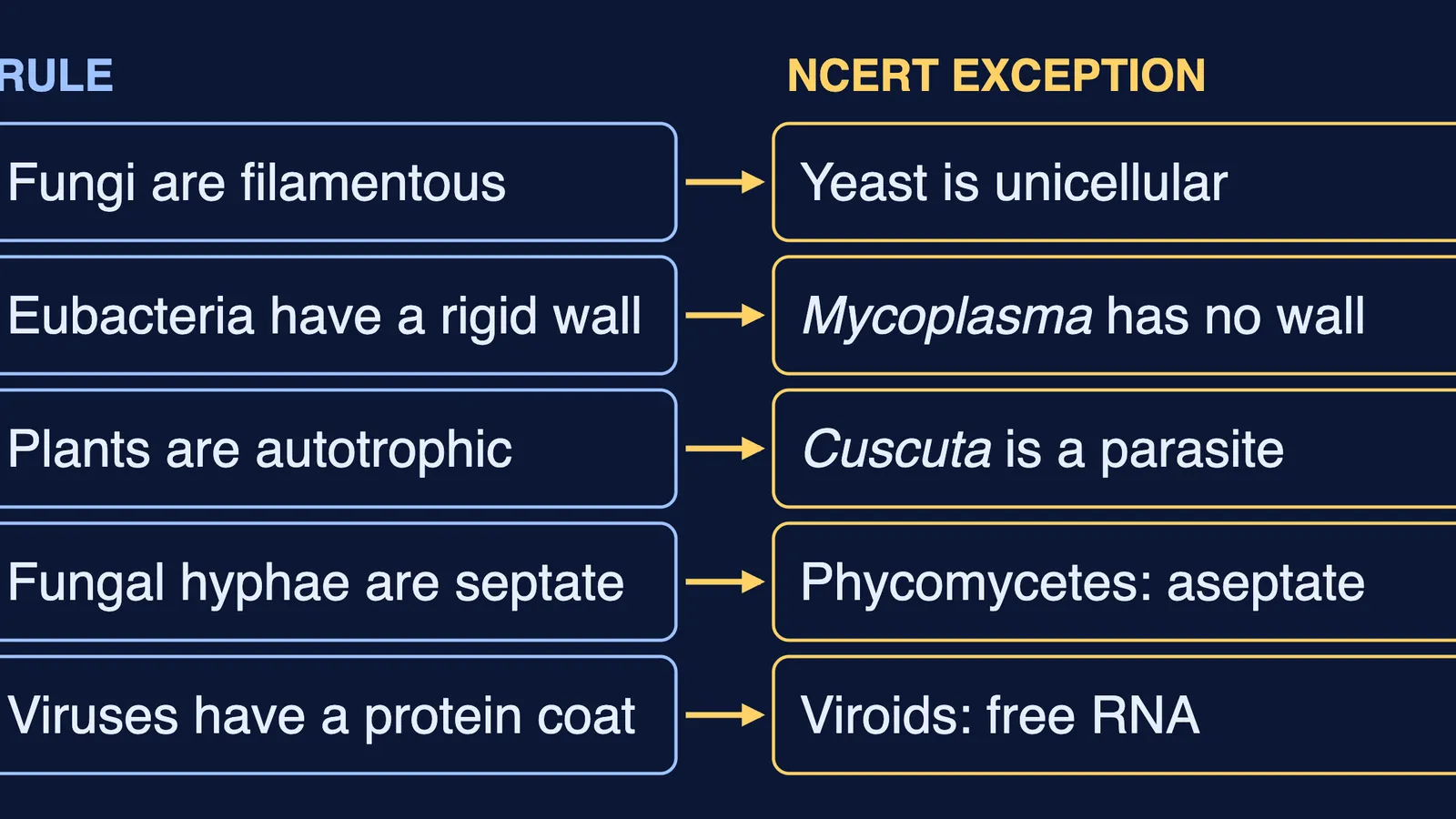
Rule: fungi are filamentous, built of hyphae. Exception: yeasts are unicellular. (2.3)
Rule: ascomycetes are mostly multicellular, such as *Penicillium*. Exception: yeast (*Saccharomyces*) is a rare unicellular one. (2.3.2)
Rule: eubacteria have a rigid cell wall. Exception: *Mycoplasma* has no cell wall at all. (2.1.2)
Rule: most bacteria are heterotrophs. Exception: some make their own food, either by photosynthesis (cyanobacteria) or by chemosynthesis. (2.1, 2.1.2)
Rule: Plantae members are autotrophic. Exception: insectivorous plants (bladderwort, Venus fly trap) and the parasite *Cuscuta* are partly heterotrophic. (2.4)
Rule: a photosynthetic protist feeds itself. Exception: euglenoids, cut off from sunlight, hunt smaller organisms like heterotrophs. (2.2.3)
Rule: photosynthetic protists such as diatoms and dinoflagellates have a cell wall. Exception: euglenoids, also photosynthetic, have a protein-rich pellicle in its place. (2.2.1, 2.2.2, 2.2.3)
Rule: fungal hyphae have septae in ascomycetes, basidiomycetes and deuteromycetes. Exception: phycomycetes have aseptate, coenocytic mycelium. (2.3.1)
Rule: in fungal sexual reproduction, fusion of two haploid cells can give diploid cells at once. Exception: ascomycetes and basidiomycetes pass through a dikaryotic (n + n) stage before the nuclei fuse. (2.3)
Rule: fungi reproduce asexually by spores and sexually by fusion of gametes. Exception: basidiomycetes generally lack asexual spores and have no sex organs; two vegetative cells of different strains fuse instead. (2.3, 2.3.3)
Rule: fungal classes have a known sexual stage. Exception: deuteromycetes are known only from asexual or vegetative phases. (2.3.4)
Rule: a virus wraps its nucleic acid in a protein coat. Exception: a viroid is free RNA with no protein coat. (2.6)
One more applies to the whole system: Whittaker's five kingdoms make no mention of viruses, viroids, prions or lichens (NCERT 2.6).
How do you handle odd-one-out and exception questions?
Name the feature before reading options: wall, body form, nutrition or sexual stage.
Sort every option against that one feature. Three should agree; if two disagree, you have picked the wrong feature.
For "which is NOT an exception", restate the rule and strike each option that breaks it.
Watch for a true fact moved to a neighbouring group.
Part 2: can you spot the exception?
Odd-one-out
Q1. Based on body form, which is the odd one out? (1) *Penicillium* (2) *Aspergillus* (3) *Saccharomyces* (4) *Neurospora*
Answer: (3). Yeast is unicellular; NCERT treats all other fungi as filamentous (2.3).
Q2. Based on whether a cell wall is present, which is the odd one out? (1) *Nostoc* (2) *Anabaena* (3) *Mycoplasma* (4) curd-making heterotrophic bacteria
Answer: (3). *Mycoplasma* completely lacks a wall (2.1.2).
Q3. Based on a place in Whittaker's five kingdoms, which is the odd one out? (1) *Nostoc* (2) *Gonyaulax* (3) *Albugo* (4) a lichen
Answer: (4). Whittaker's system does not mention lichens (2.6).
Q4. Based on whether NCERT describes a sexual stage, which is the odd one out? (1) *Mucor* (2) *Agaricus* (3) *Alternaria* (4) *Neurospora*
Answer: (3). *Alternaria* is a deuteromycete, known only by asexual phases (2.3.4).
Which is NOT an exception?
Q5. Rule: fungal mycelium is septate. Which is NOT an exception? (1) *Mucor* (2) *Rhizopus* (3) *Albugo* (4) *Aspergillus*
Answer: (4). *Aspergillus* is an ascomycete with septate mycelium; the rest are phycomycetes (2.3.1, 2.3.2).
Q6. Rule: bacteria depend on other organisms or dead matter for food. Which is NOT an exception? (1) *Nostoc* (2) *Anabaena* (3) bacteria that oxidise ammonia for energy (4) bacteria that turn milk into curd
Answer: (4). Curd-making bacteria are heterotrophic; the others are autotrophs (2.1.2).
Q7. Which is NOT left out of Whittaker's five kingdoms? (1) viroids (2) prions (3) viruses (4) slime moulds
Answer: (4). Slime moulds are saprophytic protists (2.2.4).
Two-statement questions
Codes for Q8 to Q11: (1) both correct (2) both incorrect (3) I correct, II incorrect (4) I incorrect, II correct.
Q8. I: Yeast is an ascomycete even though most ascomycetes are multicellular. II: Slime moulds are saprophytic protists.
Answer: (1). NCERT 2.3.2 and 2.2.4.
Q9. I: Euglenoids deprived of sunlight prey on smaller organisms. II: Euglenoid pigments differ from those of higher plants.
Answer: (3). NCERT 2.2.3 calls the pigments identical.
Q10. I: A viroid has a protein coat but no nucleic acid. II: Viroid RNA is of low molecular weight.
Answer: (4). A viroid is free RNA without a coat (2.6).
Q11. I: A fungus stays in deuteromycetes after its sexual stage is found. II: Ascomycetes generally lack asexual spores.
Answer: (2). Such fungi move to their rightful class; ascomycetes form conidia (2.3.2, 2.3.4).
Single-correct MCQs
Q12. Which rule-exception pair is wrong? (1) Fungi are filamentous: yeast (2) Eubacteria have a rigid wall: *Mycoplasma* (3) Plants are autotrophic: Venus fly trap (4) Fungal mycelium is septate: *Agaricus*
Answer: (4). *Agaricus* is a basidiomycete with branched, septate mycelium (2.3.3).
Q13. Which feature sets basidiomycetes apart from the general fungal pattern? (1) aseptate mycelium (2) no sex organs, so two somatic cells of different strains fuse (3) ascospores formed inside asci (4) only the asexual stage known
Answer: (2). The other options describe phycomycetes, ascomycetes and deuteromycetes (2.3.3).
What should you do with your misses?
Write the rule and exception for each miss in your own words, with the section number.
For a wrong odd-one-out pick, list every feature the four options share.
Retry only the misses a few days later.
For the full chapter, read our chapter guide comparing the five kingdoms, then try the statement and match-the-list set and the assertion-reason questions on this chapter.
Which fungal class still trips you up?
Fermi's AI tutor works out what you already know and builds a plan for the session.