

On this page
Every answer rests on the NCERT Class 11 Biology chapter (Reprint 2026-27), in Unit 1 of the NMC NEET (UG)-2026 syllabus.
The NTA information bulletin for NEET (UG)-2026 sets 180 questions in 180 minutes, with Biology as 90 of them. Each has four options and one correct or best answer: +4 if right, −1 if wrong.
How do you attack statement questions on Biological Classification?
Mark T or F beside each statement, then read off the code. For Q1 to Q4:
(1) Both statements correct
(2) Both statements incorrect
(3) Statement I correct, Statement II incorrect
(4) Statement I incorrect, Statement II correct
Traps pair a correct name with a wrong detail.
Q1. I: Methanogens in the gut of cows produce methane (biogas) from their dung. II: Halophiles are the archaebacteria of hot springs.
Answer: (3). Halophiles live in salty areas; hot springs hold thermoacidophiles (NCERT 2.1.1).
Q2. I: A virus capsid is made of capsomeres. II: Viruses are inert outside their specific host cell.
Answer: (1). Both are in NCERT 2.6.
Q3. I: Deuteromycetes reproduce sexually by ascospores. II: Basidiomycetes commonly form asexual spores and have well-developed sex organs.
Answer: (2). Deuteromycetes use only conidia; basidiomycetes generally lack asexual spores and sex organs.
Q4. I: Slime mould spores lack true walls and survive only briefly. II: Under suitable conditions, slime moulds form a plasmodium that may spread over several feet.
Answer: (4). NCERT 2.2.4: the spores have true walls and survive for many years.
Q5. A. Desmids (golden algae) are chrysophytes. B. Dinoflagellates are mostly freshwater. C. Most dinoflagellates have one longitudinal flagellum and one in a transverse furrow. D. Diatoms are the chief ocean producers. Which are correct? (1) A, C and D only (2) A and B only (3) B, C and D only (4) A, B, C and D
Answer: (1). NCERT 2.2.2 calls dinoflagellates mostly marine, so B is false.
How do you crack match-the-list questions on this chapter?
Start with the List-I entry you know best, cross out options that pair it wrongly, then test a second entry.
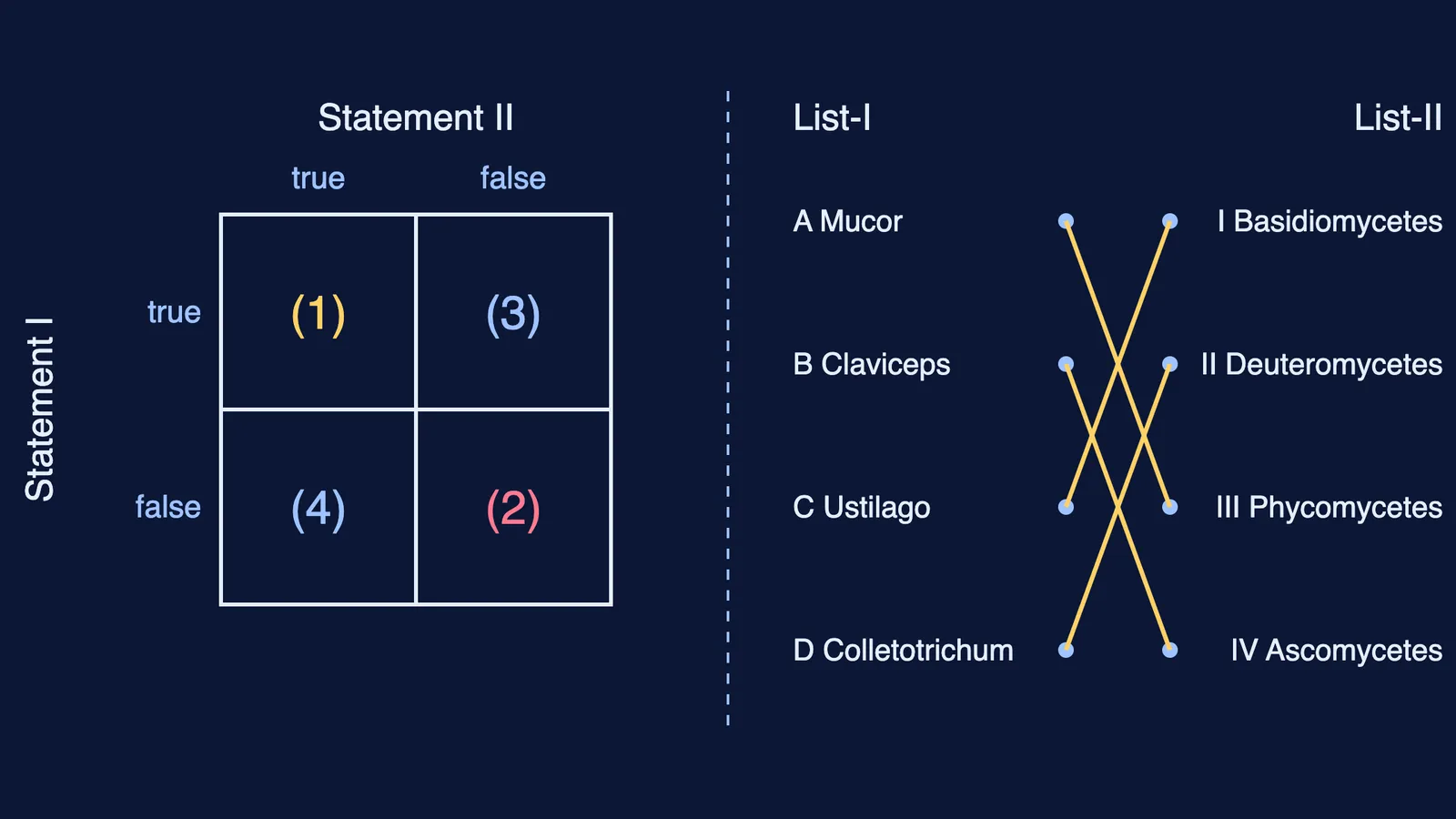
Q6. A. Mucor B. Claviceps C. Ustilago D. Colletotrichum; I. Basidiomycetes II. Deuteromycetes III. Phycomycetes IV. Ascomycetes. (1) A-IV, B-III, C-II, D-I (2) A-II, B-IV, C-I, D-III (3) A-III, B-IV, C-I, D-II (4) A-III, B-I, C-IV, D-II
Answer: (3). NCERT 2.3 places the four genera in these classes.
Q7. A. Ivanowsky (1892) B. Beijerinck (1898) C. Stanley (1935) D. Diener (1971); I. Named the fluid Contagium vivum fluidum II. Free RNA behind potato spindle tuber disease III. Crystallised viruses IV. Mosaic agent passing bacteria-proof filters. (1) A-I, B-IV, C-III, D-II (2) A-IV, B-I, C-III, D-II (3) A-IV, B-III, C-I, D-II (4) A-III, B-I, C-II, D-IV
Answer: (2). NCERT 2.6 gives this order: filters, naming, crystals, viroids.
Q8. A. Amoeboid B. Flagellated C. Ciliated D. Sporozoan protozoans; I. Trypanosoma II. Entamoeba III. Plasmodium IV. Paramoecium. (1) A-II, B-I, C-IV, D-III (2) A-I, B-II, C-IV, D-III (3) A-II, B-III, C-I, D-IV (4) A-IV, B-I, C-II, D-III
Answer: (1). NCERT 2.2.5 gives these examples.
Q9. A. Puccinia B. Penicillium C. Neurospora D. Yeast; I. Bread and beer II. Wheat rust III. Biochemical and genetic work IV. Antibiotics. (1) A-IV, B-II, C-III, D-I (2) A-II, B-III, C-IV, D-I (3) A-I, B-IV, C-III, D-II (4) A-II, B-IV, C-III, D-I
Answer: (4). NCERT 2.3 and 2.3.2 state each use.
Which single-answer MCQs test this chapter's details?
Name the group each wrong option actually describes before you choose.
Q10. Per NCERT Table 2.1, the Monera cell wall is: (1) cellulose (2) chitin (3) noncellulosic, polysaccharide plus amino acid (4) absent in every member
Answer: (3). Only Mycoplasma lack a wall, so (4) overreaches.
Q11. Which partially heterotrophic plant does NCERT name as a parasite? (1) Bladderwort (2) Venus fly trap (3) Cuscuta (4) Chlorella
Answer: (3). Options (1) and (2) are insectivorous; Chlorella is in Protista.
Q12. Which is true of phycomycetes? (1) Fusion of two gametes forms a zygospore (2) Conidia form on conidiophores (3) Four basidiospores form on a basidium (4) Only the asexual stage is known
Answer: (1). The others describe ascomycetes, basidiomycetes and deuteromycetes.
Q13. Chemosynthetic autotrophic bacteria: (1) use light to make ATP (2) oxidise substances such as nitrites and ammonia to make ATP (3) are the most abundant bacteria (4) are all parasites
Answer: (2). NCERT 2.1.2 names heterotrophic bacteria as most abundant.
Q14. An infectious agent of abnormally folded protein, similar in size to viruses, is a: (1) viroid (2) prion (3) bacteriophage (4) lichen
Answer: (2). NCERT links prions to BSE in cattle and CJD in humans. This is a study summary, not medical advice.
What should you do after checking your answers?
Sort each miss: wrong group, wrong detail, or misread code.
For a wrong group or detail, reread the NCERT section cited and write the fact in your own words.
For a misread code, redo the item saying T or F aloud first.
A week later, retry only your misses.
See our Class 11 guide to the five kingdoms, assertion-reason questions on Biological Classification and key terms list.
Not sure which group of organisms to revise first?
Fermi's AI tutor works out what you already know and builds a plan for the session.


