On this page
Biological Classification is Chapter 2 of the NCERT Class 11 Biology textbook (reprint 2026-27). The CBSE Biology syllabus for 2026-27 lists five kingdom classification, the features and major groups of Monera, Protista and Fungi, and lichens, viruses and viroids. The key terms below follow that order, checked against NCERT. For a kingdom-by-kingdom comparison and practice questions, see our Biological Classification Class 11 chapter guide.
How did classification move from two kingdoms to five?
Two kingdom classification: the Linnaeus-era split of all life into Plantae and Animalia. It lumped prokaryotes with eukaryotes and green algae with fungi.
Five kingdom classification: R.H. Whittaker's 1969 system of Monera, Protista, Fungi, Plantae and Animalia, as the NCERT chapter records. His criteria were cell structure, body organisation, mode of nutrition, reproduction and phylogenetic relationships.
Three-domain system: a proposal that splits Monera into two domains and puts the eukaryotic kingdoms in a third.
Holozoic nutrition: the animal way of feeding, in which food is swallowed and then broken down inside an internal cavity.
What are the key terms for Kingdom Monera?
Kingdom Monera: the prokaryotes, that is, bacteria, whose metabolism varies more than that of most other organisms.
Coccus, bacillus, vibrio, spirillum: sphere, rod, comma and spiral bacteria.
Archaebacteria: bacteria of harsh habitats, helped by a differently built cell wall. Examples: halophiles (very salty places), thermoacidophiles (hot springs), methanogens (marshes).
Methanogens: archaebacteria in marshes and the gut of cows and buffaloes that produce methane (biogas).
Eubacteria: the "true bacteria"; their cell wall is stiff, and the motile ones swim with a flagellum.
Cyanobacteria (blue-green algae): photosynthetic eubacteria with chlorophyll a, like green plants. Don't confuse with: algae such as *Spirogyra*, which are eukaryotes.
Heterocyst: a specialised cyanobacterial cell that fixes atmospheric nitrogen. Examples: *Nostoc*, *Anabaena*.
Chemosynthetic autotrophs: bacteria that make ATP from energy released by oxidising inorganic substances such as ammonia, nitrites and nitrates.
Mycoplasma: wall-less organisms that can live without oxygen; NCERT calls them the smallest known living cells.
Kingdom Protista: which terms trip students up?
Kingdom Protista: single-celled eukaryotes, mostly aquatic, with a true nucleus and membrane-bound organelles.
Chrysophytes: diatoms and golden algae (desmids), microscopic, mostly photosynthetic plankton.
Diatomaceous earth: the gritty deposit of diatoms' silica cell walls, used in polishing and filtering oils and syrups.
Dinoflagellates: mostly marine, photosynthetic protists whose wall carries stiff cellulose plates; most have two flagella, one lengthwise and one in a cross furrow.
Red tide: the sea turning red when red dinoflagellates such as *Gonyaulax* multiply very fast; their toxins can kill fish.
Pellicle: the flexible, protein-rich layer euglenoids have instead of a cell wall. Example: *Euglena*, photosynthetic in sunlight but feeding on smaller organisms, like a heterotroph, in the dark.
Slime moulds: saprophytic protists that creep over decaying leaves, engulfing organic matter.
Plasmodium (of a slime mould): the spreading aggregation slime moulds form in suitable conditions. Don't confuse with: the genus *Plasmodium*, the sporozoan that causes malaria.
Protozoans: heterotrophic protists living as predators or parasites, in four groups: amoeboid (*Amoeba*, pseudopodia), flagellated (*Trypanosoma*), ciliated (*Paramoecium*) and sporozoans (*Plasmodium*).
What do the fungi terms mean?
Hypha and mycelium: a hypha is one thread of a fungal body; the mycelium is the network of hyphae. Yeast is unicellular.
Coenocytic hypha: a hypha with no cross walls, a tube with many nuclei. Don't confuse with: septate hyphae, divided by cross walls (septa).
Saprophyte: an organism that absorbs soluble organic matter from dead material, as most fungi do. Don't confuse with: a parasite, which feeds on a living host.
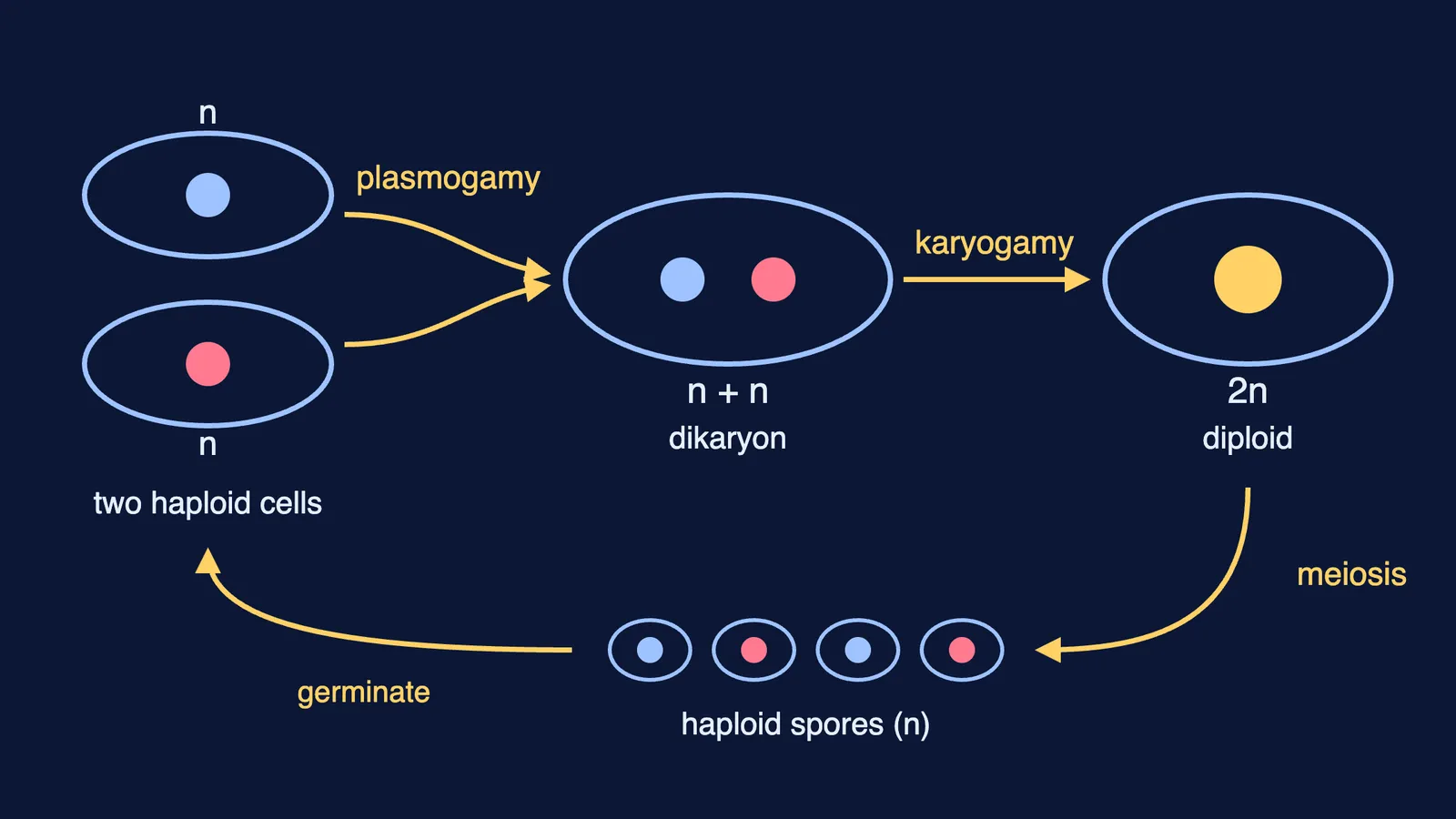
Plasmogamy: fusion of the protoplasm of two cells or gametes. Don't confuse with: karyogamy, the later fusion of their two nuclei.
Dikaryon: a cell holding two separate haploid nuclei (n + n), seen in ascomycetes and basidiomycetes between plasmogamy and karyogamy; this phase is the dikaryophase.
Phycomycetes: aseptate, coenocytic fungi of water, moist decaying wood, or living plants as obligate parasites; asexual zoospores or aplanospores, sexual zygospore. Examples: *Mucor*, *Rhizopus*, *Albugo*.
Ascomycetes (sac fungi): branched, septate mycelium; ascospores form inside sac-like asci, in fruiting bodies called ascocarps. Examples: *Penicillium*, yeast, *Aspergillus*, *Neurospora*.
Basidiomycetes: mushrooms, rusts and smuts, with no sex organs; karyogamy and meiosis in the basidium give four basidiospores outside it. Examples: *Agaricus*, *Ustilago*, *Puccinia*.
Deuteromycetes (imperfect fungi): fungi known only from asexual stages, reproducing by conidia. Examples: *Alternaria*, *Colletotrichum*, *Trichoderma*.
Conidia: asexual spores formed outside, on special hyphae called conidiophores. Don't confuse with: ascospores, sexual spores formed inside an ascus.
We compare the four classes of Kingdom Fungi separately.
Are viruses living? Viruses, viroids and lichens
Virus: a non-cellular particle, inert outside a host, that hijacks a living cell to copy itself: an obligate parasite with protein and either RNA or DNA, never both. Per the NCERT chapter, Beijerinck named it "virus" in 1898.
Capsid: the protein coat around a virus's nucleic acid, built from capsomeres.
Bacteriophage: a virus that infects bacteria, usually with double-stranded DNA. Don't confuse with: plant viruses such as tobacco mosaic virus, which usually have single-stranded RNA.
Viroid: a free, low-molecular-weight RNA with no protein coat, discovered by T.O. Diener in 1971 as the cause of potato spindle tuber disease. Don't confuse with: a virus, whose nucleic acid sits inside a protein capsid.
Lichen: a mutually useful partnership of an alga and a fungus; they do not grow in polluted areas, so they indicate pollution.
Phycobiont and mycobiont: the algal partner (makes food) and the fungal partner (shelter, water, minerals). Don't confuse with: mycorrhiza, a fungus living with the roots of higher plants.
How to learn these terms
Redraw NCERT's five-kingdom comparison from memory: cell type, wall, nucleus, body organisation, nutrition.
Redraw the fungal sexual cycle from the diagram at the top and label each stage.
Learn the mix-ups as pairs: plasmogamy vs karyogamy, conidia vs ascospores, virus vs viroid, slime-mould plasmodium vs *Plasmodium*, phycobiont vs mycobiont.
Tie one organism to each group: *Gonyaulax* with red tide, *Nostoc* with heterocysts, *Albugo* with mustard.
Firm up ranks and naming from The Living World Class 11 first.
If a term feels abstract, the Fermi Concept Library covers every concept in biology, each with its own lesson and its place in the map.