On this page
Here are six assertion-reason items and four Statement I / Statement II pairs on Biological Classification, each block running from easy to hard. Every statement was checked against Chapter 2 of NCERT Class 11 Biology (reprint 2026-27). The NMC NEET (UG)-2026 syllabus lists this chapter in Unit 1 as five kingdom classification, the major groups of Monera, Protista and Fungi, lichens, viruses and viroids.
How do you answer assertion-reason questions on Biological Classification?
Use these keys throughout.
Assertion-reason:
(A) Both A and R are true and R is the correct explanation of A.
(B) Both A and R are true but R is NOT the correct explanation of A.
(C) A is true but R is false.
(D) A is false but R is true.
Statement pairs:
(A) Both statements are correct.
(B) Both statements are incorrect.
(C) Statement I is correct, Statement II is incorrect.
(D) Statement I is incorrect, Statement II is correct.
Judge A alone, then R alone, and only if both are true ask, "Is R the reason NCERT gives for A?" In this chapter most false lines swap a feature between two neighbouring groups: septate and aseptate, endogenous and exogenous, DNA and RNA.
For the chapter itself, read our guide to the five kingdoms for NEET, and for more on the format, our assertion-reason strategy post.
Assertion-reason questions on Biological Classification
Q1 (easy). Assertion (A): Diatomaceous earth, a gritty soil used for polishing, is built up from diatom remains. Reason (R): Silica in diatom cell walls keeps the walls from breaking down.
Answer: (A). Both are true, and NCERT gives the silica walls as the direct reason the wall deposits built up over time. Trap: picking (B) because R sounds like a separate structural fact.
Q2 (easy). Assertion (A): The body of euglenoids is flexible. Reason (R): Euglenoids have a rigid cell wall made of cellulose plates.
Answer: (C). A is true. R is false: euglenoids have no cell wall but a protein-rich pellicle, and that pellicle is what makes the body flexible. Stiff cellulose plates belong to dinoflagellates. Trap: borrowing the dinoflagellate wall for Euglena.
Q3 (medium). Assertion (A): Mycoplasma are the smallest living cells known. Reason (R): Mycoplasma can survive without oxygen.
Answer: (B). Both are true per NCERT section 2.1, but surviving without oxygen has nothing to do with cell size. The feature NCERT stresses for Mycoplasma is that they completely lack a cell wall. Trap: choosing (A) because both facts sit in the same sentence of the textbook.
Q4 (medium). Assertion (A): Bacteriophages usually contain single-stranded RNA. Reason (R): No virus contains both RNA and DNA.
Answer: (D). A is false: bacteriophages are usually double-stranded DNA viruses. Single-stranded RNA is the general case for plant viruses. R is true. Trap: mixing up which host goes with which nucleic acid.
Q5 (hard). Assertion (A): In the five kingdom classification, Chlamydomonas and Paramoecium are placed in different kingdoms. Reason (R): Chlamydomonas has a cell wall, while Paramoecium lacks one.
Answer: (D). A is false: both are single-celled eukaryotes, so both go into Protista. NCERT uses exactly this pair to show how Protista brought together organisms the older system had split between plants and animals. R is true. Trap: treating the cell wall as the deciding test, as the two kingdom system did.
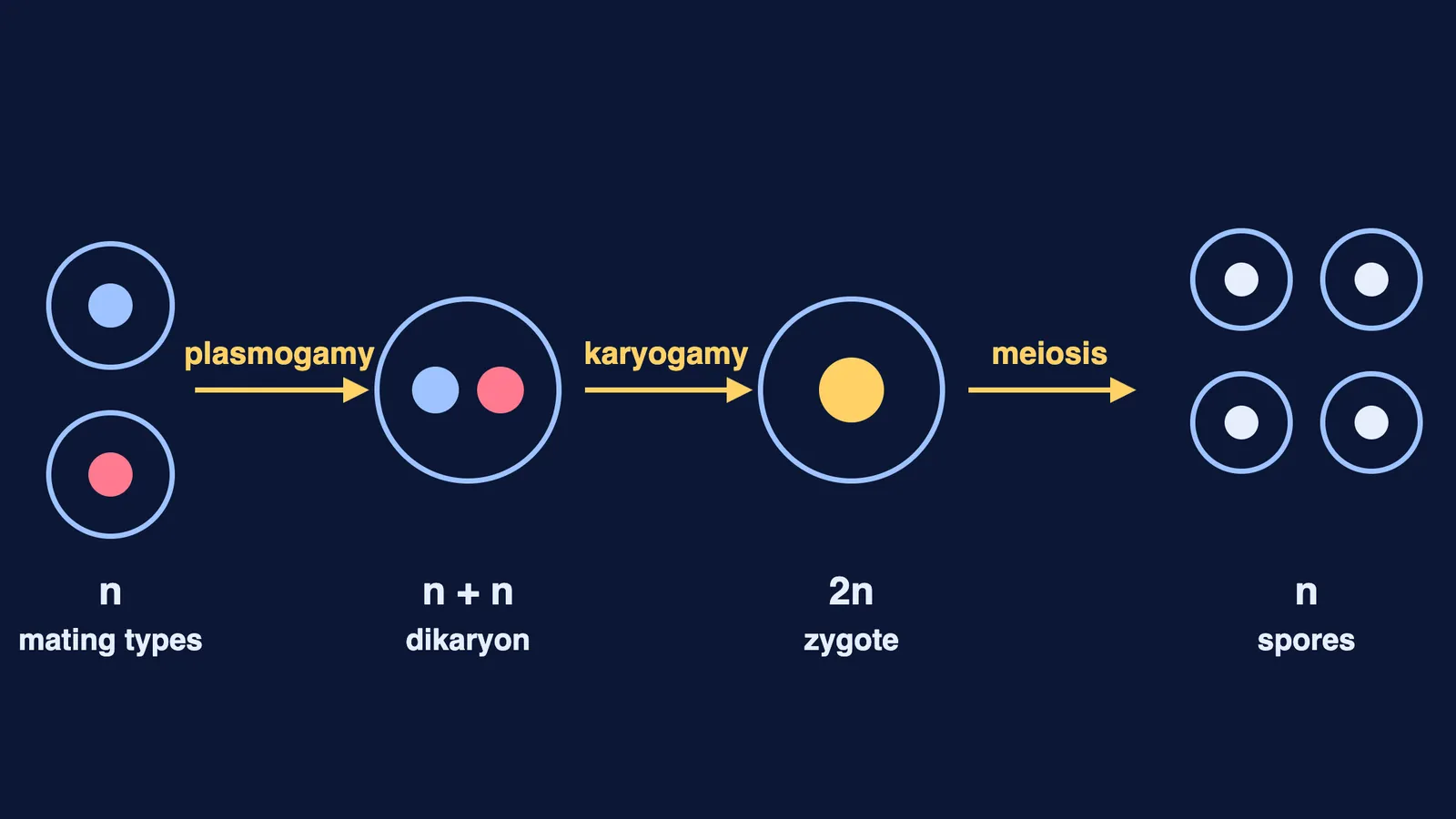
Q6 (hard). Assertion (A): In ascomycetes and basidiomycetes, a dikaryotic stage (n + n) occurs during sexual reproduction. Reason (R): In the sexual cycle of fungi, meiosis in the zygote produces haploid spores.
Answer: (B). Both are true. The dikaryon is the gap between plasmogamy and karyogamy, when two nuclei share a cell before fusing; R describes the step after fusion, so it does not explain why the dikaryon exists. Trap: reading any true line about the fungal sexual cycle as the explanation.
Statement I / Statement II questions on Biological Classification
Q7 (easy). Statement I: Cyanobacteria have chlorophyll a similar to green plants. Statement II: Nostoc and Anabaena can fix atmospheric nitrogen in specialised cells called heterocysts.
Answer: (A). Both are correct as written in NCERT section 2.1.2. Trap: doubting Statement I because cyanobacteria are prokaryotes.
Q8 (medium). Statement I: In a lichen, the phycobiont is autotrophic and the mycobiont is heterotrophic. Statement II: Lichens grow well in polluted areas.
Answer: (C). Statement I is correct: the algal partner makes food and the fungal partner gives shelter and absorbs water and minerals. Statement II is incorrect: lichens do not grow in polluted areas, which is why they are good pollution indicators. Trap: reversing "indicator" to mean "thrives in".
Q9 (medium). Statement I: In phycomycetes, the mycelium is septate and branched. Statement II: In ascomycetes, conidia are produced exogenously on special mycelium called conidiophores.
Answer: (D). Statement I is incorrect: phycomycete mycelium is aseptate and coenocytic. Septate, branched mycelium belongs to the other three classes. Statement II is correct. Trap: applying the majority description to every class.
Q10 (hard). Statement I: The three-domain system keeps Kingdom Monera as one domain and splits the eukaryotes into two domains. Statement II: In basidiomycetes, basidiospores are produced endogenously in sac-like asci.
Answer: (B). Statement I is incorrect: the three-domain system divides Monera into two domains and keeps the eukaryotic kingdoms in the third. Statement II is incorrect: basidiospores form exogenously on a basidium; endogenous spores in asci are ascospores. Trap: each statement is the right fact attached to the wrong group.
How should you use this set?
Attempt all ten in one sitting without notes, writing the key and one line of reason.
Mark each miss as a truth error (you misjudged A, R or a statement) or a link error (both true, wrong call on "explains").
For each truth error, reread that NCERT section and write the corrected line in your own words.
For each link error, write the real reason NCERT gives, then join it to A with "because".
Retry the misses a few days later, then turn one correct item into a false one by swapping a group.
If a group's features keep blurring together, the Fermi Concept Library gives every biology concept its own lesson and place in the map, so you can revisit one group at a time. For a full revision of the chapter, see our Class 11 walk-through of the five kingdoms.