On this page
Ask for dalchini in an Indian shop and you may be handed cassia, which is sold as taj. The two barks come from different trees, and one chemical sets them apart: coumarin, a sweet, hay-scented compound that cassia carries in much larger amounts than true cinnamon. Coumarin is also a neat exam example: a ring (a lactone) that only one of two geometric isomers can close. Here is that chemistry, then what Indian and German food-safety bodies say.
What is the difference between cassia and true cinnamon?
FSSAI's guidance note on cinnamon (dalchini) and cassia (taj) says true cinnamon comes from Cinnamomum verum (also called C. zeylanicum), native to Sri Lanka and South India. Cassia comes from other species, such as Chinese cassia (C. cassia) and Indonesian cassia (C. burmannii). Cassia sticks are thick bark curled in from both sides into a hollow tube; a Ceylon cinnamon stick is thin layers rolled like a cigar. The note rates coumarin content low for cinnamon and high for cassia.
Cinnamon's familiar flavour compound, cinnamaldehyde, is (E)-3-phenylprop-2-enal (PubChem CID 637511): the phenyl group and the CHO sit on opposite sides of the C=C, so it is the E isomer. The cinnamic acid made in the Perkin reaction from benzaldehyde is also E.
What is coumarin, chemically?
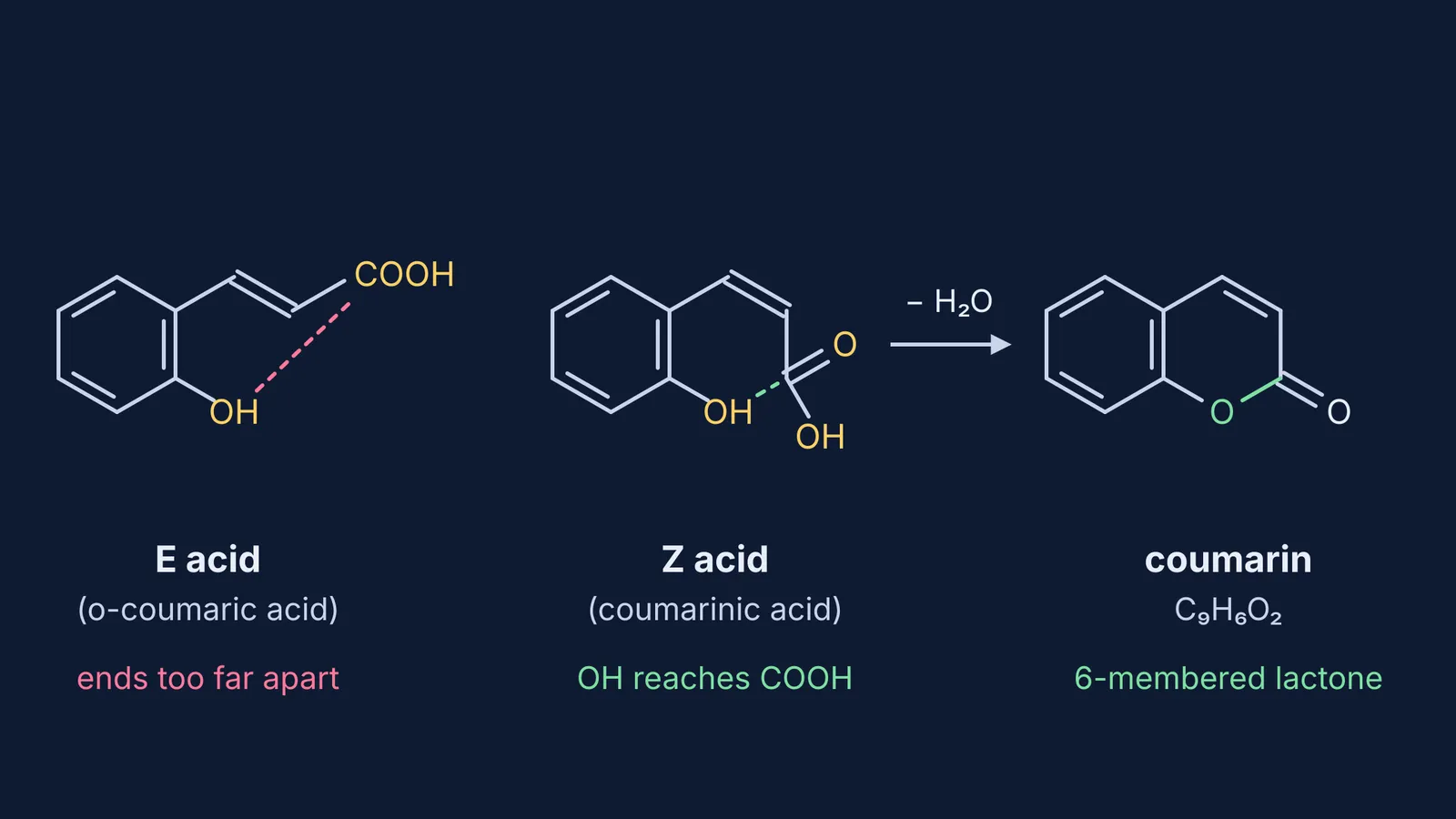
Coumarin is C₉H₆O₂, molar mass 146.14 g/mol, IUPAC name chromen-2-one (PubChem CID 323). It is a benzene ring fused to a six-membered ring containing an O atom next to a C=O. An O–C(=O) unit inside a ring is a cyclic ester: a lactone.
Open the ring at the ester bond, add back water, and you get 2-hydroxycinnamic acid: a benzene ring with OH on one carbon and CH=CH–COOH on the next. Coumarin is the lactone of this acid. The ring that forms has six atoms (O, the C=O carbon, the two alkene carbons and two ring carbons), so it is a δ-lactone. The ring-size rule for why five- and six-membered lactones form easily is in what hydroxy acids give on heating.
Why can only the cis acid form coumarin?
Each alkene carbon of 2-hydroxycinnamic acid carries two different groups, so the acid exists as two geometric isomers that cannot interconvert by rotation.
The E (trans) isomer is o-coumaric acid, (E)-3-(2-hydroxyphenyl)prop-2-enoic acid (PubChem CID 637540). The aryl ring and COOH lie on opposite sides of the C=C, so the COOH ends up far from the phenolic OH.
The Z (cis) isomer is coumarinic acid, (Z)-3-(2-hydroxyphenyl)prop-2-enoic acid (PubChem CID 5280841). The chain curls back so the COOH carbon sits next to the phenolic O.
Only in the Z isomer can the phenolic O attack the carbonyl carbon of COOH. Water is lost and the six-membered ring closes:
C₉H₈O₃ (coumarinic acid) → C₉H₆O₂ (coumarin) + H₂O
Check the balance: carbon 9 = 9, hydrogen 8 = 6 + 2, oxygen 3 = 2 + 1. By mass, 164.16 g/mol → 146.14 + 18.02 g/mol, which also adds up.
The E isomer has the same formula, but its ends cannot meet. Closing the ring would first need rotation about the C=C, which means breaking the π bond, so o-coumaric acid stays open. The ring does the reverse too: Chemcess's coumarin entry notes that alkali opens coumarin to salts of the cis acid, and acidifying them gives coumarin back. Wikipedia's coumarin article gives the plant route as lactonisation of the cis acid and notes that William Henry Perkin first synthesised coumarin in 1868.
How is this like maleic and fumaric acid?
Maleic acid (cis) has both COOH groups on one side, so on heating it loses water to form a cyclic anhydride. Fumaric acid (trans) cannot do this directly. The same cis closeness gives maleic acid its internal hydrogen bond, explained in why maleic acid is more acidic than fumaric acid.
The rule to carry into the exam: two groups on a C=C can join into a ring only when they are cis (Z) to each other. A trans isomer must isomerise first.
What do FSSAI and BfR say about coumarin in cassia?
FSSAI's letter of 23 November 2023 says it had received complaints of cassia (taj) being passed off as cinnamon (dalchini) "to capitalize on the higher profit margin offered by Cassia". It points out that the two spices have separate standards, in sub-regulations 2.9(4) and 2.9(5) of the Food Safety and Standards (Food Products Standards and Food Additives) Regulations, 2011. A maximum coumarin limit was added to the cinnamon standard, "aiding in the distinction between cinnamon and cassia based on coumarin content". The test method is in FSSAI's spices Manual of Methods (22 June 2021). The letter asked states to run market surveillance and report by 31 December 2023. FSSAI's guidance note adds that, as part of normal food, "consumption of cassia is safe".
Germany's Federal Institute for Risk Assessment explains the health side in its FAQ on coumarin in cinnamon (updated 27 September 2012). In especially sensitive people, coumarin taken as a medicine has caused liver effects that are usually reversible. BfR adds that no such liver damage from eating cinnamon had been described in the literature. Its tolerable daily intake (TDI) is 0.1 mg per kg of body weight per day, the same value the European Food Safety Authority calculated. A TDI is a lifetime daily average, and BfR says exceeding it in the short run poses no health risk.
Coumarin in cassia varies a lot. BfR reports monitoring data with an average of about 3,000 mg per kg of cassia, and the highest measured levels at about 10,000 mg per kg, more than three times the average. Ceylon cinnamon contains only low levels.
Worked example: turning the TDI into grams of cassia
An illustration of the arithmetic, not advice on how much to eat, for a 60 kg adult and a 15 kg child.
Daily TDI for the adult. 0.1 mg/kg × 60 kg = 6 mg of coumarin per day.
Cassia at the average level. 3,000 mg/kg is 3 mg per gram. 6 mg ÷ 3 mg/g = 2 g of cassia.
Cassia at the highest measured level. 10,000 mg/kg is 10 mg per gram. 6 mg ÷ 10 mg/g = 0.6 g.
The child. 0.1 mg/kg × 15 kg = 1.5 mg per day, which is 0.5 g of cassia at the average level and 0.15 g at the highest.
Check. BfR gives about 2 g for the adult and about 0.5 g for the child, matching steps 2 and 4.
In moles. 6 mg ÷ 146.14 g/mol = 0.041 mmol.
The answer depends on body weight and, above all, on which bark it is and how much coumarin that batch holds. For your own diet, follow FSSAI and your health authority's guidance.
For more geometric isomerism, the Concept Library covers every concept in chemistry, and Fermi Test Prep helps with JEE Main and Advanced preparation through an AI tutor.
Quick checklist
Coumarin, C₉H₆O₂, is the six-membered lactone (δ-lactone) of 2-hydroxycinnamic acid.
Only the Z (cis) acid, coumarinic acid, can close the ring; the E acid, o-coumaric acid, cannot.
Equation: C₉H₈O₃ → C₉H₆O₂ + H₂O, balanced in C, H and O.
BfR TDI: 0.1 mg/kg body weight per day, a lifetime average; cassia averages about 3 g/kg coumarin, up to about 10 g/kg.