On this page
Maleic acid and fumaric acid share the formula HOOC–CH=CH–COOH and differ only in shape: maleic acid is the cis isomer, (Z)-butenedioic acid, and fumaric acid is the trans isomer, (E)-butenedioic acid (PubChem: maleic acid; PubChem: fumaric acid). That one change flips their acid strength twice, and a single idea explains both flips.
Why is maleic acid more acidic than fumaric acid?
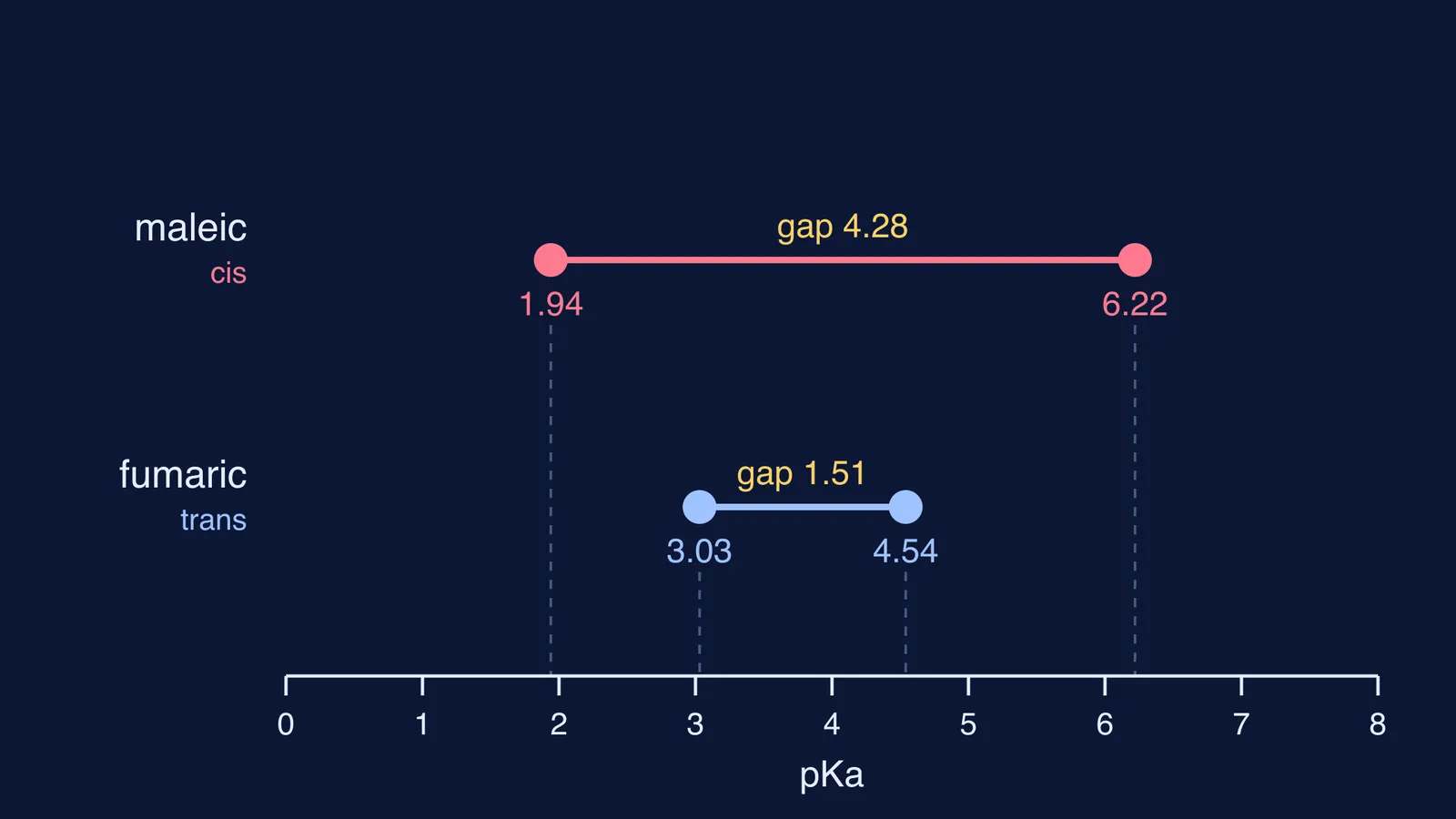
The ECHA registration dossier compiled on PubChem gives maleic acid pKa1 = 1.94 and pKa2 = 6.22 at 25 °C. The Merck Index values compiled on PubChem give fumaric acid pKa1 = 3.03 and pKa2 = 4.54 at 25 °C. A lower pKa means a stronger acid, and a gap of 1.09 units means maleic acid's Ka1 is about 12 times larger than fumaric acid's (10^1.09 ≈ 12).
The reason lies in the ion left behind, not in the acid. When maleic acid loses one proton, the hydrogen maleate ion has its COOH and COO⁻ on the same side of the double bond. They are close enough for the remaining O–H to bond to a carboxylate oxygen, closing a seven-membered ring.
This bond is real and unusually strong. In a crystal structure, Nina Lah and Ivan Leban measured its O···O distance at 2.42 Å and described it as "extremely short" (Acta Crystallographica C, 2003). Calculations by Michael McAllister put its energy at about 27 kcal/mol in the gas phase, falling by roughly 6 kcal/mol when the solvent is modelled as a dielectric continuum (Canadian Journal of Chemistry, 1997).
The hydrogen bond spreads the negative charge across both carboxyl groups and stabilises the monoanion. A more stable conjugate base means the first proton leaves more readily. In hydrogen fumarate the two groups point in opposite directions, so no such bond can form.
Why is fumaric acid more acidic in the second step?
In step two the order reverses. Maleic acid's pKa2 of 6.22 is higher than fumaric acid's 4.54 (PubChem: maleic acid; PubChem: fumaric acid), so maleic acid's Ka2 is nearly 50 times smaller (10^1.68 ≈ 48).
Two effects push the same way:
The second proton in hydrogen maleate is the one held in the hydrogen bond, so removing it means breaking that bond first.
The dianion that forms has two COO⁻ groups on the same side, close together, and their negative charges repel.
Fumarate's two charges sit at opposite ends of the molecule, so its second proton leaves more easily. The gap between the two pKa values, 4.28 for maleic acid and 1.51 for fumaric acid, reflects maleic acid's unusually stable monoanion. For another case where the distance between two COOH groups decides the order, see why oxalic acid is stronger than malonic acid.
Maleic vs fumaric acid: pKa and melting point side by side
Values from PubChem's compiled data (maleic acid; fumaric acid):
pKa1 at 25 °C: maleic acid 1.94; fumaric acid 3.03
pKa2 at 25 °C: maleic acid 6.22; fumaric acid 4.54
Gap, pKa2 minus pKa1: maleic acid 4.28; fumaric acid 1.51
Melting point: maleic acid about 131 °C (sources give 130.5 to 132.5 °C); fumaric acid 287 °C, with decomposition
Hydrogen bond in the monoanion: intramolecular in hydrogen maleate; not possible in hydrogen fumarate
Why does fumaric acid melt so much higher than maleic acid?
Fumaric acid's COOH groups point in opposite directions, so each molecule can hydrogen-bond to neighbours at both ends and pack tightly. Maleic acid's bent shape packs less well. Compare the melting points: about 287 °C for fumaric acid against about 131 °C for maleic acid (PubChem: fumaric acid; PubChem: maleic acid).
The Merck Index entry quoted on PubChem adds a twist: maleic acid is partly converted to fumaric acid when heated slightly above its melting point. The trans isomer is the more stable one, the same pattern you meet in why cis isomers boil higher but trans isomers melt higher.
How do you write this answer in an exam?
A four-step answer:
State the data: maleic acid pKa1 1.94 against 3.03 for fumaric acid (PubChem: maleic acid; PubChem: fumaric acid), so maleic acid is stronger in the first step.
Give the cause: hydrogen maleate is stabilised by an intramolecular hydrogen bond between COOH and COO⁻, which only the cis geometry allows. Draw the seven-membered ring.
Flip it for Ka2: that bond holds the second proton and the cis dianion's charges repel, so maleic acid's pKa2 (6.22) exceeds fumaric acid's (4.54).
Close with the rule: stabilised conjugate base, higher Ka; destabilised conjugate base, lower Ka.
An internal hydrogen bond also explains why o-nitrophenol is volatile. If conjugate-base stability still feels shaky, the Fermi Concept Library covers every concept in chemistry, each with its own lesson. To practise the reasoning on new pairs, the Fermi Problem Library has worked problems with a step-by-step solver that explains the reasoning rather than printing an answer.