

On this page
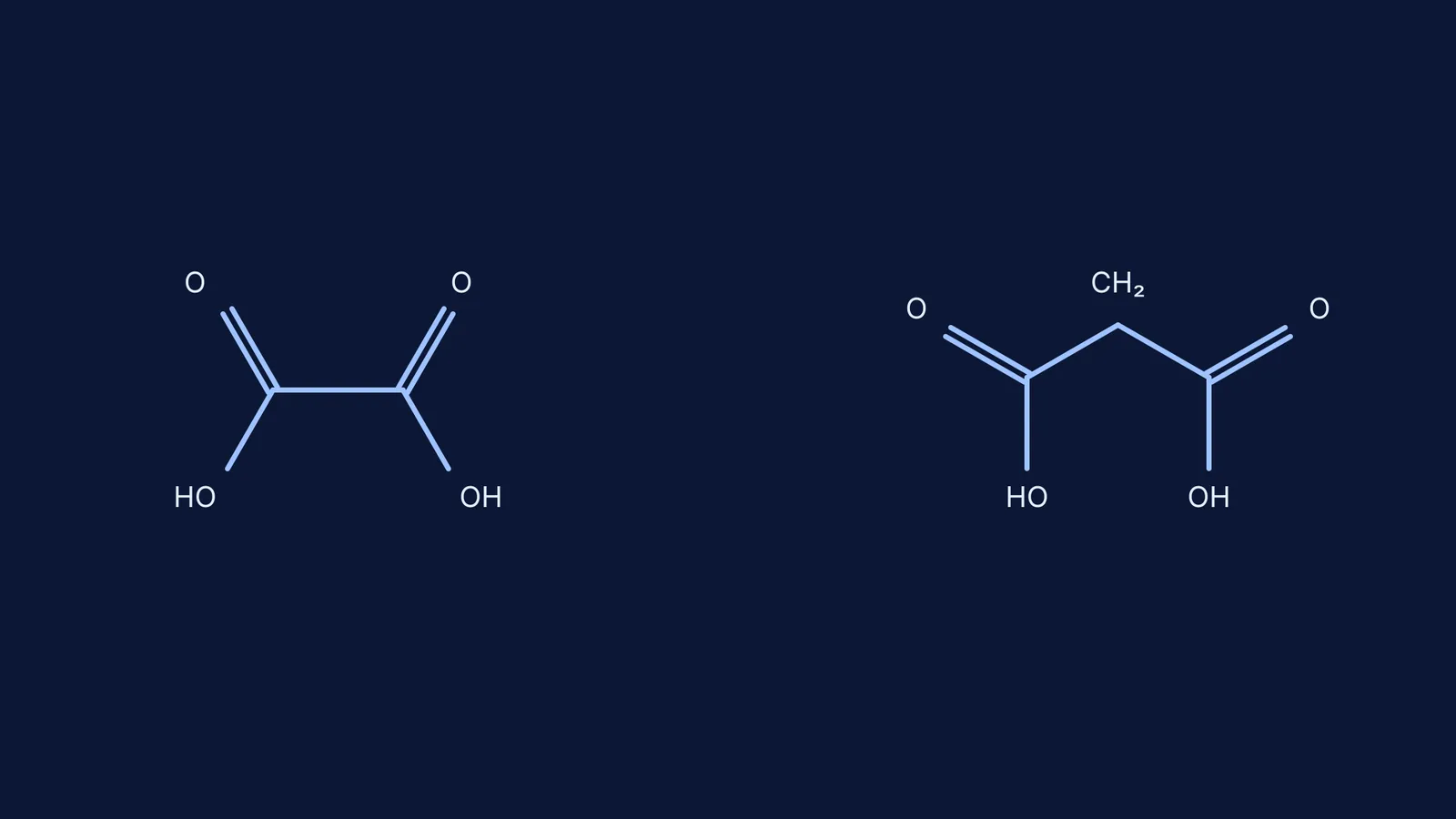
If you look at the pKa values, oxalic acid is significantly more acidic than malonic acid. In chemistry, a lower pKa means a stronger acid. For the first proton release, oxalic acid has a pKa1 of 1.25 Source, while malonic acid has a pKa1 of 2.83 Source.
The primary reason lies in the inductive effect (–I effect) and the physical distance between the two carboxyl (–COOH) groups. The –COOH group is highly electronegative and withdraws electron density through the sigma bonds.
Why is oxalic acid stronger than malonic acid?
In oxalic acid (HOOC–COOH), the two carboxyl groups are bonded directly to each other. They strongly pull electron density away from each other's O–H bonds. This intense inductive pull weakens the O–H bond, making it very easy for the first proton to leave.
In malonic acid (HOOC–CH₂–COOH), there is a methylene (–CH₂–) group separating the two carboxyl groups. Because the inductive effect drops off sharply with distance—losing strength through every additional sigma bond—the electron-withdrawing pull is much weaker here. The O–H bond remains stronger, making malonic acid a weaker acid overall. You can read more about ranking these forces in our guide to electronic effects in organic chemistry.
What happens in the first dissociation?
When an acid loses its first proton, it forms a monoanion. The strength of an acid is largely determined by how stable this resulting anion is. Both oxalic and malonic acids form resonance-stabilized monoanions, meaning the negative charge is shared across two oxygen atoms.
However, when oxalic acid loses a proton, the remaining –COOH group uses its strong, close-range –I effect to help spread out the negative charge of the newly formed –COO⁻ group. This additional stabilization makes the monoanion highly stable. In malonic acid, the –CH₂– spacer prevents the remaining –COOH group from offering the same level of inductive stabilization. If you are preparing for exams, this is why titrations often use oxalic acid; you can review the exact procedure in the KMnO4 and oxalic acid titration practical.
If you are struggling to picture how electron density shifts across a molecule, the Fermi Concept Library explains inductive and resonance effects, each with its own lesson and its place in the map.
Why is the second dissociation (pKa2) so different?
The removal of the second proton tells a different story. The second dissociation constant (pKa2) for oxalic acid is 4.28 Source, whereas for malonic acid it is 5.69 Source. Both acids have a surprisingly large gap between their first and second pKa values, but for slightly different structural reasons.
Why is malonic acid so reluctant to give up its second proton?
Once malonic acid loses its first proton, it forms a monoanion that can bend to form a highly stable six-membered ring via intramolecular hydrogen bonding. The hydrogen atom of the intact –COOH group bonds tightly to the oxygen of the –COO⁻ group. This hydrogen bond essentially "locks" the second proton in place, making it much harder to remove.
Oxalic acid's monoanion can only form a five-membered ring, which is less geometrically stable, so it does not trap the second proton as tightly through hydrogen bonding. Instead, oxalic acid's high pKa2 is driven by intense electrostatic repulsion: removing a second proton forces two negative charges to sit directly next to each other on adjacent carbons, which takes a lot of energy.
How to predict acid strength in organic chemistry
When you face an exam question comparing the acidity of two molecules, follow this framework:
Check the distance: How close is the electron-withdrawing group? The closer it is, the stronger the inductive effect, and the stronger the acid.
Look for hydrogen bonding: Does the conjugate base form a stable ring through intramolecular hydrogen bonding? If a stable six-membered ring forms, the next proton will be very hard to remove.
Compare the repulsion: For a second dissociation, how close will the two negative charges be? Proximity creates electrostatic repulsion, making the second proton harder to remove.
You can read more about how to rank these structures in our guide to carboxylic acids and their derivatives. And if you want to test your understanding, the Fermi Problem Library will walk you step-by-step through advanced organic chemistry questions, explaining the reasoning behind every electron shift.


