

On this page
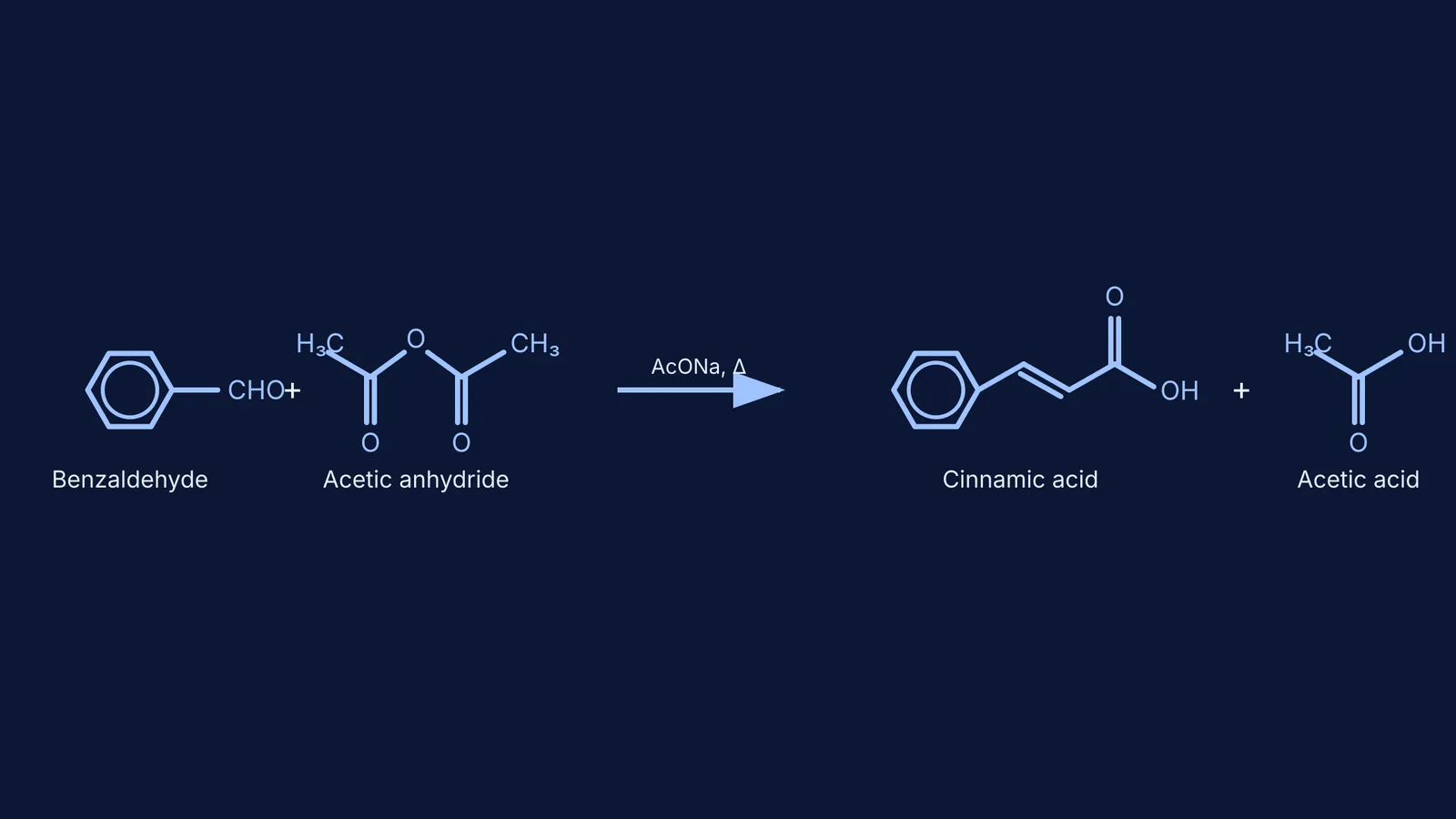
When memorising named reactions for organic chemistry exams, it is easy to lose track of the underlying logic. A common point of confusion is the Perkin reaction, in which benzaldehyde reacts with acetic anhydride and sodium acetate to produce cinnamic acid.
The mechanism relies on forming an enolate. A frequent question arises: which of these reagents actually supplies the enolate?
Which reagent supplies the enolate in the Perkin reaction?
In the Perkin reaction, the enolate is supplied by acetic anhydride, not benzaldehyde.
For an enolate to form, a molecule must possess α-hydrogens (hydrogens attached to the carbon adjacent to the carbonyl group). Benzaldehyde lacks any α-hydrogens, meaning it is impossible for it to form an enolate. Acetic anhydride, however, has them. The base in the reaction—sodium acetate—removes one of these protons to create the nucleophilic enolate ion.
English chemist William Henry Perkin developed this reaction in 1868 to synthesise unsaturated aromatic acids, and a core requirement is that the aliphatic acid anhydride must contain at least two α-hydrogens (Wikipedia).
The step-by-step mechanism
Understanding the reaction conceptually is more effective than rote memorisation. If you are struggling to picture the electron flow, the Fermi Problem Library has a step-by-step solver that explains the reasoning behind complex mechanisms.
Here is how the reaction unfolds:
Deprotonation: The acetate ion from sodium acetate acts as a weak base. It abstracts an α-proton from acetic anhydride, generating a resonance-stabilised enolate ion.
Nucleophilic attack: The newly formed enolate acts as a nucleophile. It attacks the electrophilic carbonyl carbon of benzaldehyde, pushing the π electrons up onto the oxygen to form a tetrahedral intermediate.
Proton transfer and rearrangement: The negatively charged oxygen from the aldehyde picks up a proton (often from the acetic acid byproduct formed in step 1). This creates a β-hydroxy anhydride intermediate.
Dehydration: The intermediate undergoes elimination, losing a molecule of water to form an α,β-unsaturated mixed anhydride.
Hydrolysis: Finally, the unsaturated mixed anhydride undergoes hydrolysis (usually during the aqueous workup) to produce cinnamic acid and acetic acid.
Why use sodium acetate with acetic anhydride?
In the Perkin reaction, the base chosen is typically the alkali metal salt of the acid corresponding to the anhydride.
Using sodium acetate alongside acetic anhydride prevents unwanted side reactions. If you were to use a different base, such as sodium propanoate, it could react with the acetic anhydride to form a mixed anhydride. This would lead to a complex mixture of different enolates and a variety of unwanted condensation products, lowering the yield of cinnamic acid.
What makes cinnamic acid stable?
The product of the Perkin reaction is an α,β-unsaturated aromatic acid. In cinnamic acid, the carbon-carbon double bond is conjugated with both the aromatic benzene ring and the carbonyl group of the carboxylic acid.
This extended conjugated system allows the π electrons to delocalise across the entire molecule. The resulting resonance energy makes cinnamic acid highly stable. This stability is the thermodynamic driving force for the dehydration step; the reaction readily eliminates a water molecule to reach this lower energy state.
How to practice named organic reactions
Rote learning a list of named reactions rarely works well for challenging exams like the JEE or NEET. Instead, practice the mechanism.
Start by identifying the nucleophile and the electrophile. Check for α-hydrogens to see which molecule is capable of enolisation. Once you understand why a particular bond breaks and forms, you will not have to guess the products on test day.
To strengthen your understanding of reaction mechanisms and reagent roles, explore these related topics:


