

On this page
In organic chemistry, memorising a few key pKa values gives you an enormous advantage in predicting how molecules behave. A smaller pKa number indicates a stronger acid, meaning the molecule is more willing to donate a proton (H⁺).
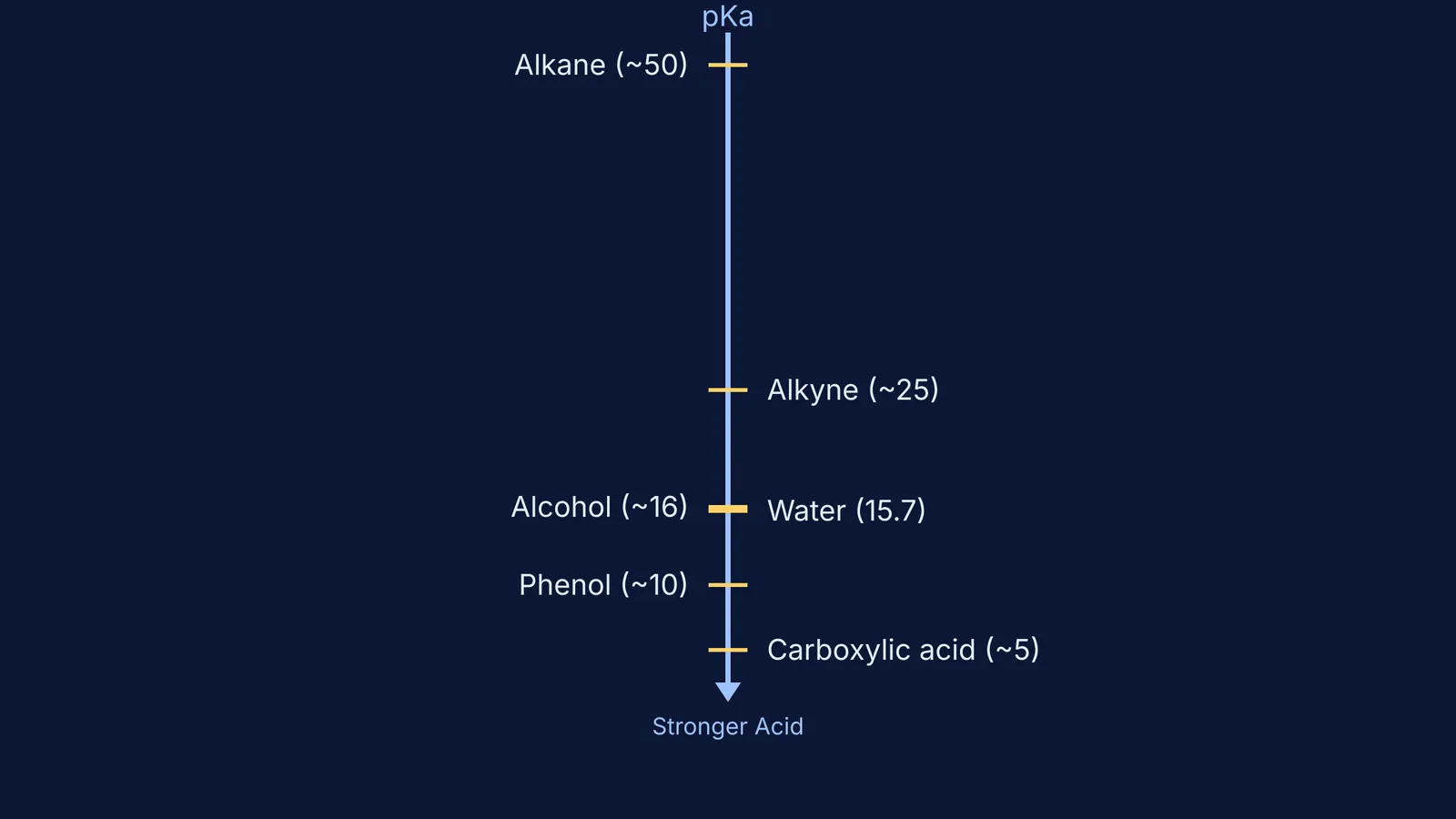
Based on the standard Evans pKa Table compiled at Harvard University, here is the approximate order of common functional groups from the weakest to the strongest acid:
Alkane (e.g. ethane): pKa ~50
Alkyne (e.g. ethyne): pKa ~25
Alcohol (e.g. ethanol): pKa ~16
Water: pKa = 15.7
Phenol: pKa ~10
Carboxylic acid (e.g. ethanoic acid): pKa ~5
When you look at the top of the ladder, alkanes are exceptionally weak acids. The carbon-hydrogen bond in an alkane is highly stable, making it virtually impossible to deprotonate under normal laboratory conditions. However, alkynes sit at a pKa of 25. This means alkynes are 10²⁵ times more acidic than alkanes. The sp-hybridised carbon in an alkyne holds its electrons much closer to the nucleus than the sp³ carbon in an alkane, which makes the resulting conjugate base significantly more stable.
Why is water more acidic than alcohol?
When first studying the properties of water and alcohols, many students assume that an organic alcohol should be more acidic. However, water (pKa 15.7) is actually a slightly stronger acid than most simple alcohols like ethanol (pKa ~16).
The reason comes down to the alkyl group attached to the oxygen in an alcohol. Alkyl groups are weakly electron-donating. When an alcohol loses a proton to become an alkoxide ion (such as the ethoxide ion), the alkyl group pushes additional electron density onto an oxygen atom that is already bearing a negative charge. This destabilises the conjugate base. Water lacks this electron-donating group, making the hydroxide ion slightly more stable than an alkoxide ion.
Why is phenol more acidic than alcohol?
A common point of confusion for students learning about Ethanol and ethanoic acid: Class 10 properties and reactions is why they behave so differently from phenol, even though both alcohols and phenols feature an -OH group.
According to the Evans pKa Table, phenol (pKa ~10) is roughly 1,000,000 times more acidic than a typical alcohol. This massive leap in acidity is caused by the adjacent benzene ring. When phenol loses a proton, the resulting phenoxide ion is heavily stabilised by resonance. The negative charge is spread around the aromatic ring rather than being concentrated entirely on the oxygen atom. Because the conjugate base is so stable, the intact phenol molecule is much more willing to give up its proton. You can see this heightened reactivity at play in the Reimer-Tiemann and Kolbe reactions of phenol, step by step.
How do you predict reactions with the pKa ladder?
The true power of the pKa ladder lies in predicting acid-base equilibria. An acid-base reaction will only proceed strongly in the forward direction if the reacting acid is stronger than the conjugate acid being formed on the product side.
Here is a practical framework to apply to any reaction you encounter:
Identify the acid on the reactant side and note its approximate pKa.
Identify the conjugate acid on the product side and note its pKa.
The equilibrium always favours the side with the weaker acid (the higher pKa).
For example, will sodium hydroxide (NaOH) successfully deprotonate phenol?
The reactant acid is phenol (pKa ~10). The base is the hydroxide ion, which becomes water (the conjugate acid, pKa 15.7) after accepting a proton. Since 10 is less than 15.7, phenol is a stronger acid than water, meaning the equilibrium lies far to the right and the reaction goes forward.
Conversely, will NaOH deprotonate ethanol?
The reactant acid is ethanol (pKa ~16), and the conjugate acid is again water (pKa 15.7). Because 16 is greater than 15.7, ethanol is a weaker acid than water. The reaction does not proceed to any significant degree because the equilibrium heavily favours the reactants.
What about alkynes? Will sodium amide (NaNH₂) deprotonate a terminal alkyne?
The acid is the alkyne (pKa ~25). The base is the amide ion (NH₂⁻), which becomes ammonia (pKa ~38) after accepting a proton. Since 25 is less than 38, the alkyne is much stronger than ammonia. The reaction proceeds completely to the right, forming a useful acetylide ion for further synthesis.
If you are unsure whether your predicted mechanism is correct, the Fermi Problem Library has worked problems with a step-by-step solver that explains the reasoning rather than printing an answer.


