On this page
A motor that has run at full load for an hour is hot inside, but you cannot push a thermometer into the middle of its coils. Test engineers do not need to. They measure the resistance of the copper winding before the test and again just after it, and the winding tells them its own temperature. With copper's number 234.5 the whole calculation is one line, and it is exactly the kind of temperature-coefficient numerical that appears in JEE Main.
How can a winding act as its own thermometer?
The resistance of a metal rises with temperature. The basic formula R = R₀[1 + α(T − T₀)], with the toaster examples and the usual sign slips, is covered in temperature coefficient of resistance: formula and worked examples. A platinum sensor such as the Pt100 resistance thermometer uses the same idea with a small coil of platinum built for the job.
A motor winding is a long copper wire. So it is a resistance thermometer already, and it is a large one: it measures the average temperature of all the copper at once. That is why the motor standard IEC 60034-1 lists the resistance method as one of its ways of finding how much a winding heats up. Clause 8.6.2 of the 2010 edition of IEC 60034-1 gives the calculation, and the same clause says the reading needs a quick shutdown, because the winding starts cooling the moment the power is switched off.
Where does the number 234.5 come from?
For copper of 100% standard conductivity, the US National Bureau of Standards Copper Wire Tables (Handbook 100) give the temperature coefficient as 0.00427 per °C at 0 °C and 0.00393 per °C at 20 °C. In the same table they give an "inferred absolute zero temperature of resistance" of 234.5.
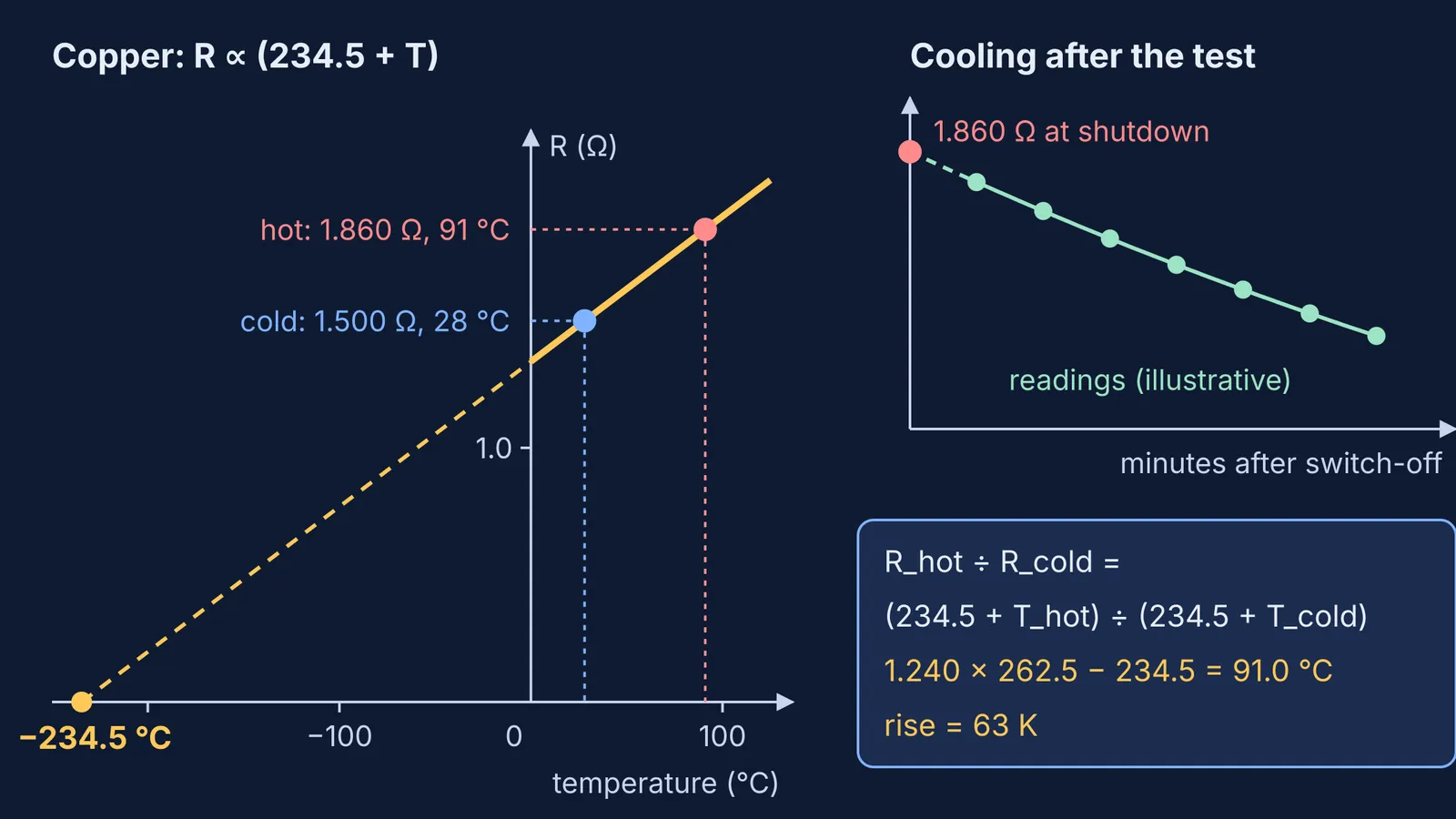
Here is what that means. Between about 0 °C and 100 °C, the resistance of copper against temperature is very close to a straight line. Extend that line backwards and it reaches zero resistance at −234.5 °C. So you can write:
R ∝ (234.5 + T), with T in °C.
Taking the ratio for two temperatures gives the working formula:
R_hot ÷ R_cold = (234.5 + T_hot) ÷ (234.5 + T_cold)
The −234.5 °C point is only the end of an extrapolated line. Copper does not lose its resistance there. NCERT also notes that copper's graph bends well away from a straight line far below 0 °C.
Why do books quote two different values of α for copper?
Because α depends on the reference temperature. Since R ∝ (234.5 + T), the fractional change per degree measured from a temperature T₀ is 1 ÷ (234.5 + T₀).
At 0 °C: 1 ÷ 234.5 = 0.00426 per °C.
At 20 °C: 1 ÷ 254.5 = 0.00393 per °C, the value in the NBS tables.
At 28 °C: 1 ÷ 262.5 = 0.00381 per °C.
The straight line is the same. Only the point you measure the fraction from moves. IEC 60034-1 rounds the constant to 235 for copper and uses 225 for aluminium, and defines it as the reciprocal of the temperature coefficient at 0 °C.
Worked example: how hot is the winding after the test?
Question. Before a load test, a motor's winding reads 1.500 Ω at 28 °C, the same as the room. Just after the test it reads 1.860 Ω. The room is still at 28 °C. Find the average winding temperature and its rise above the room. Take copper's constant as 234.5.
Resistance ratio. R_hot ÷ R_cold = 1.860 ÷ 1.500 = 1.240.
Cold value on the 234.5 scale. 234.5 + 28 = 262.5.
Hot value on the same scale. 1.240 × 262.5 = 325.5.
Hot temperature. T_hot = 325.5 − 234.5 = 91.0 °C.
Rise. 91.0 − 28 = 63.0 K.
Check with α at 28 °C. α₂₈ = 1 ÷ 262.5 = 0.00381 per °C. The fractional rise in resistance is 0.240, so ΔT = 0.240 ÷ 0.00381 = 63.0 K. Same answer.
With IEC's rounded 235 the result is 1.240 × 263 − 235 = 91.1 °C, a difference of only 0.1 K. For an aluminium winding with the same readings, the constant 225 gives 88.7 °C.
Is a 63 K rise acceptable for a motor?
Table 7 of IEC 60034-1 (2010) sets the limits. For an air-cooled AC winding of 200 kW or less, measured by the resistance method, the limit of temperature rise is 80 K for thermal class 130 (B) and 105 K for class 155 (F). Our 63 K is inside the class B limit, assuming this is such a motor.
Two cautions:
This is an average. The resistance method sees the whole length of copper. The hottest spot is hotter than the average. IEC 60034-1 assumes cooling air of at most 40 °C, so an 80 K rise means an average of up to 120 °C, below the 130 °C of class B; the hot spot sits somewhere in that gap.
The winding cools fast. IEC 60034-1 Table 5 allows 30 s after switch-off for machines up to 50 kW. If the reading is later, the standard asks for readings about a minute apart, plotted against time and extrapolated back to that interval. This is the cooling curve in the diagram.
Load tests and resistance measurements on motors are done by qualified test staff or a licensed electrician with the machine isolated. This post explains the physics only and gives no testing instructions.
How does this appear in a JEE problem?
JEE questions use the same algebra with different words. A typical version: "A copper coil has a resistance of 20.0 Ω at 20 °C. When a current flows, its resistance becomes 24.0 Ω. Find its temperature, given α = 0.00393 per °C at 20 °C." Here the reference matches α, so ΔT = (24.0 − 20.0) ÷ (20.0 × 0.00393) = 50.9 K, and T = 70.9 °C. The 234.5 route gives (24.0 ÷ 20.0) × 254.5 − 234.5 = 70.9 °C. The two agree because 1 ÷ 0.00393 is 254.5, which is 234.5 + 20.
When a question gives α at 0 °C but R at some other temperature, the ratio method saves you from the mismatch in the common mistake above. To work more problems like this with a step-by-step solver that explains the reasoning, try the Fermi Problem Library. If you are preparing for JEE, Fermi Test Prep offers personalised preparation for JEE Main & Advanced with an AI tutor, live classes, adaptive mocks, mentorship and a study plan that updates based on mastery.
Quick checklist
For copper, R ∝ (234.5 + T in °C); IEC 60034-1 rounds this to 235, and uses 225 for aluminium.
T_hot = (R_hot ÷ R_cold)(234.5 + T_cold) − 234.5.
α depends on the reference: 1/234.5 at 0 °C, 1/254.5 = 0.00393 at 20 °C.
1.500 Ω at 28 °C and 1.860 Ω hot give 91.0 °C, a 63 K rise.
The method gives the average winding temperature; the hot spot is higher.
Read quickly after switch-off, or extrapolate the cooling curve back.