

On this page
If you look up during the migration season, you will often see flocks of geese, pelicans or swans flying in a distinct V shape. They are not doing this to follow a leader or because of a rigid social hierarchy. They are doing it to save energy during journeys that can span thousands of kilometres.
By flying in a V formation, each bird strategically positions itself to ride the upward air currents created by the wings of the bird immediately in front of it. It is a brilliant, instinctual display of aerodynamics.
Why do birds fly in a V shape?
The secret lies in the fundamental way that wings generate lift. When a bird flies, its wings create a zone of high pressure underneath and a zone of low pressure above. This pressure difference is what pushes the bird upward against gravity.
However, air is a fluid, and it behaves dynamically. At the very tips of the wings, the high-pressure air from below constantly curls outward and upward, trying to escape into the low-pressure zone above. This constant spillage creates two continuous, spinning spirals of air trailing behind the bird, known as wingtip vortices.
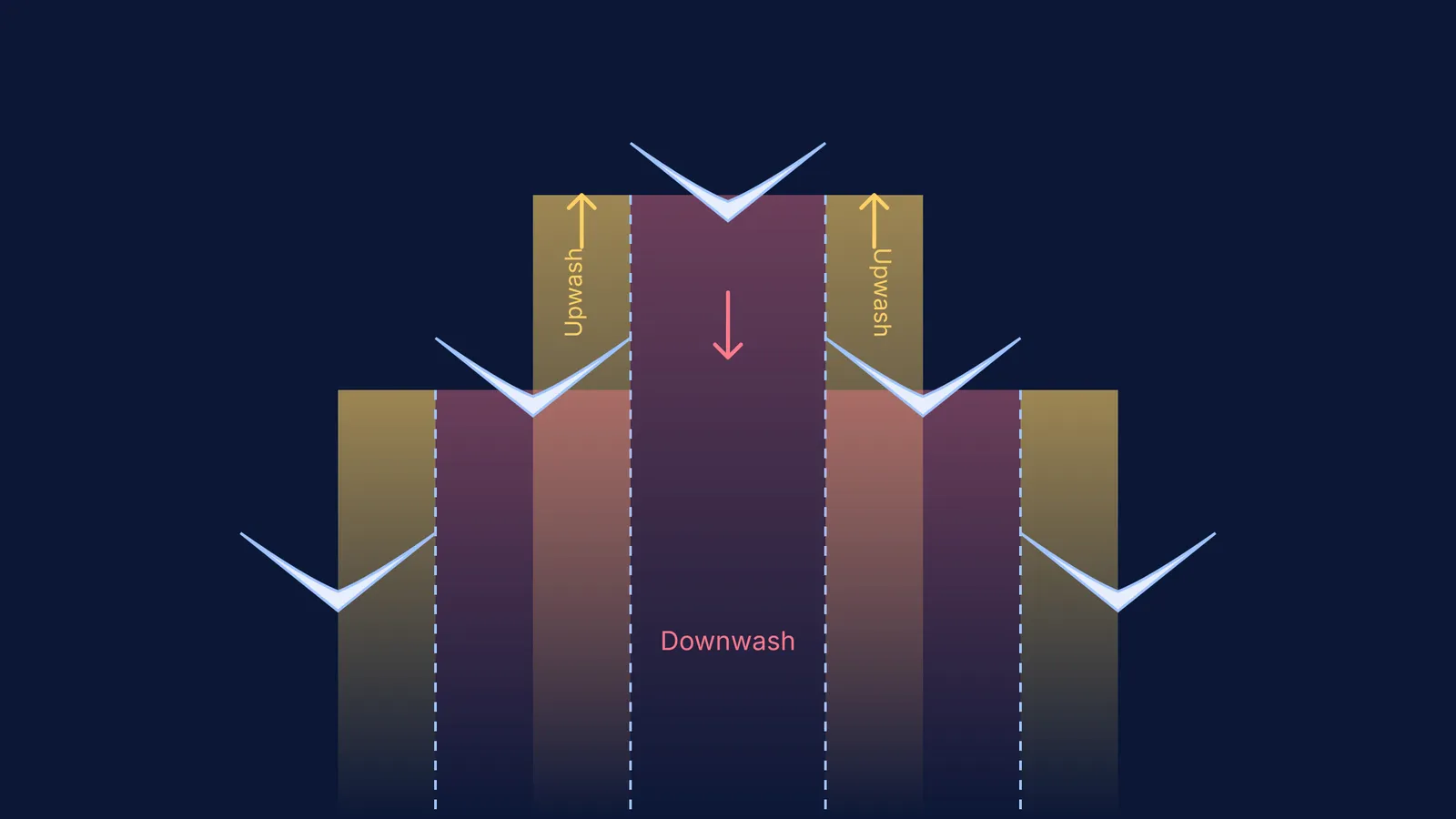
The air directly behind the bird, between these two vortices, is pushed downward to keep the bird aloft. This is the downwash. Flying in the downwash is exhausting because it constantly pushes a trailing bird toward the ground, acting like an aerodynamic treadmill.
But just outside the wingtips, the air from the vortex is moving rapidly upward. This is the upwash. By flying in a V shape, a trailing bird places its inner wing precisely in the upwash of the bird ahead, catching a free ride on the rising air and saving significant effort.
Understanding how vortices of air generate lift can be difficult to picture from a textbook diagram alone. The Fermi Simulation Lab provides interactive simulations for the ideas that are easier to see than to read, letting you watch fluid dynamics in action.
How much energy do they actually save?
For decades, the upwash advantage was a purely theoretical concept based on aircraft physics. The energy conservation in animals was finally proven in a landmark 2001 study published in *Nature* by Henri Weimerskirch and his colleagues.
The researchers trained Great White Pelicans to fly behind a boat and an ultralight aircraft. By attaching lightweight heart-rate monitors to the birds, they found that pelicans flying in a V formation had heart rates 11.4% to 14.5% lower than when they were flying solo.
Because of the free lift provided by the upwash, the birds in the formation did not have to flap as hard or as often, and they were able to spend much more time gliding. This perfectly illustrates the principle explored by Julius Robert Mayer, a ship's doctor and conservation of energy: the lead bird does the mechanical work to impart kinetic energy into the air, and the trailing bird extracts some of that energy to stay aloft without doing the metabolic work itself.
How do they time their flaps?
Sitting in the right spot is only half the battle. In 2014, a secondary study in *Nature* by Steven J. Portugal and his team revealed that birds actively adjust their flight mechanics in real-time to exploit the air flow.
By tracking fourteen Northern Bald Ibises with custom-built precision GPS and inertial measurement units, the team found that birds time their wingbeats perfectly with the bird ahead. When they are positioned in the sweet spot of the upwash, they flap entirely in sync (in-phase). This guarantees that their wings are moving downward at the exact moment the surrounding air is moving upward, maximizing lift.
If a bird gets blown off course and falls directly behind the leader into the sinking downwash, it instantly shifts to flapping out of sync (anti-phase) to minimize the drag. The ability to sense the wake and adapt to it instantly highlights how smooth air breaking into complex swirling structures affects motion—a classic example of the phenomena studied by Roddam Narasimha and turbulence in fluid flow.
A practical takeaway: The Drafting Method
You can apply the aerodynamic physics of the V formation directly to your own study habits. When tackling a difficult syllabus, studying alone is like flying solo—you take on the full aerodynamic drag of interpreting all the new material from scratch.
Instead, form a study group of three or four and rotate the "leader" position:
Assign topics: Each week, one person is responsible for reading a difficult chapter first, taking the hardest position at the front of the flock.
Draft the summary: The leader writes a one-page summary or teaches the core concepts, breaking the heavy resistance of the new information.
Ride the upwash: The rest of the group learns the material through the leader's simplified explanation, saving hours of initial frustration and confusion.
Rotate: Switch the leader for the next chapter so that no one burns out.
Just like migratory birds, you will cover far more ground when you learn to share the resistance.


