

On this page
A glider released from its tow looks as if it should simply fall. Instead it slides through the air on a shallow downhill slope, and if the pilot finds rising air it can climb higher than where it was let go. The trick fits into three Class 11 ideas: forces on an inclined path, energy, and relative motion.
What pushes a glider forward if it has no engine?
Gravity does. NASA's Beginner's Guide to Aeronautics lists just three forces on a descending glider: weight, lift and drag, with no thrust (NASA Glenn: forces on a glider).
The glider's path tilts slightly downward. Resolve its weight W along and across that path, the same way you resolve forces for a block on a ramp:
Along the path, the component W sin(a) pulls the glider forward and balances drag D.
Across the path, lift L balances the other component, W cos(a).
Divide the two and you get D/L = tan(a), where a is the glide angle.
So a glider is always descending relative to the air around it. Height is its fuel tank: it spends gravitational potential energy to pay for the work done against drag.
What is glide ratio, and how far can a glider go?
The lift-to-drag ratio, L/D, decides how flat that downhill slope is: the higher the L/D, the smaller the glide angle and the greater the distance a glider covers for a given loss of height (NASA Glenn: lift to drag ratio). In a steady, wings-level glide with no wind, the glide ratio equals the glider's L/D (Wikipedia: Glider (sailplane))).
A glide ratio of 30:1 means that in smooth air a glider travels 30 metres forward while losing 1 metre of height, according to the same article. The 1930s Grunau Baby managed 17:1, the modern ASG29 does better than 50:1, and the Eta exceeds 70:1. The rule of thumb: distance in still air = glide ratio x height.
How do gliders climb in thermals?
Gliders stay up because the air itself is often moving. Thermals are columns of rising air formed when sunlight warms the ground, and once a pilot finds one they fly in circles to stay inside it; climb rates of several metres per second are common (Wikipedia: Lift (soaring))). The same article describes ridge lift, where wind is pushed up the windward side of a slope, and wave lift, standing waves that form when strong wind blows over mountains.
This is relative motion. The glider still sinks through the air, but if the air rises faster than the glider sinks, the glider goes up relative to the ground. Glider pilots can stay airborne for hours by flying through air rising as fast as or faster than they descend, and, depending on climate and terrain, thermals can allow climbs of more than 3,000 metres over flat country (Wikipedia: Gliding). Wave lift goes further: the world distance record listed on the same page, 3,008 km by Klaus Ohlmann on 21 January 2003, was flown using mountain waves in South America.
A thermal is buoyancy at work: warm air rises for the same reason a hot-air balloon rises. The glider, far heavier than the air it displaces, simply rides along.
A worked example: plan a 100 km flight
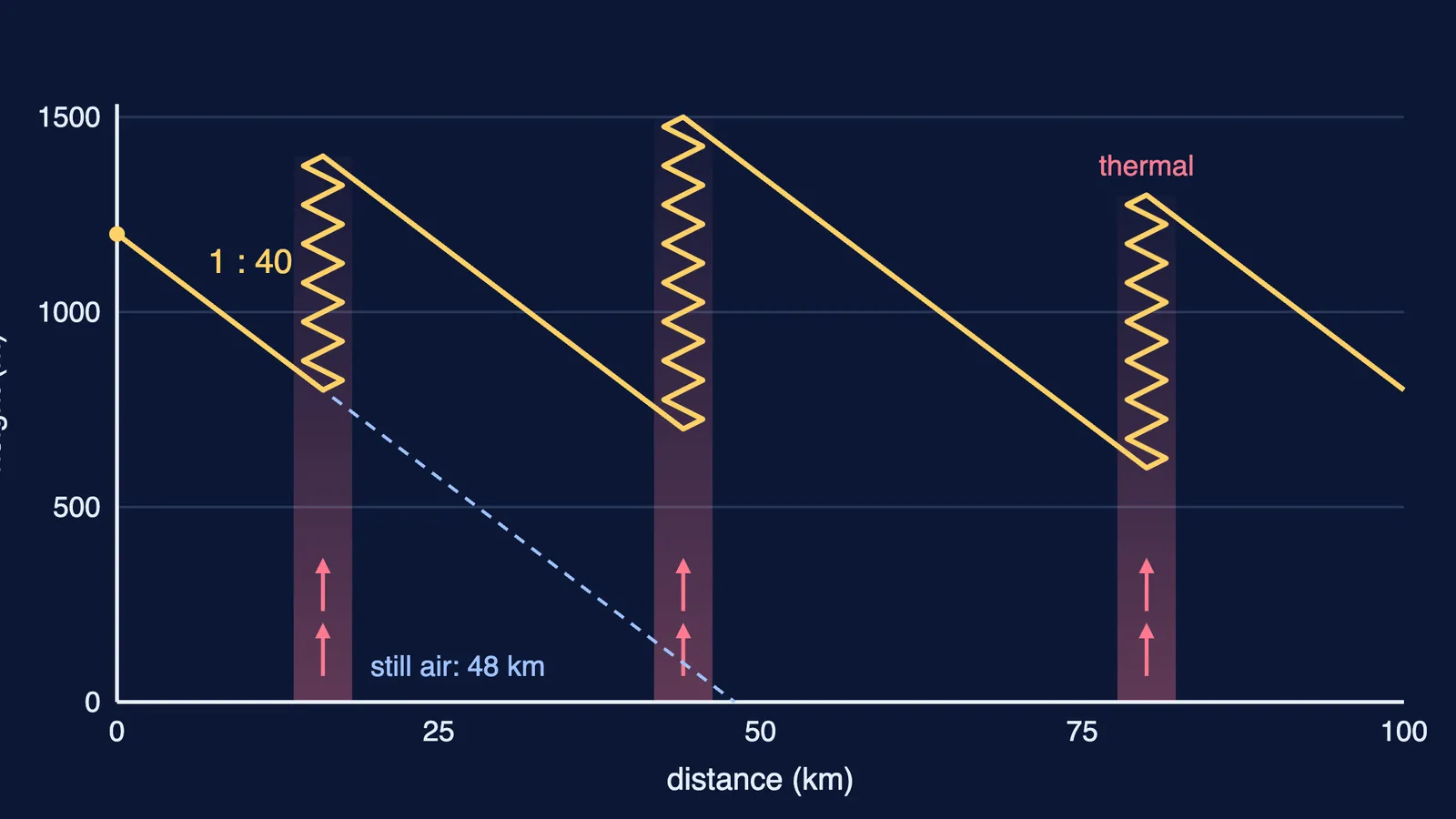
Take a 40:1 glider released at 1,200 m. The numbers use the formulas above and simplified thermals; the diagram at the top plots this flight.
Still air, no thermals: distance = 40 x 1,200 m = 48 km. Then it has to land.
Sink rate: if it holds 40:1 at 90 km/h (25 m/s), it sinks at about 25 / 40 = 0.6 m/s.
In a thermal rising at 2 m/s, the net climb is about 2 - 0.6 = 1.4 m/s (less in practice, since circling adds sink). Climbing 600 m takes 600 / 1.4, roughly 430 seconds, or about 7 minutes.
Each glide costs 1,000 / 40 = 25 m of height per kilometre. Gliding from 1,400 m down to 700 m buys 700 x 40 = 28 km.
In the diagram, three climbs (to 1,400 m, 1,500 m and 1,300 m) are enough to cover 100 km and still arrive 800 m up.
If resolving the components is where you get stuck, the picture is easier to see than to read, which is what our Fermi Simulation Lab is for. For another object riding the air, see why a cut kite floats down slowly.
What should you remember for exams?
No thrust: the weight component along the path balances drag.
Glide angle: tan(a) = D/L, so distance = (L/D) x height in still air.
Climbing is relative motion: the air must rise faster than the glider sinks.
Energy view: potential energy lost equals work done against drag in a steady glide.
To work through problems like these one step at a time, Fermi's AI tutor works out what you already know and builds a plan for the session around it.


