On this page
Picture a rocket in deep space, far from gravity and air, burning its fuel at a steady rate. Before you read on, make a prediction. Does it gain the same speed in every second of the burn, or does the gain change? Write your answer down, with a reason. Then test it by changing two numbers: exhaust speed and mass ratio.
Most people guess "evenly": the engine pushes just as hard all the way through. The catch is what that push is acting on.
Why does a rocket speed up faster as it burns fuel?
Thrust depends on how fast the exhaust leaves and how much mass leaves each second. In the OpenStax University Physics section on rocket propulsion, a worked example has a steady thrust of 5 × 10⁴ N, yet the acceleration climbs from 2.5 m/s² at the start to 2.9 m/s² at 15 s and 3.6 m/s² at 30 s.
The reason is a = F/m. The force stays the same, but every second the rocket is lighter, so the same push gives a bigger acceleration. As the textbook puts it, "even though the force on the rocket is constant, the resulting acceleration is not; it is continuously increasing."
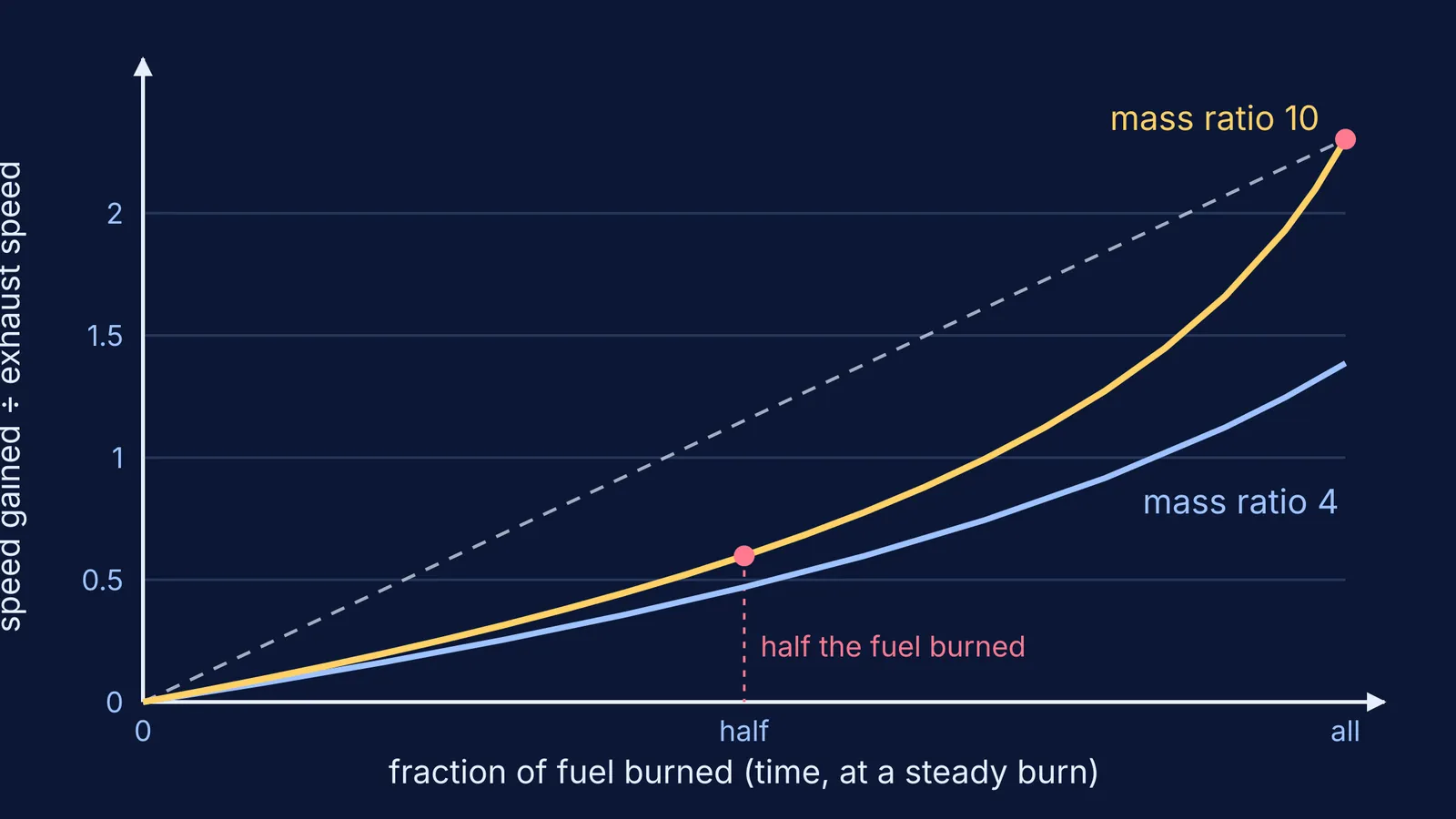
So the speed-time graph is not a straight line. It curves upward, getting steeper towards the end of the burn. If you want the thrust formula itself, our post on rocket thrust and the u dm/dt formula works through it.
How much speed does a rocket gain from its fuel?
The total comes from the ideal rocket equation. NASA Glenn's Beginner's Guide writes it as Δu = V_eq ln(MR).
Mass ratio (MR) is the rocket's full starting mass divided by its empty mass, as defined on that NASA page.
V_eq is the equivalent exhaust speed. NASA relates it to specific impulse by V_eq = Isp × g₀, with g₀ = 9.8 m/s² (NASA Glenn, specific impulse).
The equation leaves out drag and gravity. You add those afterwards.
The same NASA page gives a real-world anchor: for an ideal hydrogen-oxygen rocket with a specific impulse of about 350 seconds, reaching a low orbit takes a mass ratio of 10, which means 90% of the weight of a rocket going to orbit is propellant. For the history of the equation, read our piece on Konstantin Tsiolkovsky and the rocket equation.
Worked example: does the first half of the fuel do half the work?
Use NASA's numbers (ideal rocket equation page): Isp = 350 s and a mass ratio of 10. Take a 100-tonne rocket that is 10 tonnes empty, so it carries 90 tonnes of fuel.
Exhaust speed: V_eq = 350 × 9.8 = 3,430 m/s.
Whole burn: 3,430 × ln(100/10) = 3,430 × 2.303 ≈ 7,900 m/s.
First 45 tonnes of fuel: the mass falls from 100 to 55 tonnes, so the gain is 3,430 × ln(100/55) = 3,430 × 0.598 ≈ 2,050 m/s.
Last 45 tonnes: the mass falls from 55 to 10 tonnes, so the gain is 3,430 × ln(55/10) = 3,430 × 1.705 ≈ 5,850 m/s.
Same fuel, same engine, same burn time. The second half adds nearly three times as much speed, because it pushes a much lighter rocket.
What happens when you change exhaust speed or mass ratio?
Predict before each change, then check it against NASA's ideal rocket equation.
Double the exhaust speed. Prediction: the final speed doubles. It does, because Δu is directly proportional to V_eq.
Double the mass ratio from 5 to 10. Prediction: the final speed doubles? It does not. ln 5 ≈ 1.61 and ln 10 ≈ 2.30, so at 3,430 m/s the gain rises only from about 5,520 to 7,900 m/s.
Double it again, to 20. ln 20 ≈ 3.00, so the gain reaches about 10,280 m/s. Each doubling adds the same extra 0.69 × V_eq, about 2,380 m/s here.
Watch the curve's shape. A higher mass ratio makes the end of the curve bend upward more sharply, because the rocket ends up much lighter than it started.
The lesson: a faster exhaust pays off in full, while extra fuel gives less and less extra speed.
The same predict-then-test habit works in the Fermi Simulation Lab, which has interactive simulations for ideas that are easier to see than to read. The momentum idea underneath is the same one in our exploding-object momentum simulation.
What changes once gravity is included?
Near Earth, gravity takes a share for every second the engine burns. OpenStax writes the speed gained in a vertical launch as Δv = u ln(m₀/m) − gΔt, and notes that the longer the burn time is, the smaller the rocket's change of velocity will be.
If a step in the derivation still feels slippery, Fermi's AI tutor can run the simulation, draw the figure and check your understanding as it goes. Make your next prediction first, then test it.