

On this page
An explosion looks like chaos, but in a simulation you can pause it, read off every velocity and add them up. The total momentum comes out the same before and after. Below: a worked example, three predictions to make first, and why kinetic energy jumps when momentum does not.
Why is momentum conserved in an explosion?
The total momentum of a closed system stays constant, provided its mass is fixed and the net external force on it is zero, as OpenStax University Physics, section 9.3 states.
The forces that blow a shell apart are internal: each piece pushes its neighbour, which pushes back equally hard, so they add to zero. Internal forces cannot change the momentum of the centre of mass of the exploded shell, as OpenStax section 9.6 puts it. Gravity is external, but the burst is so brief that momentum just after is, to a very good approximation, the same as momentum just before.
Where does the centre of mass go after an explosion?
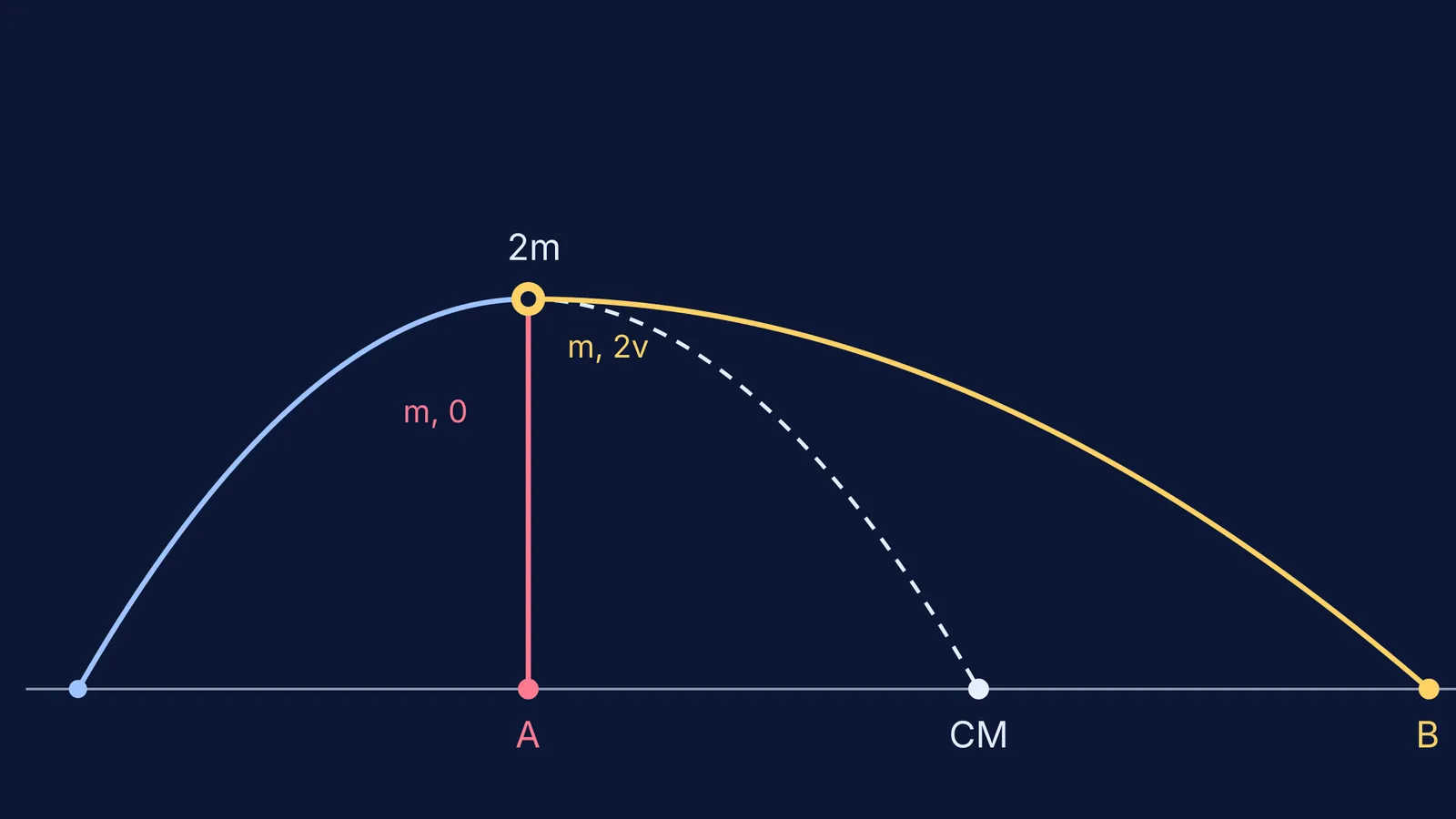
It keeps going. In the same section's fireworks example, once the burst is over the centre of mass is a projectile acted on only by gravity, so its path is a parabola. For a shell that was already flying freely, like the one below, that is the same parabola the unexploded shell would have followed.
A worked example to test in a simulation
Take g = 10 m/s² and a 2 kg shell launched at 20 m/s at 60°. Its velocity components are 10 m/s across and 17.3 m/s up, so it peaks after 1.73 s, 15 m up and 17.3 m along, and unexploded it would land at 34.6 m. Make it split at the top into two 1 kg pieces, with A left at rest.
Momentum just before: 2 kg × 10 m/s = 20 kg m/s, horizontal.
A carries none, so B must carry all of it: 1 kg × v = 20 kg m/s, so v = 20 m/s. B moves at twice the shell's speed.
Both fall 15 m from rest vertically, so both take 1.73 s to land. A drops straight down to 17.3 m. B lands at 17.3 + 20 × 1.73 = 52.0 m.
Centre of mass of the landing points: (1 × 17.3 + 1 × 52.0) ÷ 2 = 34.6 m. That is exactly where the whole shell would have landed.
Kinetic energy just before: ½ × 2 × 10² = 100 J. Just after: 0 + ½ × 1 × 20² = 200 J.
Momentum is unchanged, yet the pieces have 100 J more kinetic energy. For unequal fragments, see a shell exploding midair: momentum, fragments and energy.
Where does the extra kinetic energy come from?
From stored energy. An explosion leaves the system with much more kinetic energy than it had before, because some form of potential energy, such as the chemical energy in gunpowder or the elastic energy in a drawn bowstring, is converted into kinetic energy, as OpenStax section 9.4 explains. Think of it as a sticking collision run backwards: two lumps sticking together lose kinetic energy, one lump flying apart gains it. So "momentum is conserved, so energy must be too" is a trap.
How do fragment speeds compare?
In the frame moving with the centre of mass, total momentum is zero, so two pieces fly apart with equal and opposite momentum: m₁v₁ = m₂v₂. The lighter piece is faster in exact inverse proportion to its mass: a 1 kg and a 3 kg piece move at speeds in the ratio 3 : 1.
Kinetic energy is p²/2m, and both pieces have the same p, so the lighter piece also gets the larger share of the energy, again 3 : 1.
Three predictions to make before you press play
In a study of lecture demonstrations, Crouch, Fagen, Callan and Mazur (American Journal of Physics, 2004) found that students who only watched a demonstration understood the idea no better than students who never saw it, while students who predicted the outcome first understood it significantly better.
So before you run any explosion simulation, write down:
The centre of mass: where it will land, and whether that changes if you make the explosion stronger.
The speeds: which fragment will be faster, and by what ratio.
The energy: whether total kinetic energy will go up, down or stay the same, and by how much.
Then run it and explain any mismatch in one sentence. Change the mass split, the push direction and the moment of the burst: as long as every piece is still in the air, the centre-of-mass landing point should not move.
The Fermi Simulation Lab has interactive simulations for ideas that are easier to see than to read, and the same predict-then-check habit works there. To build your own, write a projectile simulation in Python and add a split at the top. For more practice, try these centre of mass problems. If your numbers keep coming out wrong, the Fermi Problem Library has a step-by-step solver that explains the reasoning rather than printing an answer.


