

On this page
When you board a commercial flight, the aircraft climbs steadily past the clouds, levelling off around standard cruising altitudes near 35,000 feet (about 10,668 metres), as documented in the FAA Pilot's Handbook of Aeronautical Knowledge. This cruising altitude feels routine, yet it is dictated by fluid mechanics, thermodynamics, and atmospheric structure.
How does air density change with altitude?
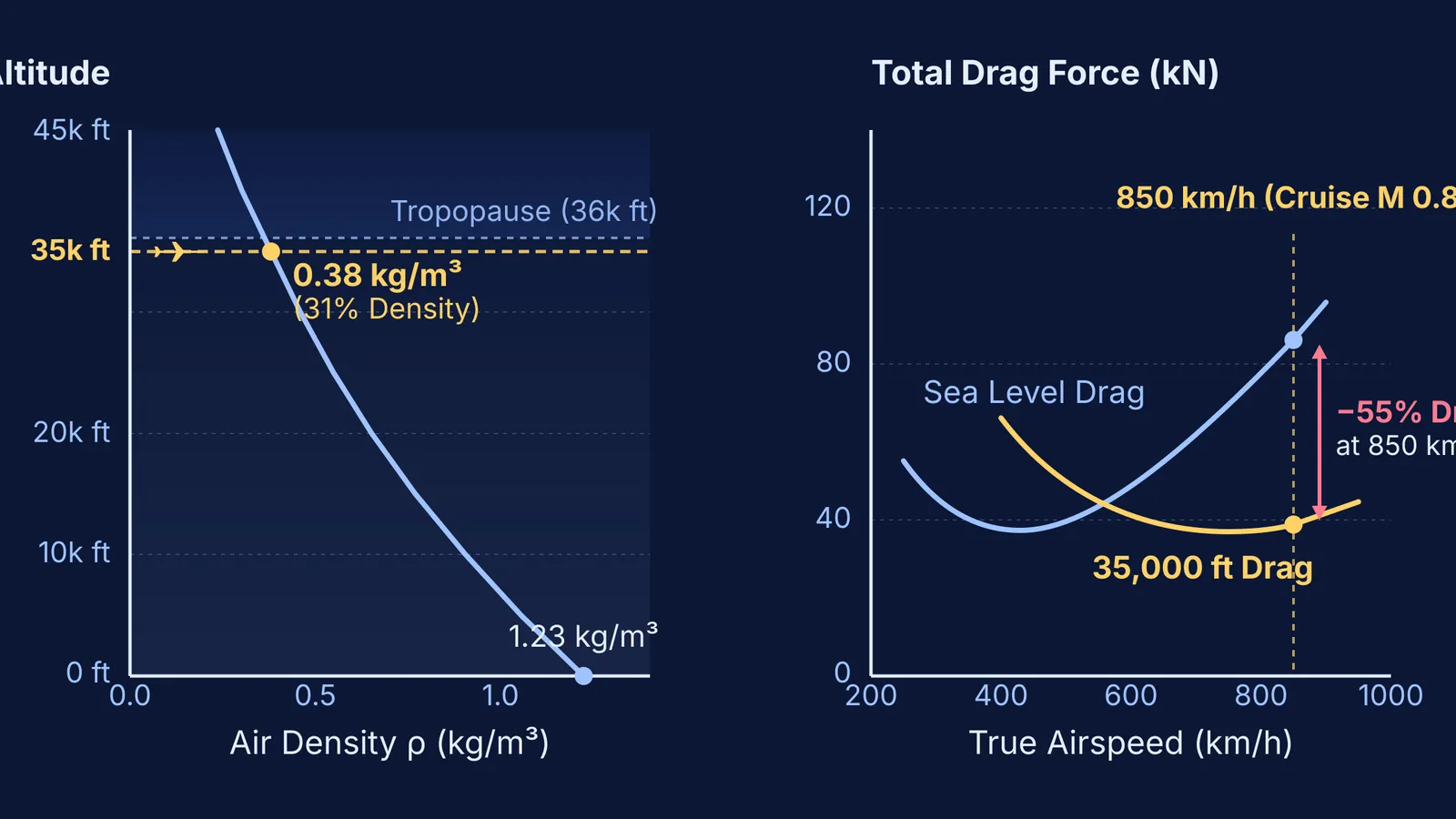
Earth's atmospheric blanket thins rapidly as you rise above sea level. According to the U.S. Standard Atmosphere, 1976, standard sea-level air density is 1.225 kg/m³ at 15 °C. By the time an airliner reaches 35,000 feet, the ambient air density drops to approximately 0.380 kg/m³, which is 31% of the sea-level value.
Atmospheric pressure falls along a similar curve. At sea level, standard air pressure stands at 1,013.25 hPa, but at 35,000 feet it drops to roughly 238 hPa, as recorded in the U.S. Standard Atmosphere, 1976. Understanding why atmospheric pressure decreases with height starts with the barometric equation, which shows how overhead air column weight decreases exponentially. Testing this relationship in an air pressure altitude simulation makes the non-linear drop visible. The FAA Pilot's Handbook of Aeronautical Knowledge also notes a standard tropospheric temperature lapse rate of roughly 2 °C per 1,000 feet, leaving outside air at a freezing -54.3 °C at 35,000 feet.
Why does thinner air reduce fuel burn and drag?
An aircraft in steady level flight encounters two forms of aerodynamic resistance: parasite drag and lift-induced drag. Parasite drag arises from skin friction and air displacement around the airframe. The NASA Glenn Research Center drag equation defines this force as D = Cd × (1/2)ρv² × A, where Cd is the drag coefficient, ρ is air density, v is true airspeed, and A is wing area.
Because parasite drag is directly proportional to air density ρ, cutting density by 69% dramatically reduces aerodynamic friction. To generate enough lift to support the aircraft's weight (L = CL × (1/2)ρv² × A), lower density requires flying faster. An airliner that faces a given drag at 470 km/h near sea level can cruise at 850 km/h (roughly Mach 0.80) at 35,000 feet under the identical dynamic pressure. The speed of sound falls to roughly 1,067 km/h in cold high-altitude air, as documented in NASA Glenn's Mach number guide. This high speed lets airliners cover distance in nearly half the time without burning extra fuel per kilometre. Exploring how aerodynamic drag alters trajectories demonstrates this direct dependence on fluid density.
Cold air also benefits the jet engines. High-bypass turbofan engines operate on the Brayton thermodynamic cycle. The large temperature gap between the -54.3 °C outside air (recorded in the U.S. Standard Atmosphere, 1976) and the combustion chamber boosts thermal efficiency, extracting more work from each kilogram of fuel.
Why is cruising above the troposphere safer and smoother?
Weather and flight safety provide another compelling reason to fly high. The troposphere contains roughly 75% of atmospheric mass and almost all water vapour, according to the U.S. Standard Atmosphere, 1976.
Because the troposphere is heated from the ground, it drives convective updrafts, cloud systems, and rainstorms. Cruising at 35,000 feet places aircraft near the tropopause—the calm boundary between the troposphere and stratosphere. Flying in this zone offers distinct operational benefits:
It keeps the plane above convective thunderstorms and heavy monsoon cloud decks, avoiding vertical turbulence.
It provides smooth horizontal air streams, minimizing structural airframe fatigue.
It extends gliding range. Under aerodynamic glide principles in the FAA Pilot's Handbook of Aeronautical Knowledge, an airliner gliding from 35,000 feet has approximately 20 to 30 minutes of glide time and over 150 km of distance to reach an alternate runway during an emergency.
Why do airplanes not fly even higher?
If thinner air reduces drag, why not cruise at 55,000 feet? The operational barrier is known in aviation as the "coffin corner", detailed in the FAA Pilot's Handbook of Aeronautical Knowledge.
As an airplane climbs into thinner air, two physical speed limits converge:
Low-speed stall: Because thinner air generates less lift, the minimum speed needed to avoid stalling increases.
High-speed buffeting: As flight speed approaches the speed of sound, shockwaves trigger boundary-layer separation and loss of control. Cold air drops the speed of sound to roughly 1,067 km/h, as shown by NASA Glenn.
Above 42,000 feet, the margin between stall speed and critical Mach narrows to a few knots. Thinner air also deprives engines of oxygen, while cabin pressurisation stresses the fuselage. Cruising between 33,000 and 38,000 feet hits the practical sweet spot.
How can you calculate the cruise advantage yourself?
You can calculate parasite drag reduction using the NASA Glenn drag equation. Consider a twin-engine jet with a wing area of 120 m² and a zero-lift drag coefficient Cd0 of 0.02, flying at 236 m/s (roughly 850 km/h).
Applying the drag equation:
At sea level (ρ = 1.225 kg/m³): D = 0.02 × 0.5 × 1.225 kg/m³ × (236 m/s)² × 120 m² ≈ 81,900 N (81.9 kN).
At 35,000 feet (ρ = 0.380 kg/m³): D = 0.02 × 0.5 × 0.380 kg/m³ × (236 m/s)² × 120 m² ≈ 25,400 N (25.4 kN).
Parasite drag drops by 56.5 kN, allowing engines to burn far less fuel. For students visualising aerodynamic lift and drag curves across altitudes, the Fermi Simulation Lab provides interactive simulations for ideas that are easier to see than to read. To practice fluid mechanics numericals, the Fermi Problem Library offers worked problems with a step-by-step solver that explains the reasoning rather than printing an answer. If you want to review atmospheric pressure laws, the Fermi Concept Library maps every concept in physics with its own lesson and place in the map.


