On this page
If a salt-analysis question asks you to confirm the ammonium ion, the test has two parts. First, warm the salt with sodium hydroxide so it gives off ammonia. Then show the gas is there in two ways: white fumes at a rod dipped in hydrochloric acid, and a brown colour or precipitate with Nessler's reagent. Here is the procedure, the chemistry behind each observation, and how to write it up.
How do you test for ammonium ion in salt analysis?
The NCERT Class 12 chemistry lab manual treats ammonium as the “zero group” cation, tested before any group reagent is added (NCERT Laboratory Manual Chemistry, Unit 7). The steps:
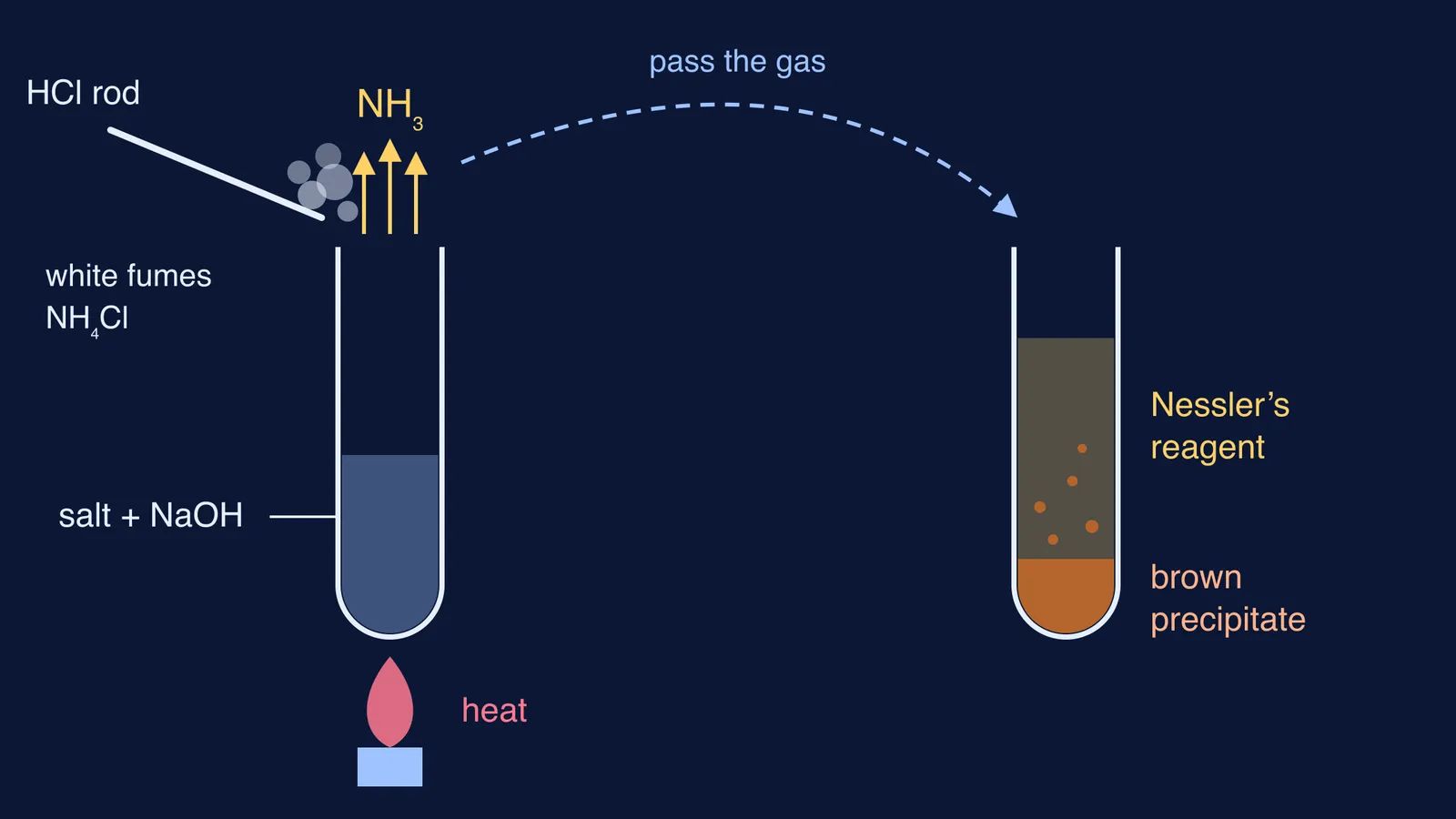
Take 0.1 g of the salt in a test tube and add 1-2 mL of sodium hydroxide solution.
Heat the tube. A smell of ammonia suggests ammonium ions are present.
Bring a glass rod dipped in hydrochloric acid near the mouth of the tube. White fumes appear.
Pass the gas through Nessler's reagent. A brown precipitate forms.
The smell is only a hint. Steps 3 and 4 are your evidence: they are two independent checks for the same gas, ammonia.
Why does warming with NaOH release ammonia?
Hydroxide ions pull a proton off the ammonium ion: NH₄⁺ + OH⁻ → NH₃ + H₂O. For ammonium sulphate the manual writes (NH₄)₂SO₄ + 2NaOH → Na₂SO₄ + 2NH₃ + 2H₂O (NCERT lab manual). Ammonia dissolves readily in water, so in a cold tube much of it stays in solution. Warming drives the gas out to where your nose, the rod and the reagent can detect it.
The white fumes are a new solid forming in mid-air. The manual gives NH₃ + HCl → NH₄Cl: ammonia meets hydrogen chloride from the rod and makes fine particles of ammonium chloride, seen as dense white fumes (NCERT lab manual).
What does Nessler's reagent do with ammonia?
Nessler's reagent is an alkaline solution of potassium tetraiodomercurate(II), K₂[HgI₄], named after the chemist Julius Nessler (Wikipedia: potassium tetraiodomercurate(II))). The standard mix is 0.09 mol/L K₂[HgI₄] in 2.5 mol/L potassium hydroxide (Wikipedia)).
According to the NCERT manual, ammonia passed through Nessler's reagent gives a brown colour or a precipitate of basic mercury(II) amido-iodide (NCERT lab manual):
2K₂HgI₄ + NH₃ + 3KOH → HgO·Hg(NH₂)I + 7KI + 2H₂O
Check the balance yourself: 7 potassium, 2 mercury and 8 iodine atoms on each side. What you see depends on how much ammonia there is. At low concentrations the pale reagent only turns a deeper yellow, while higher concentrations can give the brown precipitate (Wikipedia)). That source also notes the exact formula of the brown solid is not fully settled, so in school practical answers use the NCERT formula.
Why test for ammonium before group analysis?
Look at the NCERT flow chart for groups I-VI. Group III is precipitated after adding solid NH₄Cl and NH₄OH, and group V after adding NH₄OH and solid (NH₄)₂CO₃ (NCERT lab manual). Once you add those reagents, the solution contains ammonium ions you put there. The ammonium test only means something on the original salt, which is why it gets its own zero group. For the full order of tests, see our guide to a systematic approach to salt analysis in the chemistry practical and how to prepare the original solution for salt analysis.
How should you write the ammonium test in your practical file?
Use the usual experiment, observation and inference format. This version follows the NCERT wording:
Salt + NaOH solution, heated: smell of ammonia, so NH₄⁺ may be present.
Glass rod dipped in HCl held near the mouth of the tube: dense white fumes, so NH₃ is evolved.
Gas passed through Nessler's reagent: brown precipitate, so NH₄⁺ is confirmed.
Result: the cation is NH₄⁺. Add the equations NH₃ + HCl → NH₄Cl and the Nessler's equation above.
In the viva, if the examiner asks why you heated the tube, say: “Ammonia is very soluble in water, so warming drives it out of the solution where the HCl rod and Nessler's reagent can detect it.” If they ask why this test comes first, point to the ammonium salts added in groups III and V.
Exam questions often run the test backwards: a salt gives a gas with NaOH that turns Nessler's reagent brown, so name the cation. If you know the forward test cold, the reverse puzzle is easy. For practice, the Fermi Problem Library has worked problems with a step-by-step solver that explains the reasoning rather than printing an answer. And if you want the other side of this chemistry, read why quicklime is the drying agent in the lab preparation of ammonia.