

On this page
Every practical chemistry exam involves a mixture or a single unknown salt. You cannot perform most tests on a dry powder. The "wet tests" require the salt to be broken into free-moving ions in a liquid medium. The original solution (O.S.) is this starting liquid, prepared without adding reagents that would interfere with later tests. According to standard procedures outlined in qualitative inorganic analysis, cation separation relies heavily on the sequence of these initial reagents.
How to prepare original solution for salt analysis?
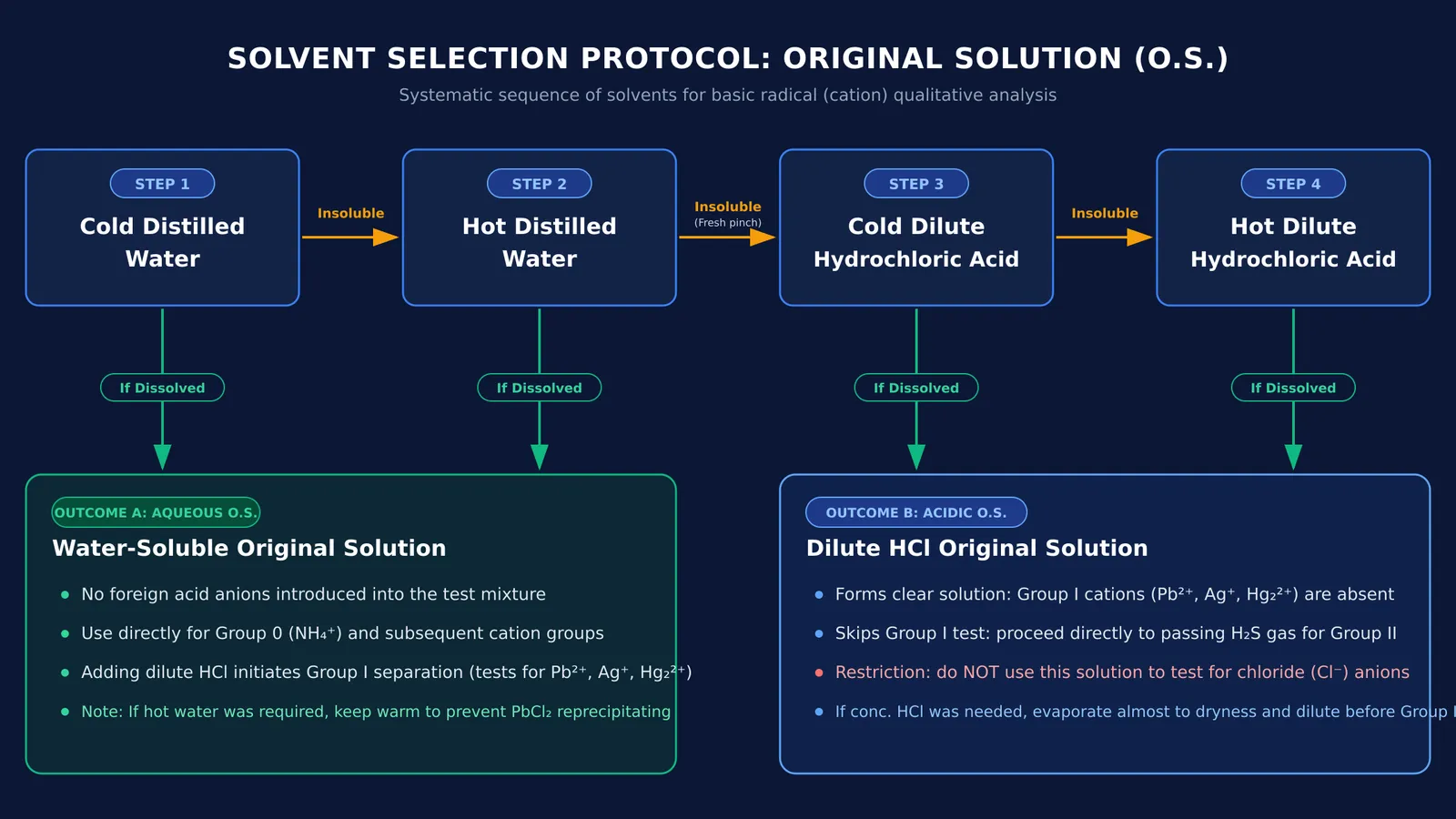
You do not simply pick a solvent at random. You must follow a strict sequence, testing a small pinch of the salt each time, moving to the next only if the salt remains insoluble.
Cold distilled water: Try this first. Shake the test tube well.
Hot distilled water: If insoluble in cold water, heat the mixture.
Cold dilute HCl: If water fails, take a fresh pinch of the salt and add dilute hydrochloric acid.
Hot dilute HCl: Heat the test tube if it does not dissolve in cold acid.
Concentrated HCl: If dilute acid fails, try concentrated HCl (first cold, then hot).
When testing these, never add the next solvent into the same test tube if a reaction has already occurred. For example, if your salt did not dissolve in hot water, discard it. Take a fresh pinch of the salt in a clean boiling tube before adding cold dilute HCl. This ensures that the water does not dilute the acid and alter the solubility dynamics.
What if the salt dissolves in dilute HCl?
Here is a major time-saver for your practicals. Dilute HCl is the designated group reagent for Group I cations, such as Lead (Pb²⁺). If a salt contains Pb²⁺, adding dilute HCl will immediately form a white precipitate of lead chloride (PbCl₂), which is insoluble in cold water. (As a quick check, PbCl₂ is unusual because it is soluble in hot water, so you can heat the precipitate to confirm its identity).
Therefore, if you add dilute HCl to your salt and it dissolves completely to form a clear solution, you have proved that Group I cations are absent. You have prepared your original solution and completed your first group test simultaneously. You can proceed directly to passing H₂S gas for Group II.
Why do we avoid nitric and sulfuric acids?
You might wonder why analytical schemes use concentrated hydrochloric acid rather than sulfuric or nitric acid when water fails. Both acids disrupt subsequent analytical groups.
Sulfuric acid (H₂SO₄) is avoided because it forms insoluble sulfates with Group V cations (Ba²⁺, Sr²⁺, Ca²⁺) and Lead (Pb²⁺). If you use sulfuric acid to prepare the original solution, these cations precipitate prematurely, ruining your systematic group separation.
Nitric acid (HNO₃) is avoided because it is a strong oxidizing agent. When you proceed to Group II and pass H₂S gas, the nitric acid oxidizes hydrogen sulfide into elemental colloidal sulfur. This creates a pale yellow turbidity that mimics an actual Group II metal sulfide precipitate.
How does the solvent affect later group tests?
The solvent you choose sets the stage for everything that follows. If your salt only dissolves in concentrated HCl, you have a highly acidic solution. Before testing for Group II (which requires passing H₂S gas), you must evaporate the solution almost to dryness and dilute it with water.
Why? In Group II, the precipitation of sulfides like copper sulfide (CuS) or arsenic sulfide (As₂S₃) requires a very specific, low concentration of sulfide ions (S²⁻). If the acidity is too high, the massive excess of H⁺ ions forces the H₂S equilibrium backwards due to the common ion effect. This starves the solution of the sulfide ions needed to form a precipitate. Evaporating the concentrated acid and replacing it with water restores the delicate balance required for the Group II tests.
For concepts that are easier to picture visually, the Fermi Simulation Lab provides interactive simulations for ideas that are easier to see than to read. To build a stronger theoretical foundation across ionic equilibria and precipitation rules, the Fermi Concept Library covers every concept in chemistry with its own lesson and its place in the map.
Once you understand why the sequence exists, qualitative analysis becomes less about memorizing rules and more about applying logical steps. For more on systematic chemical tests and precipitation principles, explore our guides on salt analysis in the chemistry practical, solubility product, common ion effect and precipitation, and counting ionisable chlorides in complexes.


