

On this page
Ammonia (NH₃) is a basic gas with a pungent smell, and its laboratory preparation is a classic test of chemical principles. Preparing the gas requires heating a mixture of an ammonium salt and an alkali. But drying and collecting it forces you to account for its chemical nature, its solubility and its density compared to air.
Here is how the laboratory setup works, why quicklime is the only suitable drying agent, and why the gas must be collected in an inverted jar.
How is ammonia prepared in the lab?
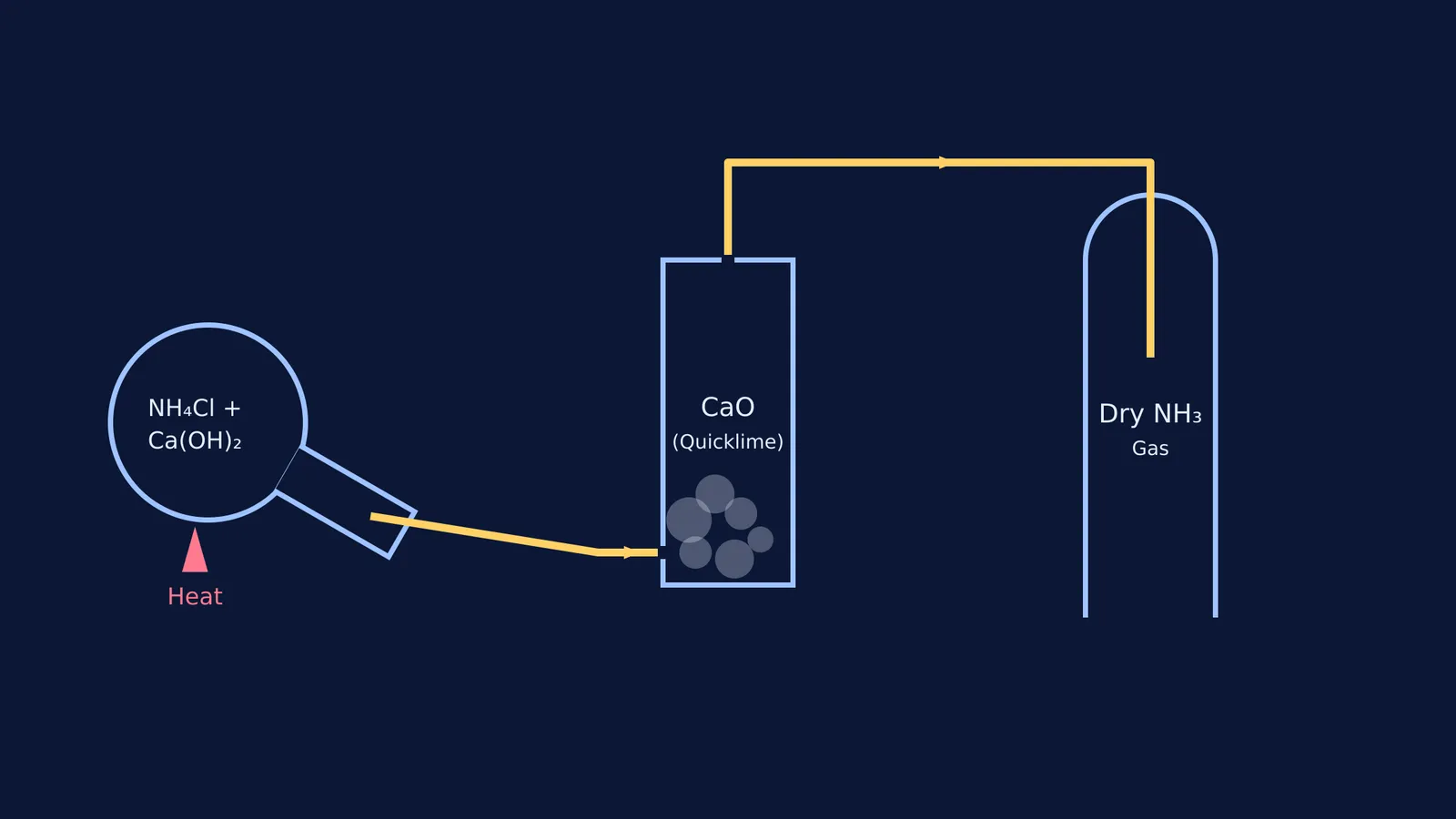
In the lab, ammonia is most commonly prepared by heating a mixture of dry ammonium chloride (NH₄Cl) and slaked lime, which is calcium hydroxide, Ca(OH)₂. The two solids are typically mixed in a round-bottom flask.
The reaction is a double displacement followed by decomposition: 2NH₄Cl(s) + Ca(OH)₂(s) → CaCl₂(s) + 2H₂O(l) + 2NH₃(g)
To drive the reaction, a Bunsen burner is used to heat the solid mixture gently. It is important to note that not all ammonium salts are safe to use for this purpose. For instance, you should never use ammonium nitrate (NH₄NO₃). When ammonium nitrate is heated, it undergoes a dangerous decomposition reaction that can lead to an explosion. Ammonium chloride is chosen because it is inexpensive and reacts smoothly with slaked lime to give a steady, controllable yield of the gas.
It is common practice to use an excess of slaked lime. Because ammonium chloride can sublime when heated, meaning it turns directly from a solid into a gas, having extra calcium hydroxide ensures that all the ammonium chloride reacts before it has a chance to escape as a vapour and condense on the cooler parts of the flask.
The flask is tilted slightly downwards. This ensures that the water formed during the reaction does not trickle back down into the hot part of the glass flask, which could shatter it.
If you are working through reaction mechanisms or need to review the properties of these products, the Fermi Concept Library breaks down exactly how displacement reactions unfold.
Why is quicklime used as a drying agent?
The ammonia gas produced in the flask carries water vapour with it. To obtain dry ammonia, the gas must be passed through a drying tower. The drying agent used here is quicklime, or calcium oxide (CaO).
Quicklime is chosen because it is basic. It readily absorbs the moisture to form solid calcium hydroxide, but it does not undergo any chemical reaction with the basic ammonia gas.
This is a favourite question in board exams and competitive tests: why can't we use standard drying agents? The reason is that ammonia reacts with almost all of them:
Concentrated sulphuric acid (H₂SO₄): This is a strong acid (the same acid produced industrially by the contact process). It immediately reacts with the basic ammonia to form a salt, ammonium sulphate: 2NH₃ + H₂SO₄ → (NH₄)₂SO₄.
Phosphorus pentoxide (P₂O₅): This is an acidic oxide. It reacts with ammonia and water to form ammonium phosphate: 6NH₃ + P₂O₅ + 3H₂O → 2(NH₄)₃PO₄.
Anhydrous calcium chloride (CaCl₂): Although it is not acidic, calcium chloride reacts with ammonia to form a solid addition complex: CaCl₂ + 8NH₃ → CaCl₂·8NH₃.
Because of these side reactions, quicklime is the only practical choice for drying the gas.
Why collect it by downward displacement of air?
Once the ammonia is dry, it is collected in an inverted gas jar. The gas is lighter than air, so as it fills the jar from the top, it pushes the heavier air out through the bottom. This method is called collection by the downward displacement of air (or upward delivery).
We collect it this way for two physical reasons:
It is lighter than air: According to PubChem, the molar mass of ammonia (NH₃) is 17 g/mol. Air is a mixture of nitrogen, oxygen and other gases, and its average molar mass is about 29 g/mol (Engineering ToolBox). Because ammonia is significantly lighter, it naturally rises.
It is highly soluble in water: We cannot collect ammonia over water (as we do with oxygen or hydrogen) because it is exceptionally soluble. Attempting to collect it over water would simply leave you with a solution of ammonium hydroxide (NH₄OH).
How do you test for the presence of ammonia?
Since ammonia is a colourless gas, you cannot tell simply by looking at the gas jar whether it is full. While the pungent smell is a strong indicator, a chemical test is required to safely confirm that the jar is completely filled with the dry gas.
To check if the jar is full, a glass rod is dipped into concentrated hydrochloric acid (HCl) and brought near the mouth of the inverted gas jar. The concentrated acid releases hydrogen chloride gas into the air. When the invisible hydrogen chloride gas meets the escaping ammonia gas, the two react immediately.
The reaction is a straightforward combination: NH₃(g) + HCl(g) → NH₄Cl(s)
This produces fine, solid particles of ammonium chloride suspended in the air, which appear as thick, dense white fumes. The moment you see these dense white fumes spilling from the mouth of the gas jar, you know that the jar has overflowed with ammonia and is now completely full.


