On this page
NCERT teaches two reactions as isolated facts: phenol heated with zinc dust gives benzene, and a sulphonic acid fused with alkali gives a phenol. In 1868 and 1869 these two moves, run in opposite directions, were the tools of the first synthesis of a natural dye: alizarin, the red of the madder root. The chemist at the centre was Carl Graebe.
Who was Carl Graebe?
The facts below come from Graebe's entry in the Neue Deutsche Biographie (NDB vol. 6, 1964, by Berend Strahlmann). The translations from German are ours.
Born 24 February 1841 in Frankfurt am Main; died there on 19 January 1927.
After a false start in mechanical engineering, he studied chemistry with Robert Bunsen in Heidelberg (doctorate 1862) and briefly with Hermann Kolbe.
In 1864 he joined the new dye works of Meister, Lucius & Co. at Höchst. The NDB says "aniline and iodine vapours soon damaged his health", and he left.
In 1865 he went to Adolf von Baeyer in Berlin, who soon made him his assistant. You can read about Baeyer in Adolf von Baeyer, synthetic indigo and the strain in small rings.
Later posts: Leipzig, Königsberg, Zürich and, from 1878, Geneva.
How did zinc dust turn alizarin into anthracene?
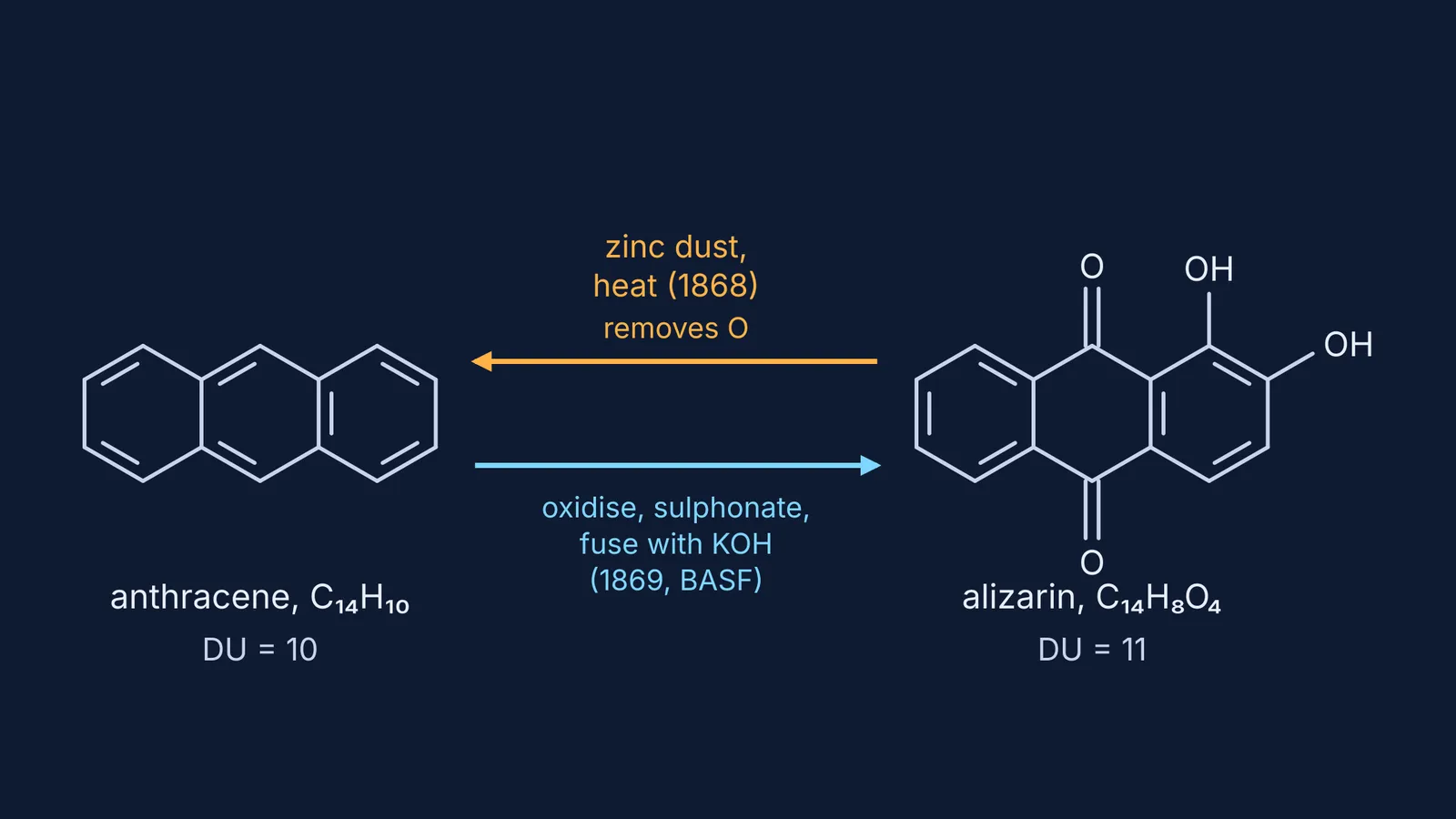
The NDB says Graebe's greatest success came in 1868, when he applied Baeyer's newly found method, zinc-dust distillation, to alizarin, and so found its parent substance, anthracene.
Hot zinc dust strips oxygen off an aromatic compound as zinc oxide and leaves the parent hydrocarbon with its carbon skeleton intact, exactly as in phenol → benzene. For a refresher, see preparation of benzene from sodium benzoate and phenol.
Once you know the skeleton is anthracene, three fused benzene rings, the only question left is where the oxygens sit. The Chemical Society's anniversary report of 30 March 1869 (Journal of the Chemical Society, vol. 22) says Graebe's "most exhaustive investigation of the quinone group" led him "to consider alizarin to be dioxyanthraquinone". Today we write alizarin as 1,2-dihydroxyanthraquinone. The 1869 report does not give the positions of the two OH groups; the 1,2 numbering is the modern structure.
How did Graebe and Liebermann make alizarin from anthracene?
Graebe teamed up with Carl Liebermann. According to the NDB, "within a few weeks they synthesised alizarin, the most important dye of the madder root, and with it, for the first time, a natural dye". Their route used bromination. In 1869 they assigned their patents to BASF (the Badische Anilin- und Sodafabrik) and continued the work there, where Heinrich Caro found the cheaper sulphonation route.
The 1869 anniversary report cited the synthesis as "one of the most remarkable achievements" in synthesis. It also saw the industrial point: anthracene is a constituent of coal tar, so the discovery would add "the most important of the colour-giving principles of madder" to the coal-tar colours. The coal-tar dye industry had begun with William Perkin and mauve.
What does the 1872 paper say about the sulphonation route?
Graebe and Liebermann's paper "Derivatives of Anthracene" (Annalen 160, 121–145) was abstracted in English in the Journal of the Chemical Society, vol. 25 (1872), pp. 139–141. We give its observations as history, not as a procedure.
Sulphonation. Anthraquinone heated with sulphuric acid to 250–260 °C gave anthraquinone-monosulphonic acid, C₁₄H₇(O₂)SO₃H. More acid and a higher temperature gave the disulphonic acid.
Alkali fusion. Heating the potassium salt with caustic potash, the mass "assumes gradually a violet colour, and if the heat has been sufficiently high, it contains alizarin".
A coloured intermediate. With the disulphonic acid, the red mixture first turned "dark blue", the salt of an oxyanthraquinone-sulphonic acid. Longer heating turned it purple as alizarin formed.
Impurities. Crude alizarin "always contains some oxyanthraquinone and other colouring matters".
Soda-lime. Anthracene-carboxylic acid decomposes into carbon dioxide and anthracene on heating; "on heating it with soda-lime this decomposition is complete".
Worked example: follow the atoms from alizarin to anthracene and back
Use C = 12.011, H = 1.008, O = 15.999, Zn = 65.38.
Step 1: molar masses. Alizarin C₁₄H₈O₄ = 240.21 g/mol. Anthracene C₁₄H₁₀ = 178.23 g/mol. Anthraquinone C₁₄H₈O₂ = 208.22 g/mol.
Step 2: percentage composition of alizarin. C = 168.15 ÷ 240.21 = 70.00 %. H = 8.064 ÷ 240.21 = 3.36 %. O = 26.64 %.
Step 3: degree of unsaturation. DU = (2C + 2 − H) ÷ 2.
Alizarin: (28 + 2 − 8) ÷ 2 = 11. That is 3 rings + 6 C=C (two benzene rings) + 2 C=O.
Anthracene: (28 + 2 − 10) ÷ 2 = 10. That is 3 rings + 7 C=C.
Step 4: the zinc-dust step as bookkeeping. Going from C₁₄H₈O₄ to C₁₄H₁₀ removes 4 O and adds 2 H. The maximum mass of anthracene from 1.000 g of alizarin is 178.23 ÷ 240.21 = 0.742 g.
How much zinc, at least? Average oxidation state of carbon in alizarin: 14x + 8(+1) + 4(−2) = 0, so x = 0. In anthracene: 14x + 10 = 0, so x = −10/14. The 14 carbons gain 10 electrons in total. Each Zn → Zn²⁺ gives 2, so at least 5 Zn per molecule, or 5 × 65.38 ÷ 240.21 = 1.36 g of zinc per gram of alizarin. On paper, C₁₄H₈O₄ + 5Zn + H₂O → C₁₄H₁₀ + 5ZnO balances (14 C, 10 H, 5 O, 5 Zn on each side). Treat that as bookkeeping, not a mechanism; our sources do not say where the extra hydrogen comes from in the real distillation.
Step 5: the forward route, matched to NCERT.
Anthracene → anthraquinone: an oxidation (DU rises from 10 to 11 as two C=O appear).
Sulphonation: C₁₄H₈O₂ + H₂SO₄ → C₁₄H₇O₂(SO₃H) + H₂O. Same idea as benzene → benzenesulphonic acid.
Alkali fusion: NCERT writes C₆H₅SO₃Na + 2NaOH → C₆H₅ONa + Na₂SO₃ + H₂O. Now count oxygens. One sulphonate gives one O⁻, but alizarin has two OH groups. So the fusion must also oxidise. On paper: C₁₄H₇O₂SO₃Na + 3NaOH + [O] → C₁₄H₆O₂(ONa)₂ + Na₂SO₃ + 2H₂O (14 C, 10 H, 9 O, 4 Na, 1 S each side). The 1872 abstract does not say where the extra oxygen comes from, so [O] is just a placeholder.
Soda-lime decarboxylation: C₁₄H₉COOH + 2NaOH → C₁₄H₁₀ + Na₂CO₃ + H₂O, the same as sodium benzoate → benzene.
Where does this sit in your syllabus?
Class 12 Alcohols, Phenols and Ethers (sulphonic acid → phenol; phenol + zinc dust), Class 11 Hydrocarbons (sulphonation, soda-lime decarboxylation), and Class 11 degree of unsaturation and percentage composition.
A typical exam line: "A red dye C₁₄H₈O₄ gives anthracene on distillation with zinc dust. Find its DU and the minimum mass of zinc needed per gram." You now have both answers: 11 and 1.36 g.
For more conversions of this kind, the Fermi Problem Library has a step-by-step solver that explains the reasoning, and the Concept Library covers phenols and aromatic substitution concept by concept.
Quick checklist
Zinc-dust distillation removes oxygen and reveals the hydrocarbon skeleton: alizarin → anthracene (Graebe, 1868).
Graebe and Liebermann went back from anthracene to alizarin, first by bromination; Caro's sulphonation route at BASF was cheaper.
Alizarin C₁₄H₈O₄: M 240.21, C 70.00 %, DU 11. Anthracene C₁₄H₁₀: M 178.23, DU 10.
1.000 g alizarin → at most 0.742 g anthracene, using at least 1.36 g zinc.