

On this page
Organic chemistry conversions often rely on a few reliable methods to create or strip away functional groups. For exams like JEE and NEET, knowing how to strip groups off an aromatic ring to leave pure benzene is an essential skill.
Here is how you carry out the standard laboratory preparations of benzene, alongside a few industrial methods you might encounter.
How do you prepare benzene from sodium benzoate?
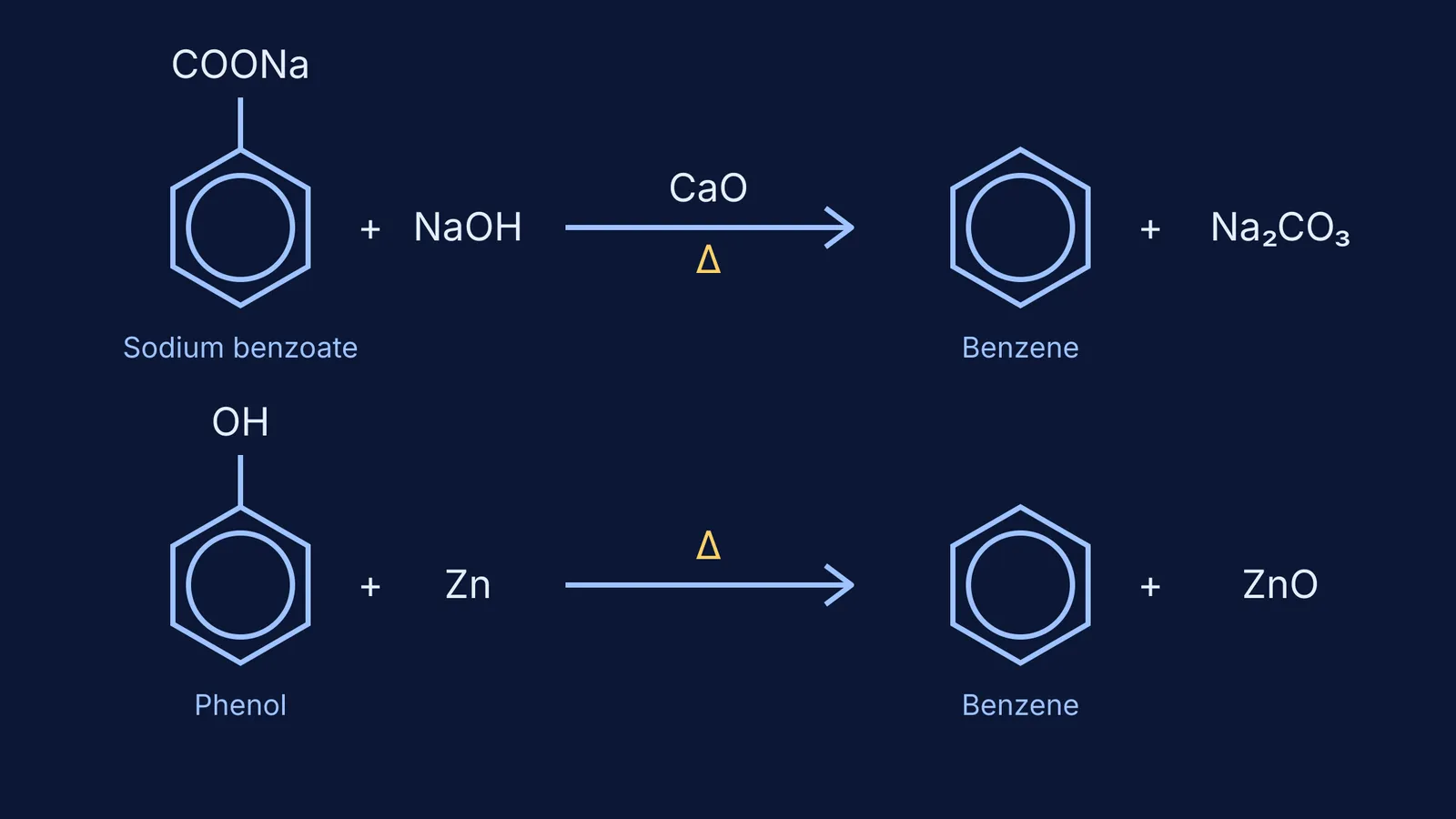
Benzene is prepared in the laboratory by the decarboxylation of sodium benzoate (Vedantu). When you heat the sodium salt of benzoic acid (sodium benzoate) with soda lime, the carboxyl group is removed as sodium carbonate, leaving benzene.
The reaction strips the entire -COONa group off the ring and replaces it with a hydrogen atom. The carbon dioxide leaves the reaction in the form of sodium carbonate (Na₂CO₃).
Why use soda lime instead of pure sodium hydroxide?
Soda lime is a solid mixture of sodium hydroxide (NaOH) and calcium oxide (CaO). In theory, the reaction only requires the NaOH to provide the sodium and oxygen needed to form the Na₂CO₃ byproduct.
However, pure sodium hydroxide is highly hygroscopic, meaning it absorbs moisture from the air so quickly that it becomes a wet slurry. It also attacks the glass of the reaction vessel when heated. Adding calcium oxide makes the mixture much easier to handle, keeps the reagents dry, and stops the solid from melting too quickly during the strong heating required for the reaction.
How do you prepare benzene from phenol?
Benzene can also be obtained by the chemical reduction of phenol (Vedantu). In this method, phenol vapours are passed over heated zinc dust.
The zinc acts as a strong reducing agent. It strips the oxygen atom directly from the -OH group attached to the aromatic ring. The zinc is oxidised to form solid zinc oxide (ZnO), while the phenol is reduced to benzene vapour. This provides a direct route from a functionalised aromatic ring back to the parent hydrocarbon.
What other laboratory methods exist for preparing benzene?
Beyond decarboxylation and phenol reduction, benzene can be synthesised from benzenediazonium chloride (Vedantu). In this reaction, benzenediazonium chloride is treated with hypophosphorous acid (H₃PO₂) at room temperature.
The hypophosphorous acid acts as a reducing agent, substituting the diazonium group with a hydrogen atom and forming benzene. During this process, the hypophosphorous acid is oxidised to phosphorous acid.
How is benzene prepared on an industrial scale?
While laboratory methods are useful for small-scale synthesis, industrial applications require different approaches (Vedantu).
One common industrial method is the cyclic polymerization of ethyne (acetylene). When ethyne gas is passed through a red-hot iron tube at approximately 873 K, three ethyne molecules polymerize to form one molecule of benzene.
Another significant industrial route is the dehydrogenation of cyclohexane. By heating cyclohexane in the presence of a catalyst like platinum, palladium, or nickel, hydrogen atoms are removed to generate the aromatic benzene ring. Benzene is also isolated through the fractional distillation of coal tar, where it is collected from the light oil fraction. Finally, the hydrolysis of benzene sulfonic acid with superheated steam successfully removes the sulfonic group to yield benzene.
How to spot these reactions in exam questions?
In competitive exams, these reactions rarely appear as direct "how do you prepare" questions. Instead, they are hidden in multi-step conversion sequences.
Here is a checklist for spotting them:
Look for the reagents: If a step shows NaOH/CaO over the arrow, it is a decarboxylation. You are losing one carbon atom from the main molecule.
Look for the metals: Zinc dust with heat over a phenol ring means the oxygen is leaving.
Watch the carbon count: If an aromatic reactant has 7 carbon atoms (like sodium benzoate) but the product only has 6, a decarboxylation has taken place.
Check the temperature: Red-hot iron tubes at 873 K signal the polymerization of alkynes to aromatics.
If you find it hard to track these changes through a long sequence, the Fermi Problem Library has worked problems with a step-by-step solver that explains the reasoning rather than printing an answer. To understand the electron movement behind the reduction, the Fermi Concept Library has every concept in chemistry, each with its own lesson and its place in the map.
Once you have mastered stripping groups to form benzene, you will often need to build it back up. To see how functional groups are added to the ring, read our guides on the Reimer-Tiemann and Kolbe reactions of phenol, step by step or the industrial preparation of phenol from cumene: the industrial route and its acetone by-product.


