On this page
Before a new boiler, gas cylinder or pressure vessel goes into service, it is filled and pressurised above its working pressure to check that it holds. Safety guidance asks for water rather than air wherever possible, because a vessel full of pressurised water stores almost no energy, while the same vessel full of compressed air stores enough to throw fragments a long way if it fails. Two Class 11 formulas, bulk modulus and adiabatic work, give the size of the gap.
This post builds on bulk modulus and compressibility, with worked depth problems, and on why compressed-air cars never caught on. The new part here is the comparison of the two fluids at the same pressure.
How much energy does pressurised water store?
Water does compress, a little. Its bulk modulus K is about 2.2 GPa, the value in NCERT's table in Class 11 Physics Part 2, Mechanical Properties of Solids. Raise the pressure by p and a volume V shrinks by
ΔV = pV/K
To pump the vessel up, you have to push that extra ΔV of water in. The pressure rises from 0 to p as you do, in a straight line, so the work is the area of a triangle: half of p times ΔV. That work is stored as elastic energy in the squeezed water:
E_water = ½ p ΔV = p²V/2K
Because K is large, E_water is small. The same expression, E = VyP²/2 with y = 1/K the compressibility, appears in the pressure-test section of the Jefferson Lab ES&H Manual, a US national laboratory safety manual.
How much energy does compressed air store at the same pressure?
To get air to 30 bar above atmospheric, you have to pack about 30 cubic metres of outside air into each cubic metre of tank. The stored energy is the work the air can do as it expands back to atmospheric pressure p₀.
If the vessel splits, the expansion is fast, so take it as adiabatic, with pV^γ = constant and γ = 1.4 for air. The work done by the gas going from p₁ (absolute) to p₀ is
E_air = (p₁V/(γ − 1))[1 − (p₀/p₁)^((γ − 1)/γ)]
This is the form used for pneumatic-test stored energy in the same Jefferson Lab manual, which refers to ASME PCC-2. With γ = 1.4, 1/(γ − 1) = 2.5 and (γ − 1)/γ = 0.286.
Worked example: one cubic metre at 30 bar
Take a 1.00 m³ vessel at 30 bar gauge (3.0 × 10⁶ Pa above atmospheric). Use K = 2.2 × 10⁹ Pa for water, γ = 1.4 for air and p₀ = 1.013 × 10⁵ Pa. These are round, illustrative numbers.
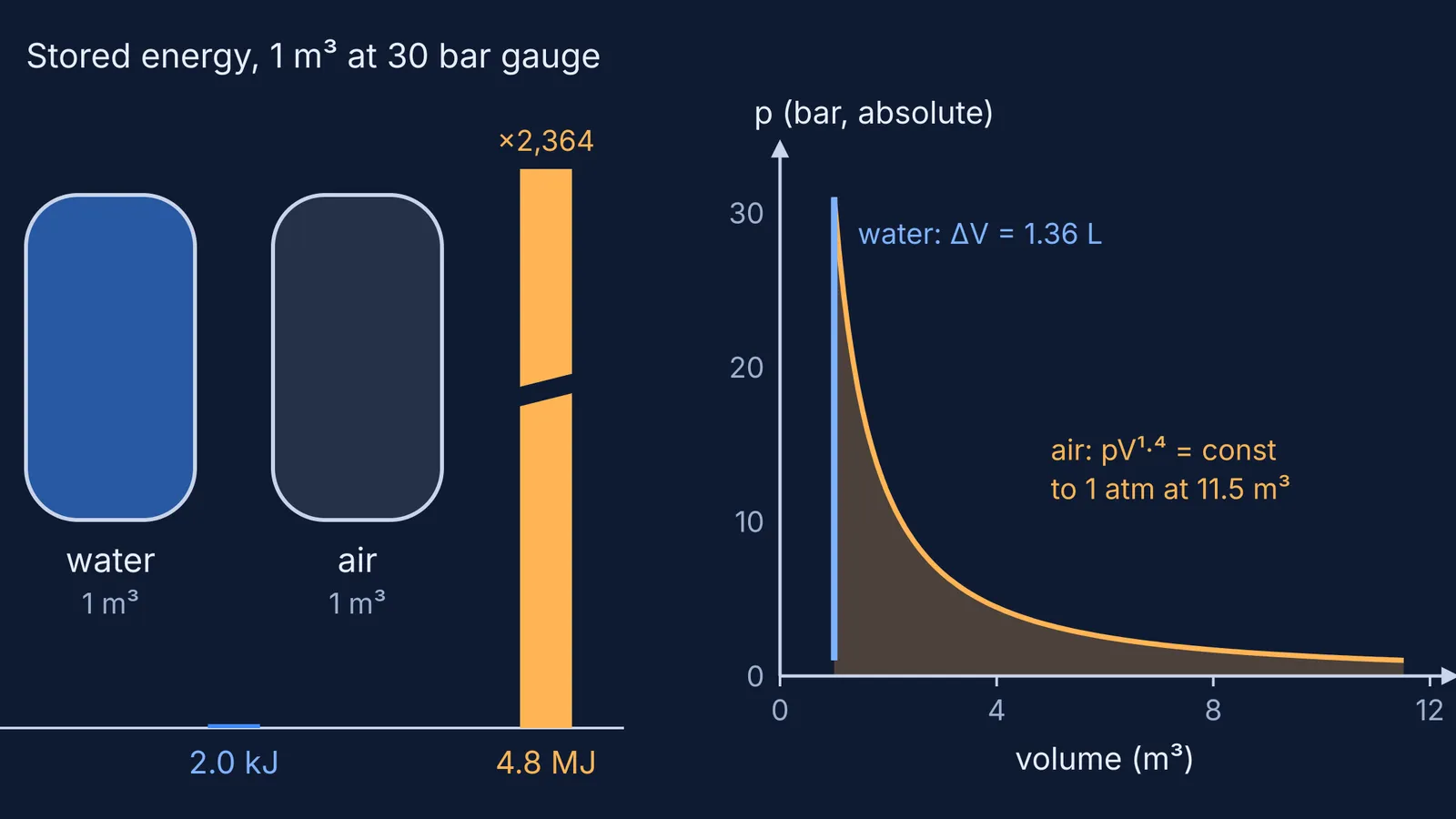
Water squeeze. ΔV = pV/K = (3.0 × 10⁶ × 1.00)/(2.2 × 10⁹) = 1.36 × 10⁻³ m³, or 1.36 litres.
Water energy. E = p²V/2K = (3.0 × 10⁶)²/(2 × 2.2 × 10⁹) = 2.0 × 10³ J, about 2.0 kJ. Check: ½ × 3.0 × 10⁶ × 1.36 × 10⁻³ gives the same 2.0 kJ.
Air pressure ratio. p₁ = 3.0 × 10⁶ + 1.013 × 10⁵ = 3.10 × 10⁶ Pa absolute, so p₁/p₀ = 30.6.
Air energy. (p₀/p₁)^0.286 = (1/30.6)^0.286 = 0.376. Then E = 2.5 × 3.10 × 10⁶ × 1.00 × (1 − 0.376) = 4.84 × 10⁶ J, about 4.8 MJ.
Ratio. 4.84 × 10⁶/2.0 × 10³ = about 2,360. The air stores over two thousand times more.
Sense check. Expanding to 1 atm, the air would fill (30.6)^(1/1.4) = 11.5 m³. The water barely moves.
To put the two in everyday terms, use KE = ½mv² for a 1,000 kg car. 2.0 kJ is that car at 7.3 km/h, a slow walk. 4.8 MJ is the same car at 354 km/h.
Units check: p²V/K has units Pa² m³/Pa = Pa m³ = N m = J. pV also has units of J. Both answers are in joules.
Why does a crack stop a water test but not an air test?
The water at 30 bar is only 1.36 litres "too much" for the vessel. If a crack lets about 1.4 litres escape, the pressure is back to atmospheric. The jet is dangerous close up, but little energy drives it, and the crack has no reason to keep growing.
Air behaves the other way. As gas leaves, the pressure inside falls slowly, because 11.5 m³ of expanded air has to get out first. The gas keeps pushing on the edges of the crack while it opens, and the 4.8 MJ can turn a split into a burst with flying pieces. The UK Health and Safety Executive's guidance note GS4, Safety requirements for pressure testing, says it plainly: to reduce the stored energy during a test, pressurise with water or another liquid rather than a gas wherever possible.
The air figure above is an upper scale, not a blast estimate. A slow, isothermal expansion would give even more work (about 10.6 MJ by p₁V ln(p₁/p₀)), and subtracting the work done pushing back the atmosphere, as the air-car post does, gives less (about 3.8 MJ). Every version leaves air more than a thousand times ahead of water.
Do the steel walls store energy too?
Yes. The walls stretch under pressure, and stretched steel stores elastic energy. For a rough feel, take the 1 m³ vessel as a sphere of radius 0.62 m with steel walls at an illustrative stress of 140 MPa (Young's modulus 200 GPa, Poisson's ratio 0.3). That gives walls about 6.6 mm thick and roughly 2 kJ of strain energy, the same order as the water. This is our own estimate, not a code figure. The walls also bulge a little, so in practice more water must be pushed in than the 1.36 litres from K alone.
Either way, water gives a few kilojoules and air gives megajoules.
Which Class 11 results does this use?
For a liquid, E = p²V/2K, the same form as ½ × stress × strain per volume. For a gas, adiabatic work, also written (p₁V₁ − p₀V₂)/(γ − 1). If the adiabatic curve is easier to see than read, the Simulation Lab has interactive simulations for ideas like this one. To revise the stress, strain and bulk modulus ideas behind the water result, use the Concept Library. The same adiabatic expansion explains why air from a burst tyre feels cold.
A note on safety
Pressure testing is a high-risk job, and HSE's GS4 treats it that way. It is done by trained, certified staff working to a written procedure and a pressure-vessel code, with the vessel segregated or enclosed. This post explains the physics only and is not a test procedure. Never pressurise any container with air or gas at home to "test" it.
Quick checklist
Liquid stored energy: E = p²V/2K. Water at 30 bar in 1 m³ stores about 2.0 kJ.
Gas stored energy, adiabatic: E = (p₁V/(γ − 1))[1 − (p₀/p₁)^((γ − 1)/γ)], with absolute pressures. Air at 30 bar gauge in 1 m³ stores about 4.8 MJ.
The ratio is about 2,400, because the gas is packed in by a factor of 30 while water shrinks by 0.14%.
A water test loses its pressure after about a litre leaks; an air test does not.
Safety guidance prefers liquid testing wherever possible, carried out by trained staff.