On this page
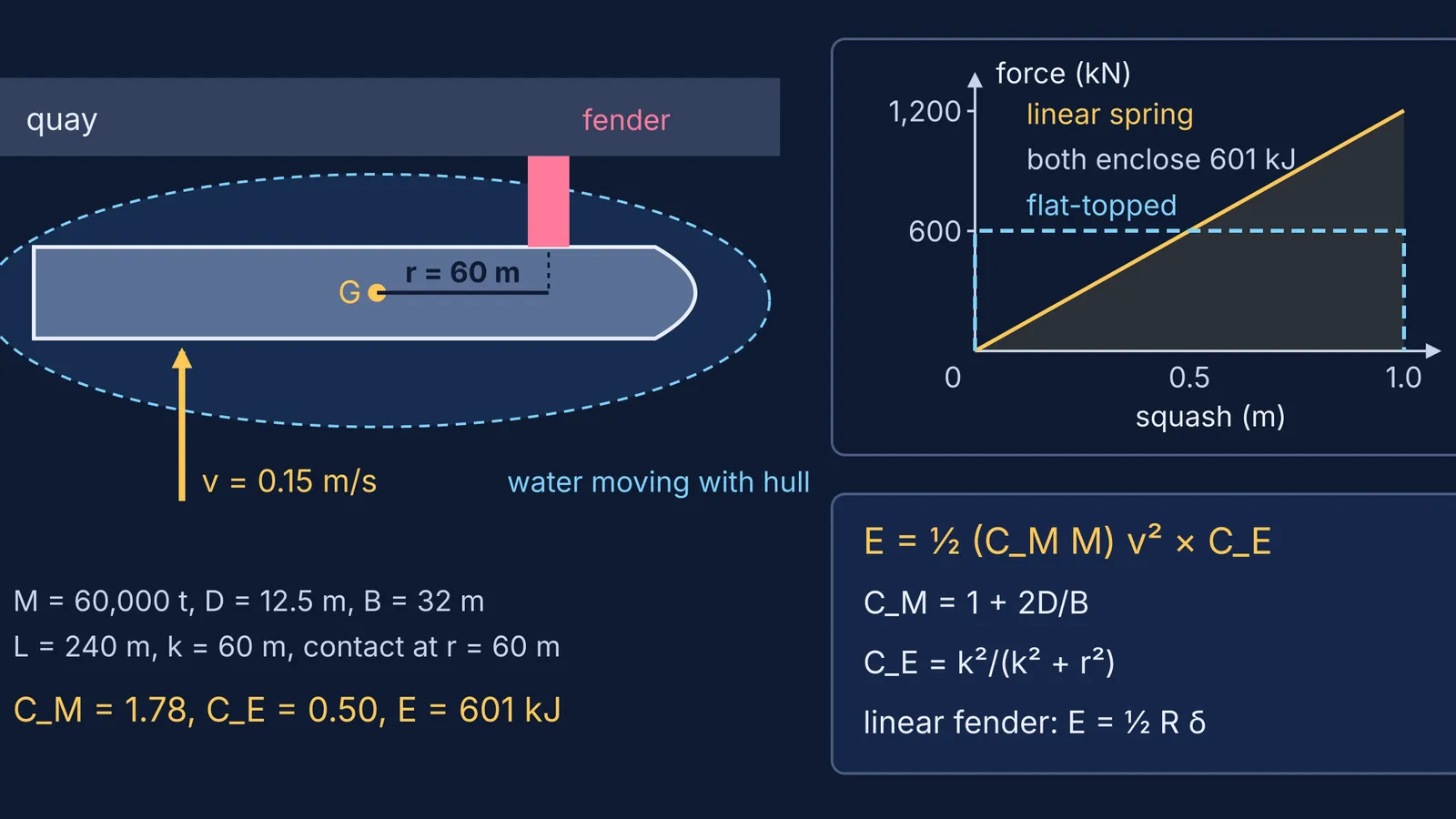
A loaded ship of 60,000 tonnes coming alongside a quay at 15 cm/s, about half a kilometre an hour, looks almost still. Yet a rubber fender has to soak up roughly 600 kJ in under a metre of squash, about the kinetic energy of a 1.2-tonne car at 114 km/h. Two pieces of physics set that number. The water around the hull moves with the ship and adds to its mass. And the ship touches at one point, off its centre, so it starts to turn and only part of its energy goes into the fender.
How much energy does a berthing ship carry?
Start with plain kinetic energy, ½Mv². Here M is the ship's displacement, its actual mass, which equals the mass of water it pushes aside. It is not the deadweight tonnage, which only counts cargo, fuel and stores.
For M = 60,000 t = 6.0 × 10⁷ kg and v = 0.15 m/s:
½Mv² = ½ × 6.0 × 10⁷ × 0.15² = 675,000 J = 675 kJ.
Port designers use the Brolsma curves published in PIANC's 2002 fender guidelines. A study of berthing velocities in the port of Rotterdam (Roubos, Groenewegen and Peters, Marine Structures, 2017) plots those curves: for ships of roughly this size (tens of thousands of tonnes) the design speeds run from about 5 cm/s at a sheltered berth with good conditions to over 20 cm/s at an exposed berth with a difficult approach. The same study found that measured speeds in Rotterdam were lower than these design values: mean speeds of 3 to 5 cm/s for each ship class, and a highest of 13 cm/s in 555 berthings. So 15 cm/s is a design value for a less sheltered berth, not a typical landing.
Energy goes as v²: at 0.10 m/s it is 300 kJ, at 0.20 m/s 1,200 kJ.
Why does the water around a ship add to its mass?
A ship moving sideways cannot move alone. It has to shove a large body of water out of the way and drag water along behind it. When the ship stops, that water must stop too, and it pushes on the hull as it does. So the ship behaves as if it were heavier. Engineers call the extra amount the added mass, or hydrodynamic mass.
A simple rule from fender design, given by Theodore Lee in Design criteria recommended for marine fender systems (Coastal Engineering Proceedings, 1968), is
C_M = 1 + 2D/B
where D is the draught (how deep the hull sits) and B is the beam (its width). The effective mass is C_M × M. Treat this as a design rule with a range, not a law: shallow water under the keel raises the added mass further, and other methods give somewhat different values.
For D = 12.5 m and B = 32 m: C_M = 1 + 2 × 12.5 ÷ 32 = 1.78. The water adds 78% to the ship's energy, and makes up 0.78 ÷ 1.78 = 44% of the total.
How a hull floats and stays upright is covered in how container ships stay stable; here the question is how it stops.
Why does only part of the energy reach the fender?
A long ship rarely lands flat along the quay. It usually first touches one fender, often near a quarter of its length from the bow or stern. That contact point is off the centre of mass, so the push from the fender also turns the ship.
This is the same physics as a rod on a smooth table struck at one end. Let the ship's radius of gyration about its centre be k and the contact point lie a distance r from the centre, along the hull. Bring the contact point to rest with an impulse J:
The centre's velocity drops by J/M′, where M′ = C_M M.
The spin produced is ω = Jr/(M′k²), which slows the contact point by a further ωr.
Setting v − J/M′ − Jr²/(M′k²) = 0 gives J = M′v k²/(k² + r²).
The kinetic energy left over then shows that the fender takes a fraction C_E = k²/(k² + r²) of ½M′v².
Lee's paper uses the same eccentricity coefficient, and the Rotterdam study quotes C_E of about 0.4 to 0.6 for quarter-point berthing. For a 240 m ship with k = 60 m touching at r = 60 m, C_E = 3600 ÷ 7200 = 0.50. Half the energy goes into the fender. After contact the ship's centre still moves towards the quay at 7.5 cm/s while it turns, and the rest of the energy is met by the mooring lines and later contacts.
A worked example: sizing the fender
Illustrative ship: displacement 60,000 t, draught 12.5 m, beam 32 m, length 240 m, k = 60 m, contact at r = 60 m, approach at 0.15 m/s.
Plain energy. ½Mv² = 675 kJ.
Add the water. C_M = 1.78, so ½(C_M M)v² = 675 × 1.78125 = 1,202 kJ.
Allow for the turn. C_E = 0.50, so E = 1,202 × 0.50 = 601 kJ.
Other factors. Fender guidelines also include smaller factors for hull softness and berth layout. Here both are taken as 1.
A fender like a linear spring. If the force rises steadily to a peak R over a squash δ = 1.0 m, the energy is ½Rδ, so R = 2E/δ = 2 × 601 kJ ÷ 1.0 m = 1,202 kN. That is about 123 tonnes-force.
A fender with a flat force. If the fender could hold a constant force over the whole 1.0 m, E = Rδ and R = 601 kN, half as much.
Check the units. kg × (m/s)² = J; J ÷ m = N.
Repeat for other speeds: at 0.10 m/s the fender takes 267 kJ, and at 0.20 m/s it takes 1,069 kJ. Leaving out the added mass would cut the 601 kJ to 338 kJ and under-design the fender by 44%.
Why are dock fenders shaped to buckle?
The quay and the hull must survive the peak force. For a fixed energy and a fixed squash, the force is lowest when the force-compression graph is flat-topped, because the area under it is then filled most efficiently. A linear spring needs twice the peak force for the same energy and the same squash. Rubber fenders are shaped so that they buckle after a short rise, which flattens the top of the curve. The linear and flat cases above are the two bounds; a real fender's curve comes from its maker's test data.
If you want more problems where energy, impulse and rotation meet, like this one, the Fermi Problem Library has a step-by-step solver that explains the reasoning. For more practice on stopping a load with a spring, see work, energy and power case study questions for Class 11.
Quick checklist
Use displacement (the ship's mass) in ½Mv², not deadweight.
Energy goes as v²: 0.20 m/s carries four times the energy of 0.10 m/s.
Added mass: C_M = 1 + 2D/B, a design rule with a range.
Off-centre contact: C_E = k²/(k² + r²), the same physics as a struck rod.
Fender energy E = ½(C_M M)v² × C_E.
Linear fender: E = ½Rδ. Flat-topped fender: E = Rδ, half the peak force.