

On this page
Three original cases, easy to hard, with worked answers. If an idea feels shaky, see our Work, Energy and Power Class 11 notes and solved numericals.
What do these Class 11 case-study questions cover?
Class 11 exams are set by your school, so treat these as practice, not a board pattern. Every case stays inside Unit IV of the CBSE 2026-27 Class XI Physics curriculum. Definitions follow NCERT Class 11 Physics, Chapter 5 (Reprint 2026-27), which defines power as the rate of doing work and gives 1 kWh = 3.6 × 10⁶ J. Take g = 10 m/s².
Case 1: How much work does a porter do pulling a luggage trolley?
At Pune railway station, a porter pulls a luggage trolley (with suitcases, 60 kg in all) along a level platform. He pulls the handle with a force of 80 N at 30° above the horizontal, and the trolley starts from rest. The resistance to motion behaves like friction with coefficient 0.1. After 20 m he reaches the coach door. A second porter, with an identical trolley and load on the same platform, also starts from rest and pushes with the same 80 N, directed 30° below the horizontal.
(i) The work done by the first porter over 20 m is about: (a) 1,600 J (b) 1,386 J (c) 800 J (d) 0 J
(ii) How much work does gravity do on the trolley over the 20 m, and why?
(iii) Find the work done by friction and the trolley's speed at the coach door.
(iv) How much less kinetic energy does the pushed trolley have after 20 m? Why?
Answers.
(i) (b). W = Fd cos θ = 80 × 20 × cos 30° = 1,385.6 J ≈ 1,386 J.
(ii) Zero. Gravity is vertical and the displacement horizontal, so cos 90° = 0.
(iii) N = 600 − 80 sin 30° = 560 N, so friction is 56 N and does −56 × 20 = −1,120 J. Net work = 1,385.6 − 1,120 = 265.6 J = ½ × 60 × v², so v ≈ 2.98 m/s.
(iv) Pushing down raises N to 640 N, so friction becomes 64 N and does −1,280 J. Net work is 105.6 J, 160 J less: the downward component presses the trolley into the floor.
Case 2: What power does an e-rickshaw need to climb a flyover?
A loaded e-rickshaw in Lucknow has a mass of 900 kg. On a level road it cruises at a steady 4 m/s (14.4 km/h) against a constant resistive force of 300 N from air and the road. On its route is a flyover whose ramp rises 1 m for every 20 m travelled along the road. The motor can deliver at most 2.0 kW, and the battery stores 5.0 kWh of usable energy. Ignore losses in the motor and battery.
(i) The kilowatt hour printed on the battery is a unit of: (a) power (b) energy (c) force (d) momentum
(ii) What power does the motor deliver on the level road at 4 m/s?
(iii) Can it climb the ramp at 4 m/s? If not, find its fastest steady speed there.
(iv) On level road only, how far can it travel on a full battery? Does this distance depend on the cruising speed?
Answers.
(i) (b). 1 kWh = 1,000 W × 3,600 s = 3.6 × 10⁶ J.
(ii) At steady speed, driving force = resistance, so P = Fv = 300 × 4 = 1,200 W.
(iii) Uphill the motor must also balance mg sin θ = 9,000 × (1/20) = 450 N, so F = 750 N and P = 750 × 4 = 3,000 W. That is more than 2.0 kW, so no; v(max) = 2,000 ÷ 750 ≈ 2.67 m/s (9.6 km/h).
(iv) Energy = 5.0 × 3.6 × 10⁶ = 1.8 × 10⁷ J. Distance = energy ÷ force = 1.8 × 10⁷ ÷ 300 = 60,000 m = 60 km. With constant resistance, speed changes only the time, not the distance.
Case 3: How much kinetic energy is lost when rail wagons couple?
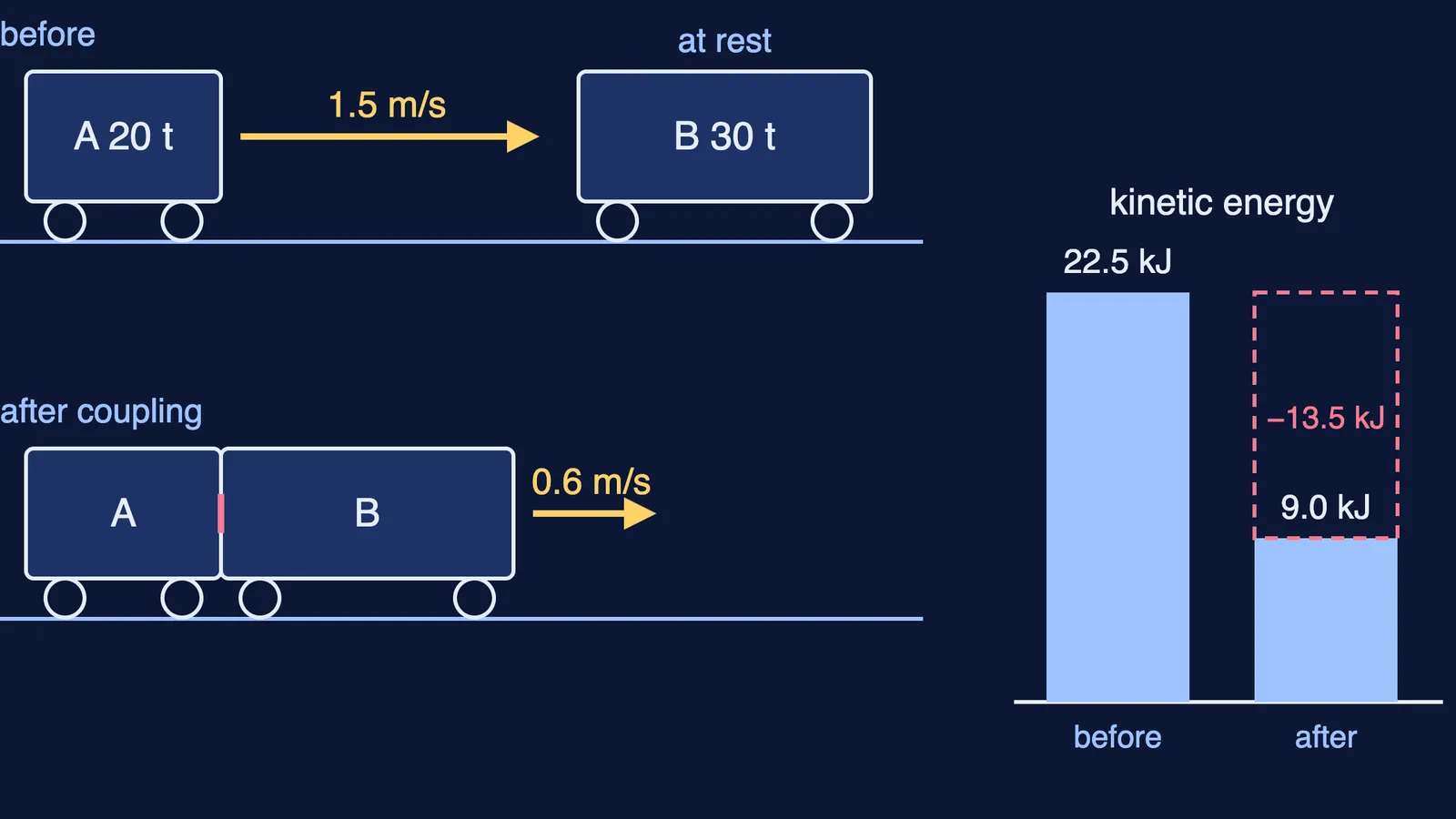
In a shunting yard near Itarsi, wagon A (mass 20 tonnes) rolls at 1.5 m/s along a straight, level track towards wagon B (mass 30 tonnes), which stands at rest. When they meet, the couplers lock and the wagons move off together. The coupled pair then hits an end-of-track buffer that acts like a single spring of spring constant 2.0 × 10⁵ N/m. Ignore friction and rolling resistance throughout.
(i) During the coupling, which of these is conserved? (a) kinetic energy only (b) linear momentum only (c) both (d) neither
(ii) Find the speed of the coupled wagons.
(iii) How much kinetic energy is lost in the coupling, and what fraction of the original is that?
(iv) Find the maximum compression of the buffer spring.
Answers.
(i) (b). Momentum is conserved in every collision; bodies that move off together have had a completely inelastic collision, which loses kinetic energy.
(ii) 20,000 × 1.5 = 50,000 × v, so v = 0.6 m/s.
(iii) Before: ½ × 20,000 × 1.5² = 22,500 J. After: ½ × 50,000 × 0.6² = 9,000 J. Lost: 13,500 J, or 60% (equal to m(B) ÷ (m(A) + m(B)) = 30/50).
(iv) All 9,000 J becomes spring energy: ½ × 2.0 × 10⁵ × x² = 9,000, so x² = 0.09 and x = 0.30 m.
How do you solve case-study questions on work, energy and power?
Mark the angle between each force and the displacement; at 90° a force does no work.
For a force at an angle, recompute the normal force before friction, as in Case 1.
Use the work-energy theorem whenever friction acts; use conservation of mechanical energy only when every force is conservative.
For vehicles at steady speed, find the driving force by balancing forces, then use P = Fv.
In a collision, write momentum first; kinetic energy is conserved only if the case says "elastic".
Next, try our assertion-reason questions on work, energy and power, and read the guide to case-based questions. If a step keeps slipping, the Fermi Problem Library has worked problems with a step-by-step solver that explains the reasoning rather than printing an answer.


