On this page
In this chapter, most assertion-reason statements sound true. Marks go to whoever can tell a true reason from the correct one.
What do these Work, Energy and Power questions cover?
Every item stays inside Unit 4, Work, Energy and Power, of the NEET (UG)-2026 syllabus published by the National Medical Commission. Each statement is checked against NCERT Class 11 Physics, Chapter 5, Work, Energy and Power (Reprint 2026-27). New to the chapter? Read our guide on how to prepare Work, Energy and Power for NEET.
How do you answer assertion-reason questions?
Judge each statement alone. If both are true, say "A, because R" and check it holds.
Assertion-reason keys (Q1 to Q6):
(A) Both A and R are true and R is the correct explanation of A.
(B) Both A and R are true but R is NOT the correct explanation of A.
(C) A is true but R is false.
(D) A is false but R is true.
Statement I and II keys (Q7 to Q10):
(A) Both statements are correct.
(B) Both statements are incorrect.
(C) Statement I is correct, Statement II is incorrect.
(D) Statement I is incorrect, Statement II is correct.
Assertion-reason questions on Work, Energy and Power
Q1 (easy). Assertion (A): A ball thrown straight up and caught at the same height has zero total work done on it by gravity. Reason (R): Gravity is a conservative force, so the work it does over any closed path is zero.
Answer: (A). Both are true. Negative work going up cancels positive work coming down; zero work over a closed path is what makes a force conservative, so R explains A.
Trap: picking (B) because R sounds like a definition.
Q2 (easy). Assertion (A): If the speed of a body doubles, its kinetic energy becomes four times as large. Reason (R): At a given speed, kinetic energy is directly proportional to the mass of the body.
Answer: (B). Both are true. K = ½mv² grows with v². R is about mass, which does not change here.
Trap: choosing (A) because R comes from the same formula.
Q3 (medium). Assertion (A): Stretching an ideal spring from zero extension to x needs less work than stretching it from x to 2x. Reason (R): The potential energy stored in a spring is directly proportional to its extension.
Answer: (C). A is true: the work is kx²/2, then 2kx² − kx²/2 = 3kx²/2. R is false: spring energy kx²/2 goes with the square of the extension.
Trap: mixing up spring force (∝ x) with spring energy.
Q4 (medium). Assertion (A): When a moving ball hits an identical ball at rest and they stick together, the pair has zero kinetic energy afterwards. Reason (R): Total linear momentum is conserved in every collision.
Answer: (D). A is false: momentum conservation gives the pair speed v/2, so half the kinetic energy survives. R is true, and it is what shows A is wrong.
Trap: reading "completely inelastic" as "all kinetic energy lost".
Q5 (hard). Assertion (A): In a one-dimensional elastic collision between a moving ball and an identical ball at rest, the moving ball stops. Reason (R): In an elastic collision, total kinetic energy is constant at every instant of contact.
Answer: (C). A is true: equal masses exchange velocities. R is false: the bodies deform during contact, so kinetic energy matches only before and after the collision.
Trap: thinking "elastic" means energy never dips.
Q6 (hard). Assertion (A): A crate is pulled up a rough incline at constant speed; the net work done on it by all forces is zero. Reason (R): The work done by friction on the crate is negative.
Answer: (B). Both are true. By the work-energy theorem, constant speed means zero change in kinetic energy, so zero net work. Friction's negative work is only one term in that sum.
Trap: calling A false because the pull does positive work.
Statement I and Statement II questions on Work, Energy and Power
Q7 (easy). Statement I: One kilowatt hour equals 3.6 × 10⁶ joules. Statement II: One horsepower equals 746 watts.
Answer: (A). Both are correct. 1 kWh = 1000 W × 3600 s = 3.6 × 10⁶ J, and NCERT gives 1 hp = 746 W.
Trap: treating the kilowatt hour as a unit of power.
Q8 (medium). Statement I: Like kinetic energy, the work done by a force can never be negative. Statement II: The potential energy of a body can be negative, depending on where its zero is chosen.
Answer: (D). I is incorrect: friction on a moving body does negative work. II is correct: potential energy is fixed only up to a constant, so values below the chosen zero are negative.
Trap: assuming every energy-like quantity must be positive.
Q9 (medium). Statement I: If the momentum of a body is doubled, its kinetic energy doubles. Statement II: When a light ball hits a much heavier ball at rest head-on and elastically, the heavy ball moves off at nearly twice the light ball's speed.
Answer: (B). Both are incorrect. K = p²/2m, so doubling p quadruples K. The heavy ball barely moves; the light ball bounces back at nearly its original speed.
Trap: swapping the roles of the light and heavy balls.
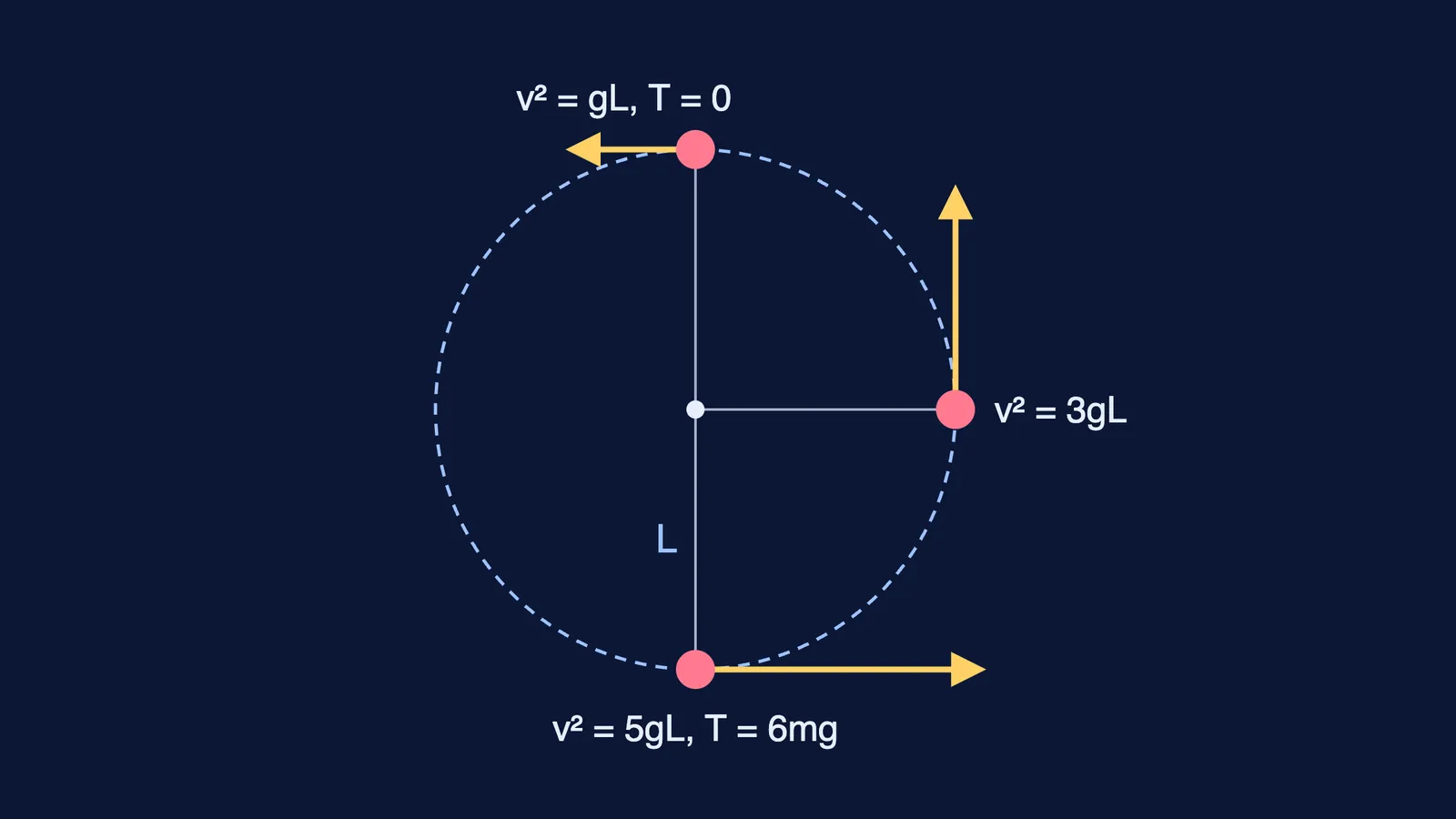
Q10 (hard). A bob on a light string of length L just manages to complete a vertical circle. Statement I: With the string horizontal, the bob's kinetic energy is three times that at the top. Statement II: At the lowest point, the tension in the string is six times the bob's weight.
Answer: (A). Both are correct. At the top gravity alone supplies the centripetal force, so v² = gL. Energy conservation gives 3gL with the string horizontal and 5gL at the bottom, where T = mg + m(5gL)/L = 6mg.
Trap: forgetting to add mg at the bottom.
How should you use this set?
Sort every miss: wrong about A, wrong about R, or wrong about the link.
For each link miss, write the real reason in one line.
For each truth miss, reread that NCERT section.
If Q10 felt abstract, the Fermi Simulation Lab has interactive simulations for ideas that are easier to see than to read.
For timed MCQs on the same chapter, try our Work, Energy and Power NEET practice questions with solutions. For a method that works in any subject, see our strategy for assertion-reason questions.