

On this page
Container ships move around 280 million containers every year, according to the World Shipping Council. Each ship carries thousands of boxes stacked high above the deck, yet comes back upright after every roll. Two ideas explain how: displacement keeps the ship afloat, and metacentric height keeps it upright.
Why does a heavy steel ship float?
Archimedes' principle states that the upward buoyant force on a body in a fluid equals the weight of the fluid the body displaces. A ship settles into the water until the water it pushes aside weighs exactly as much as the ship plus its cargo. The hull is mostly air, so it can push aside a great deal of water before the sea reaches the deck. But a tall stack of boxes can float and still roll over.
How do container ships stay stable?
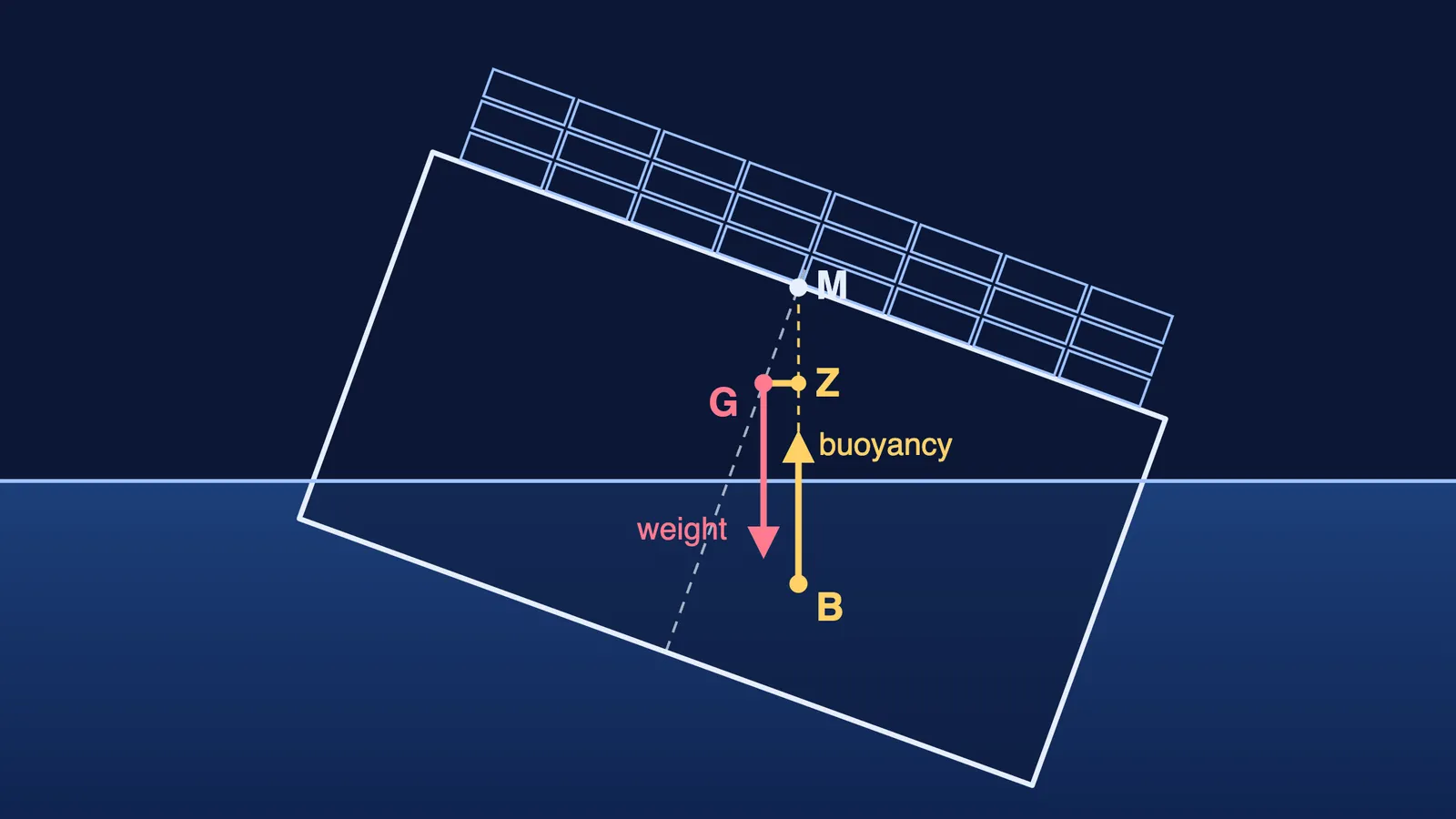
Three points decide it, as set out in this explainer on metacentric height:
G, the centre of gravity: where the ship's whole weight acts. It depends only on where the steel, fuel, ballast water and cargo sit.
B, the centre of buoyancy: the centre of the volume of water the hull displaces. Buoyancy pushes up through it.
M, the metacentre: when the ship heels a little, B slides towards the low side, and the vertical line through the new B crosses the ship's centreline at M.
The metacentric height GM is the distance from the centre of gravity G up to the metacentre M. When M is above G, weight (down through G) and buoyancy (up through B) form a couple that turns the ship back upright. The horizontal gap between those two forces is the righting lever GZ, and for small angles GZ = GM × sin θ. If G rises above M, the same couple turns the ship further over.
The height of M above B is BM = I ÷ V, where I is the second moment of area of the waterplane and V is the displaced volume. Width counts most in I, which is one reason container ships are built so broad.
A worked example: what happens when cargo sits off-centre?
Model the ship as a box 60 m wide, floating 14 m deep, with G 22 m above the keel. Real hulls are curved, so this is a classroom model.
KB = 14 ÷ 2 = 7 m, because the displaced water of a box is a rectangle.
BM = width² ÷ (12 × draught) = 3,600 ÷ 168 = 21.4 m, which is I ÷ V for a box.
KM = 7 + 21.4 = 28.4 m.
GM = 28.4 − 22 = 6.4 m. Positive, so the ship rights itself.
Now load 2,000 tonnes of containers 20 m off the centreline, on a ship displacing 250,000 tonnes. G moves sideways by 2,000 × 20 ÷ 250,000 = 0.16 m, and the ship settles where tan θ = 0.16 ÷ 6.4, a list of about 1.4 degrees. Repeat with careless loading that has left GM at only 0.5 m: the small-angle rule gives tan θ = 0.32, about 18 degrees. That overstates it at such angles; the exact box sum gives about 10.5 degrees.
The same sum, run backwards, is the inclining test: known weights are moved across a newly built ship and the angle is measured to find its real GM.
How much metacentric height is enough?
Rules set a floor. The International Maritime Organization's 2008 Intact Stability Code sets general criteria for ships: an initial metacentric height of at least 0.15 m, and a righting lever GZ of at least 0.2 m at a heel of 30 degrees or more.
More is not always better. A very large GM makes a ship stiff: it snaps back with a short roll period and high accelerations that strain cargo, as the metacentric height explainer notes. Loaders aim for enough GM, not the most.
Two things quietly eat into GM:
Weight up high. Heavy containers go low in the stack, lighter and empty ones on top.
Half-full tanks. Liquid sloshes to the low side, which acts like raising G. This free surface effect grows with the cube of the tank's width, so two baffles that split a tank into thirds cut it by a factor of 9, as the same explainer notes.
How should you study floating and stability for exams?
Use a fixed routine for buoyancy questions:
Mark G and B on every floating-body sketch before writing any equation.
Tilt the sketch. Ask which way B moves, then which way the couple turns.
Check the limits: GM above zero rights the body, zero leaves it neutral, below zero tips it over.
The same centre-of-mass thinking explains why a low stance helps a kabaddi raider, and a spinning disc finds another route to steadiness in how a frisbee stays stable in flight.
If the tilting picture is hard to hold in your head, the Fermi Simulation Lab has interactive simulations for ideas that are easier to see than to read. Fermi's AI tutor can draw the figure and work through a problem like the box example with you, checking your understanding as it goes.


