

On this page
Throw a dinner plate and it tumbles. Throw a frisbee of about the same size and it can glide for 20 metres or more. The numbers below come from Sarah Hummel's 2003 master's thesis at UC Davis, which tracked real throws with high-speed cameras and built a flight model from them.
How does a frisbee fly?
Lift is the push of air at right angles to the flow. NASA's Glenn Research Center explains it as flow turning: when a solid surface deflects moving air one way, Newton's third law pushes the surface the other way.
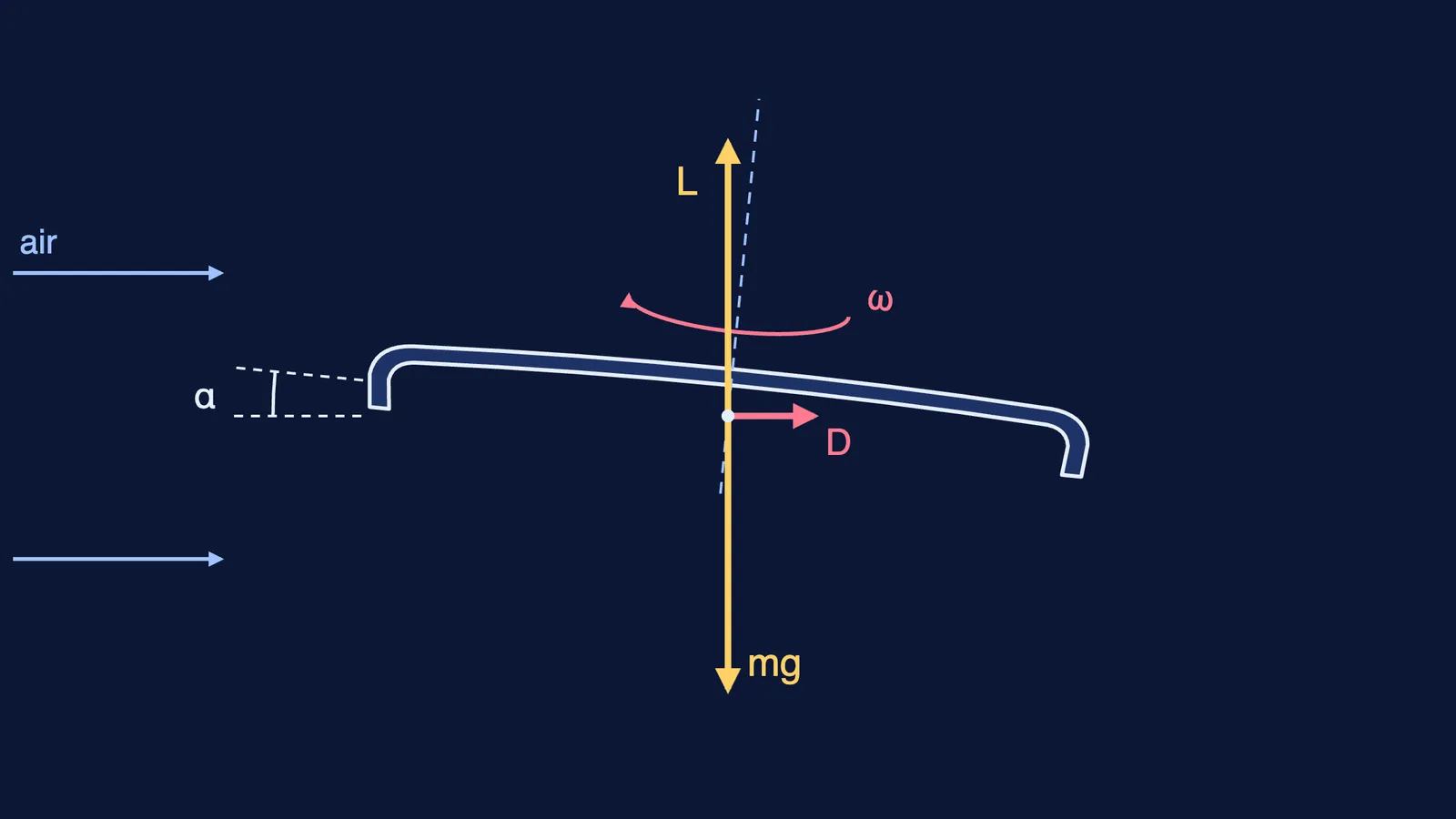
A frisbee is a wing rolled into a circle. Its top is domed and its rim curls down, a shape engineers call cambered. Hummel's thesis notes that even when the disc meets the air perfectly flat, the camber bends the passing air downward, so a frisbee makes some lift at zero tilt. Tip the front up (the angle of attack) and lift grows, until the flow breaks away at about 45°. Lift falls to zero only when the front is tipped down by about 4°.
Why does a frisbee need to spin?
Spin barely changes the lift. The same thesis reports, from wind-tunnel data by Potts and Crowther, that the lift and drag coefficients are unaffected by spin. Spin's real job is stability.
The trouble is where lift acts. At angles of attack below about 9°, it acts behind the centre of mass, so it tries to tip the nose down. A disc without spin obeys that twist and flips, like the plate.
A spinning disc has angular momentum, and a twist turns the direction of that angular momentum instead. So the frisbee rolls slowly sideways rather than nosing over: precession. The thesis gives the rule: twist = moment of inertia × spin rate × precession rate. For the same twist, spin twice as fast and the axis turns half as fast.
The shape helps here too. Much of a frisbee's mass sits in its thick rim. Hummel measured its moment of inertia about the spin axis as 0.00235 kg m², 47% more than a flat disc of the same mass and diameter, so each turn of spin stores more angular momentum.
How much tilt does a frisbee need? A worked example
Use the measured values in Hummel's thesis: mass 0.175 kg, top area 0.057 m², air density 1.23 kg/m³, and the straight-line fit to Potts and Crowther's wind-tunnel lift data, CL = 0.2 + 2.96α, with α in radians. Lift is L = ½ρv²A × CL.
Weight: 0.175 × 9.8 = 1.72 N. Level flight needs L = 1.72 N.
At 14 m/s, the release speed in the thesis: ½ × 1.23 × 14² × 0.057 = 6.87 N for each unit of CL. Flat (α = 0) gives 6.87 × 0.2 = 1.37 N, about 80% of the weight. You need CL = 1.72 ÷ 6.87 = 0.25, so α = 0.05 ÷ 2.96 = 0.017 rad, about 1°.
At 10 m/s: 3.51 N for each unit of CL, so CL = 0.49 and α is about 5.6°.
At 7 m/s: CL is about 1.0 and α about 15°.
The thesis explains why the glide lasts: as a frisbee slows and sinks, the air meets it from lower down, so the angle of attack grows on its own and lift stays close to the weight. It also says a flat frisbee needs about 16 m/s for level flight, which agrees with step 2.
Now the spin. The same fits give a nose-down twist of about 0.037 N m at 14 m/s (pitch coefficient −0.02, diameter 0.269 m). With no spin, that twist would rotate the disc (moment of inertia across its face 0.00122 kg m²) by about 54° in a quarter of a second. Spinning at 50 rad/s, the release spin the thesis lists for a 25-metre throw, the axis precesses at about 0.32 rad/s instead: roughly 4.5° in that quarter second. Rough figures, but the contrast is clear.
How do you throw a frisbee that flies straight?
A checklist drawn from Hummel's thesis:
Snap the wrist. More spin means slower drift.
Release nearly flat, nose slightly up. The thesis's common release conditions for a 25-metre throw are 14 m/s, pitched up 11°.
Release cleanly. Early wobble comes from stray rotation given at release, and throwing without it takes practice.
Expect a curve. A right-handed backhand (clockwise seen from above) rolls right while the angle of attack is under about 9°, then left once it slows and the angle passes 9°.
Related reads: why a boomerang comes back, why a skater spins faster with arms pulled in, and the Kutta–Joukowski lift theorem for wings.
If precession still feels like magic, the Fermi Simulation Lab has interactive simulations for ideas that are easier to see than read. Fermi's AI tutor can draw the figure with you and check your understanding as it goes, so you can redo the worked example at your own throw speed.


