

On this page
You throw it away from you, and a few seconds later it is coming back. Nothing pulls a boomerang home. It returns because two ideas from rotational motion work together: lift on a wing, and what a torque does to something that is spinning. "A boomerang does funny things because it is in fact a gyroscope," writes Cambridge engineer Hugh Hunt in his one-page boomerang theory.
What makes one arm lift more than the other?
Each arm of a returning boomerang has an airfoil cross-section, like a small wing, as HyperPhysics at Georgia State University explains. You throw it nearly upright, so it spins in an almost vertical plane while it moves forward.
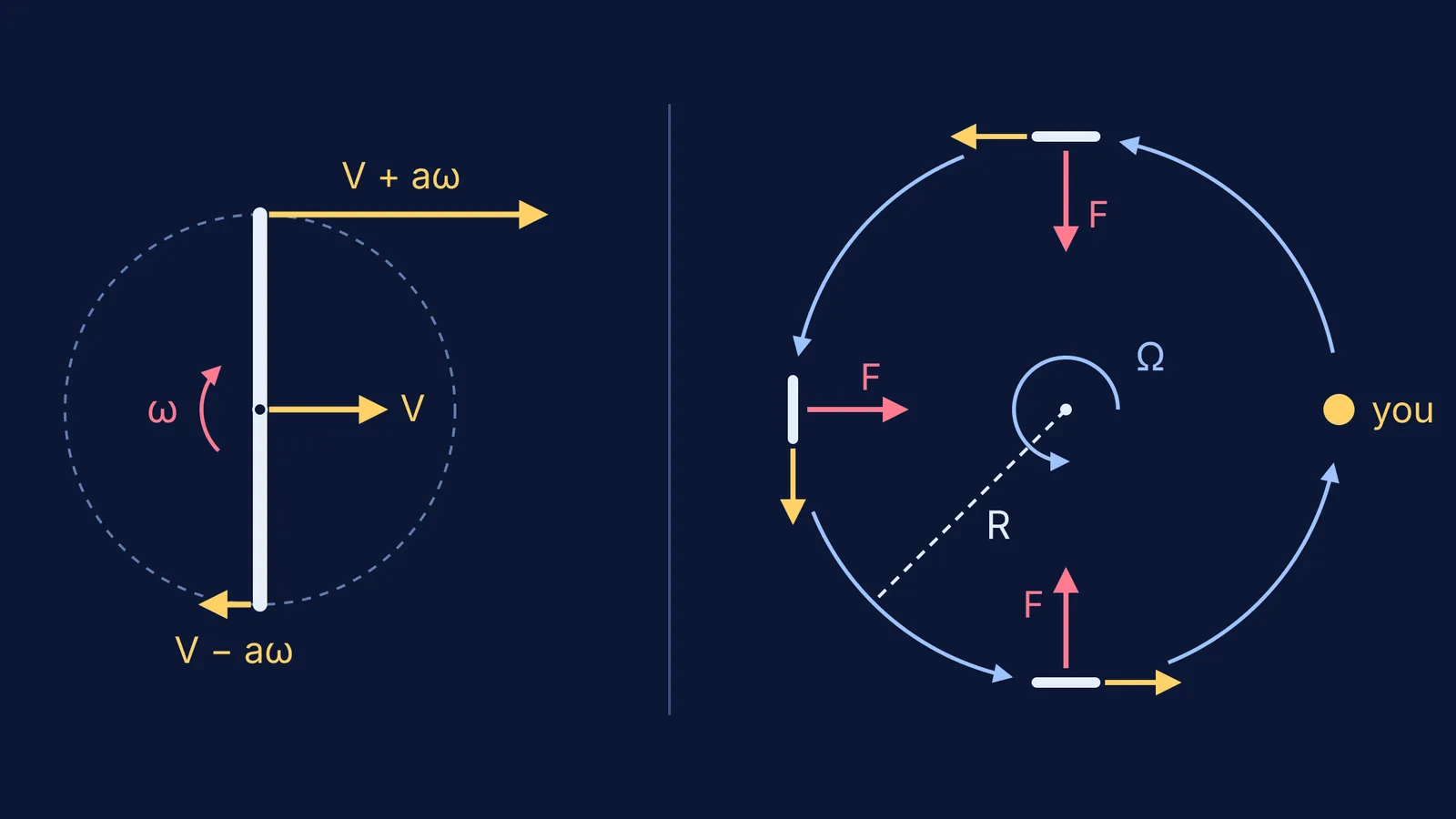
Now add the two motions. The centre moves forward at speed V. The spin adds speed to the arm at the top and takes it away from the arm at the bottom. In Hunt's model, the top tip moves through the air at V + aω and the bottom tip at V − aω, where a is the arm length and ω is the spin rate.
Lift grows with the square of airspeed: L = ½ρv²C_L A is the lift equation Hunt uses, with ρ the air density, C_L the lift coefficient and A the wing area. So the top of the spinning boomerang lifts much harder than the bottom.
Why doesn't the extra lift just tip it over?
More lift on top than at the bottom is a torque. On a still object, that torque would simply roll it over. A spinning boomerang has angular momentum, and a torque on angular momentum changes its direction: the spin axis swings sideways. This is precession, the same effect that keeps a spinning wheel from falling over.
The torque never lets up, so the axis keeps turning, and the flight path turns with it. HyperPhysics describes a steady counterclockwise precession seen from above, which carries the boomerang in a curve back towards the thrower.
Hunt writes this as C = JωΩ: the twisting couple C equals the moment of inertia J times the spin ω times the precession rate Ω. When Ω matches the rate at which the boomerang goes round its circle, it stays lined up with its path all the way home. If ω as a vector feels slippery, revise how the right-hand rule gives the direction of angular velocity.
A worked example: one throw, in numbers
For a cross-shaped boomerang, Hunt shows that the right flick of the wrist is aω = √2 V. Put in numbers: suppose you throw at V = 20 m/s with arms a = 0.15 m long. These are our illustration values, not measurements.
Spin needed: ω = √2 × 20 ÷ 0.15 ≈ 189 rad/s, about 30 turns a second.
Top tip airspeed: 20 + 28.3 ≈ 48 m/s.
Bottom tip airspeed: 20 − 28.3 ≈ −8 m/s. The bottom tip is moving slightly backwards through the air.
Halfway along the arms, the speeds are 20 + 14.1 ≈ 34 m/s at the top and 20 − 14.1 ≈ 6 m/s at the bottom. Because lift goes as v², the top point gets roughly (34.1 ÷ 5.9)² ≈ 34 times the lift of the bottom one.
Does throwing harder make a bigger circle?
No, at least in Hunt's simple model. Combining his equations, Hunt finds the radius of the circle is R = 4J/(ρC_Lπa⁴), "independent of spin speed ω and forward velocity V". Throw harder and the lift and the spin rise together, so the loop stays the same size.
What changes the circle is the boomerang itself. For a cross shape Hunt uses J = ⅓ma², so R = 4m/(3πρC_L a²). Read it off:
Twice the mass (same size and shape), twice the radius.
Longer arms at the same mass, a smaller circle.
Arms that lift better (larger C_L), a smaller circle.
Thinner air (smaller ρ), a bigger circle.
That is a useful exam habit too: before you plug in numbers, check which variables cancel.
How do you throw a boomerang so it comes back?
The throwing guide from Rangs Boomerangs gives this routine for a right-hander:
Grip it firmly with the flat side away from you (to the right), cocked back as far as is comfortable for maximum spin.
Hold it close to upright, not flat like a frisbee.
Face the wind, then turn 45 degrees to the right of it.
Aim about 5 degrees upward, just above the horizon.
Left-handers use a left-handed boomerang, held flat side to the left, and throw 45 degrees to the left of the wind.
Catch it carefully, and throw only on open ground with nobody in the flight path.
The Fermi Simulation Lab has interactive simulations for the ideas that are easier to see than to read. For the wing side of the story, read how Zhukovsky explained the lift on a wing, and if torque or angular momentum still feels shaky, the Fermi Concept Library gives each concept its own lesson.


