

On this page
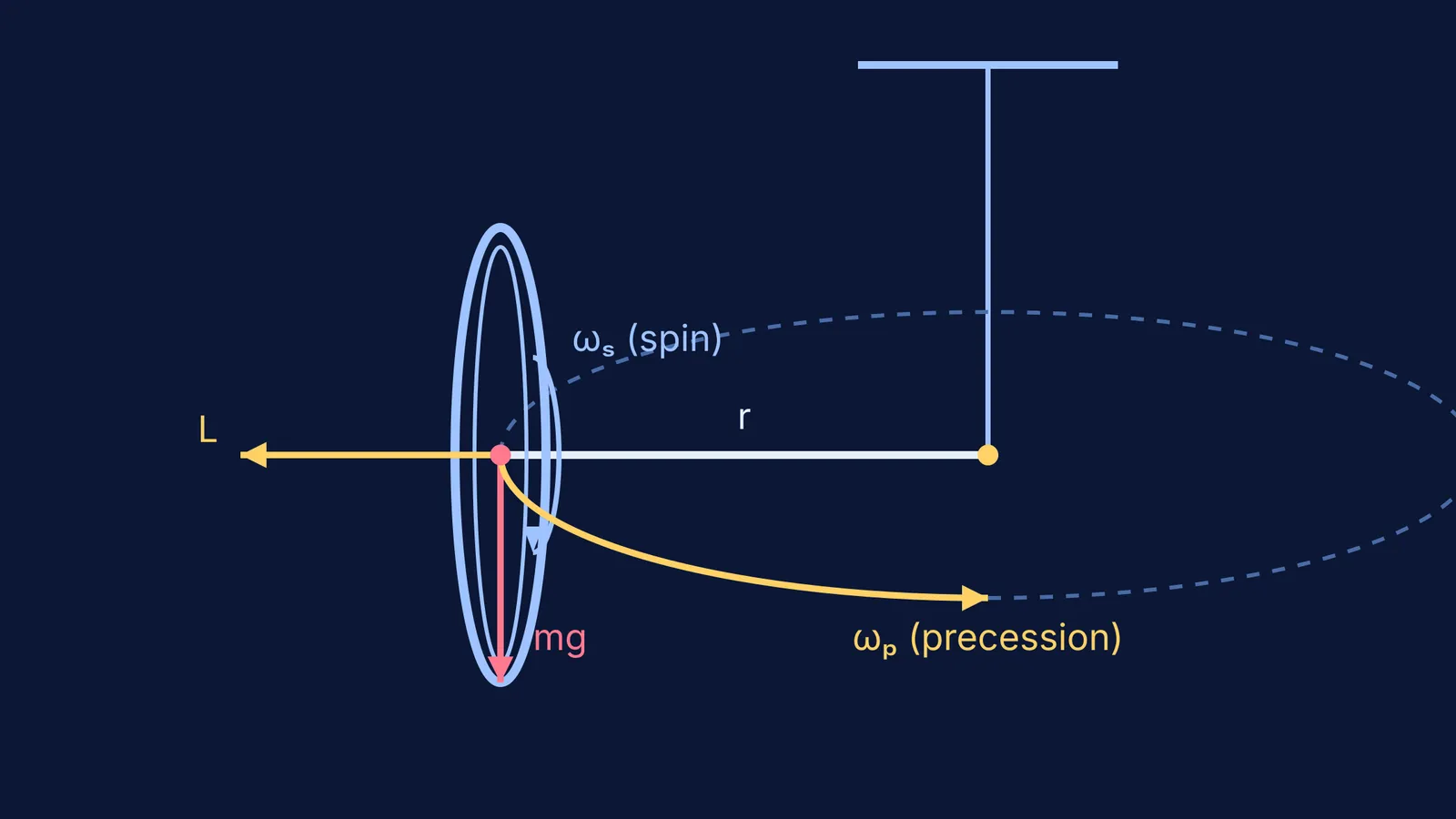
Have you ever seen a bicycle wheel hanging from a single piece of string tied to one end of its axle? If you let it go while it is stationary, it immediately drops and hangs vertically. But if you spin the wheel as fast as you can before letting go, it does something entirely unexpected: it stays perfectly horizontal and begins to orbit the string in a slow, steady circle.
This gravity-defying trick is not an illusion. It is a brilliant demonstration of gyroscopic precession, a fundamental principle of rotational motion that governs everything from spinning tops to the stability of planets. If you are preparing for your physics exams, this is a concept you must understand deeply.
What is gyroscopic precession?
When an object is not spinning, gravity pulling down on its center of mass creates a torque that simply tips it over. However, when the object is spinning rapidly, it already possesses angular momentum.
Angular momentum is a vector: it has both a size (how fast it spins and how its mass is distributed) and a direction (pointing along the axle). According to the laws of physics, a torque applied to an object changes its angular momentum. But because the torque from gravity acts at a right angle to the spin axis, it does not speed up or slow down the spin. Instead, it changes the *direction* of the spin.
This causes the entire wheel to rotate around the pivot point instead of falling. This resulting horizontal motion is what physicists call precession. The Fermi Simulation Lab lets you visualise this exact effect, allowing you to tweak the forces and watch how the torque vector continuously pulls the angular momentum vector sideways.
How are spin speed and precession speed related?
The relationship between how fast the wheel spins and how fast it precesses is one of the most tested concepts in mechanics. The formula for the precession angular velocity (ωₚ) is:
ωₚ = mgr / (Iₛ × ωₛ)
In this equation:
m is the mass of the wheel.
g is the acceleration due to gravity.
r is the distance from the pivot to the wheel's center of mass.
Iₛ is the wheel's moment of inertia.
ωₛ is the angular velocity (spin speed) of the wheel.
Notice where the spin speed (ωₛ) sits: it is in the denominator. This means that the faster you spin the wheel, the slower it precesses. As friction inevitably slows the wheel down, the precession speed increases. You have likely seen this when watching a spinning top: it starts out stable and upright, but as it loses spin speed, its precession grows wider and more rapid until it finally wobbles and falls.
Why does a spinning wheel not fall immediately?
It is important to clarify that a real bicycle wheel suspended by a string *does* slowly drop over time. It does not defy gravity forever.
In a perfect, frictionless vacuum, a rapidly spinning wheel would precess horizontally without losing height. In reality, friction at the bearings slows the spin speed (ωₛ). As it slows down, the wheel must precess faster. This requires energy, which it gets by slowly sinking and giving up gravitational potential energy.
Furthermore, if you simply drop the spinning wheel, you might notice it bobs up and down slightly as it precesses. This secondary nodding motion is called nutation. If you want a smoother precession, you have to give the wheel a slight horizontal push in the direction of precession as you release it.
Gyroscopes in the real world
This exact principle is not just a classroom demonstration; it is relied upon globally for navigation. Gyroscopes are the heart of inertial navigation systems used in aircraft, submarines, and spacecraft. Because a rapidly spinning gyroscope resists changes to its orientation, it provides a stable reference point even when a vehicle is pitching and rolling around it.
At an even grander scale, the Earth itself acts as a massive gyroscope. Because our planet bulges slightly at the equator, the gravitational pull of the Sun and Moon exerts a torque on it. This causes Earth's axis to precess. It is a very slow wobble: Earth completes one precessional cycle every 26,000 years. This means that thousands of years from now, the North Star will no longer be Polaris.
A quick check for your exams
If you encounter a gyroscope problem, remember the "90-degree rule". If you apply a force to a spinning object, the resulting motion happens 90 degrees later in the direction of rotation.
For example, if you push the top of a vertically spinning wheel forward, it will not tilt forward. It will tilt to the left or right depending on the spin direction.
You can explore these problems, including finding the tension in the string or calculating the exact precession rate, using the step-by-step solver in the Fermi Problem Library. It helps to first practice similar torque problems, such as finding the mass of a metre scale with the principle of moments or calculating a simple pendulum's string tension, before tackling 3D rotational dynamics.


