

On this page
Picture a metre scale lying flat on a smooth table, and flick one end sideways. The scale does not just slide, and it does not just spin about its middle. It does both, and for an instant one point does not move at all. This JEE favourite needs only two equations.
What happens when a rod on a smooth table is struck at one end?
Take a uniform rod of mass m and length L on a frictionless horizontal table. A blow of impulse J hits one end, perpendicular to the rod. The blow is brief and the smooth table gives no horizontal force, so J is the only horizontal impulse.
The blow changes the momentum of the whole rod as if all the mass sat at the centre of mass (CM). It also acts L/2 from the CM, so it starts the rod spinning. Every point then moves with the CM velocity plus its velocity from rotation about the CM.
How do you find the velocity and spin after the impulse?
Step 1: translation. The impulse-momentum theorem says an impulse equals the change in momentum it produces, J = Δp (OpenStax University Physics, section 9.2). The rod starts at rest, so J = m·v_cm, which gives v_cm = J/m.
Step 2: rotation. Take angular impulse about the CM: the moment of the impulse equals the change in angular momentum about the CM. The impulse has a lever arm of L/2, so J·(L/2) = I_cm·ω. The moment of inertia of a thin uniform rod about its centre is mL²/12 (OpenStax University Physics, section 10.5). So J·(L/2) = (mL²/12)·ω, which gives ω = 6J/(mL).
Take moments about the CM. Neither end is a fixed pivot, so the end-axis value mL²/3 from the same page does not apply here.
A worked example. Let m = 0.6 kg, L = 1.2 m and J = 0.3 N s.
v_cm = 0.3/0.6 = 0.5 m/s.
ω = 6 × 0.3/(0.6 × 1.2) = 2.5 rad/s.
Struck end: 0.5 + 2.5 × 0.6 = 2.0 m/s, in the direction of the blow.
Free end: 0.5 − 2.5 × 0.6 = −1.0 m/s, so it moves backwards.
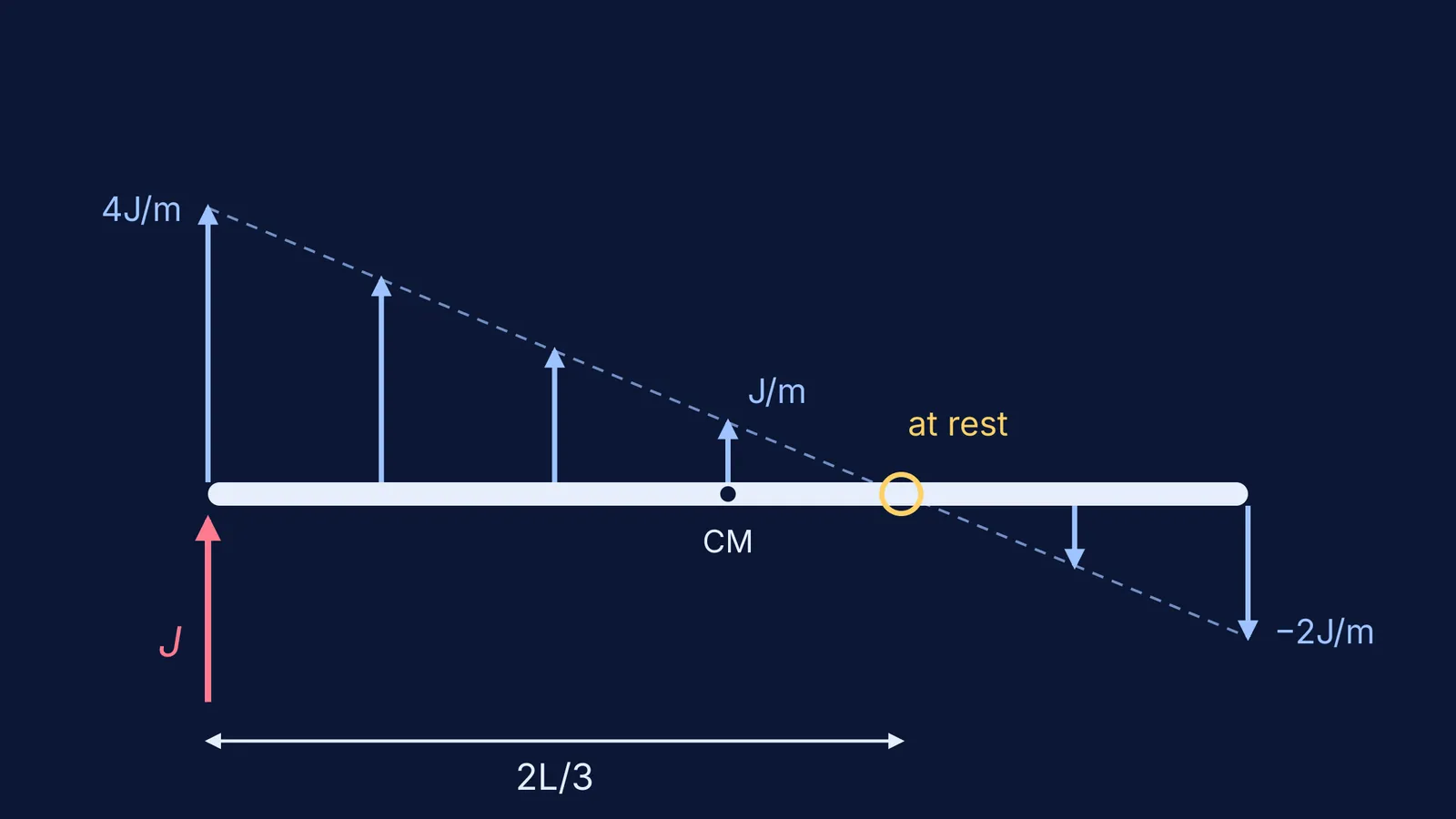
Point at rest: 0.8 m from the struck end, which is 2L/3 (worked out below).
Which point of the rod starts at rest?
Measure x from the CM along the rod, positive towards the free end. The spin pushes the struck half forward and the far half backward, so a point at x moves with velocity v(x) = J/m − 6Jx/(mL).
Struck end (x = −L/2): v = J/m + 3J/m = 4J/m.
Centre (x = 0): v = J/m.
Free end (x = +L/2): v = J/m − 3J/m = −2J/m.
Set v(x) = 0 and you get x = L/6 beyond the centre. Measured from the struck end, that is L/2 + L/6 = 2L/3. Just after the blow, the rod turns about the point two-thirds of the way along from where you hit it.
This is the centre of percussion with the roles swapped. For a uniform beam pivoted at one end, the centre of percussion is 2/3 of the length from the pivoted end (Center of percussion, Wikipedia). Its rule b = I/(pM), with p = L/2, gives b = L/6, matching our answer. Batsmen feel a version of this, though the sweet spot of a bat also depends on vibration, as we explain in what the sweet spot of a cricket bat really is.
New to axes that move? Read our guide to the instantaneous axis of rotation.
How do you check the answer in an exam?
Kinetic energy gives two independent routes. Route one: translation gives J²/(2m), and rotation, using K = ½Iω² (OpenStax University Physics, section 10.4), gives ½ × (mL²/12) × (6J/(mL))² = 3J²/(2m). The total is 2J²/m. Route two: the struck end's speed rises from 0 to 4J/m in step with the impulse, so the blow does work ½ × J × 4J/m = 2J²/m. In the numerical example, 0.075 J + 0.225 J = 0.3 J, and ½ × 0.3 × 2.0 = 0.3 J. If your two routes disagree, look for one of these slips:
Treating the far end as a fixed pivot, J·L = (mL²/3)·ω, which gives ω = 3J/(mL).
Leaving out the translation and letting the rod spin about its centre.
Putting the rest point at L/3 from the struck end, on the wrong side of the centre.
To practise the same method when the blow lands somewhere other than the end, try our post on angular impulse when a hit rod spins and moves. If your ω keeps coming out as 3J/(mL), the Fermi Problem Library has worked problems with a step-by-step solver that explains the reasoning rather than printing an answer, so you can see where the axis choice went wrong. To revise moment of inertia or centre of mass first, the Fermi Concept Library gives each concept in physics its own lesson.


