

On this page
Every cricketer knows the feeling of catching a ball right out of the middle. The ball races to the boundary while your hands feel almost nothing. Yet miss that area by just a few inches, and a jarring shudder travels up your wrists alongside a stinging buzz in your palms.
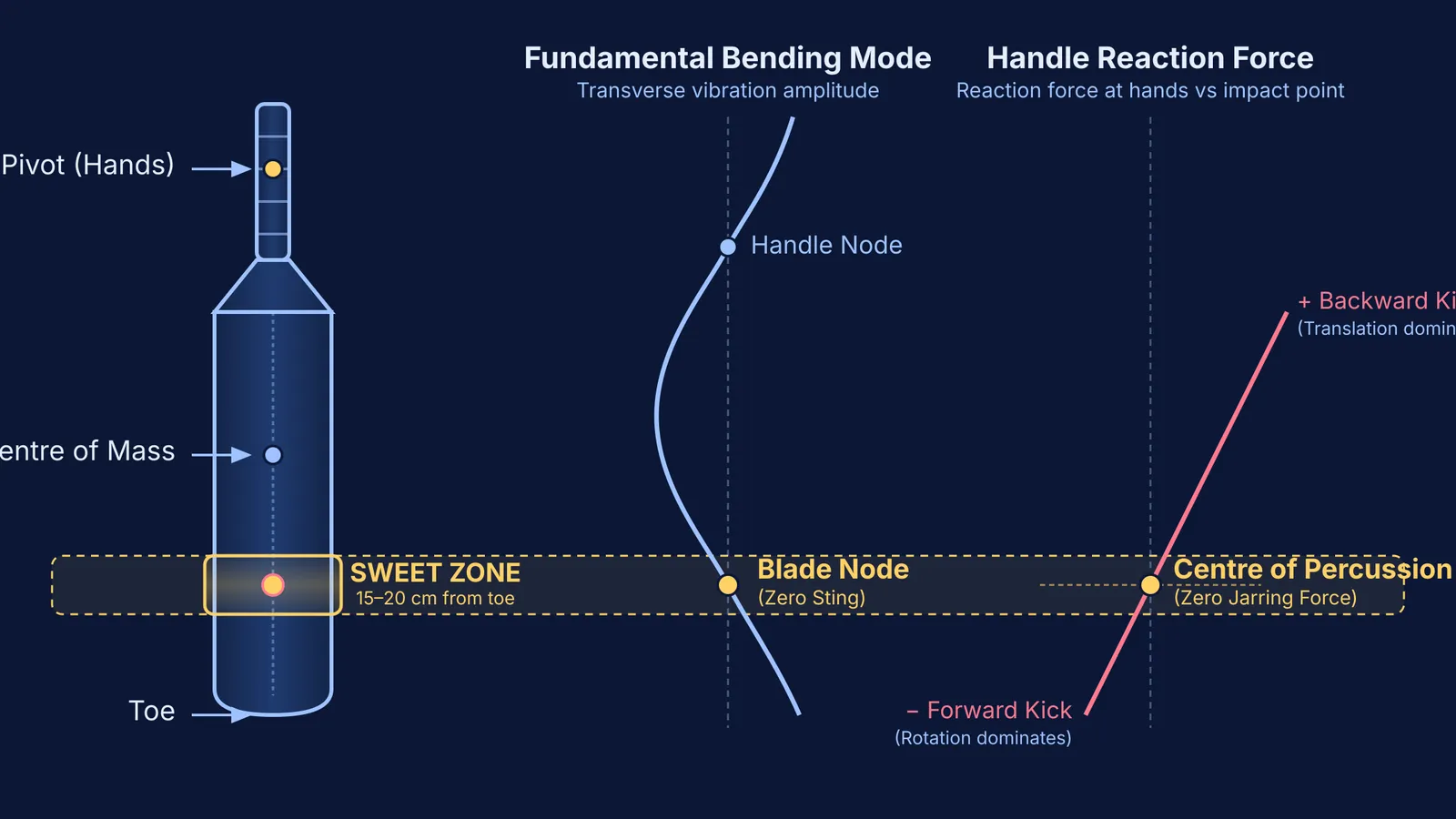
That effortless feeling marks the sweet spot. Rather than an arbitrary patch, physics defines the sweet spot as an engineered zone where three mechanical conditions coincide: the centre of percussion, the fundamental vibration node, and optimal wood thickness.
What is the sweet spot of a cricket bat?
In sports engineering, the sweet spot is defined by impact efficiency and comfort. In *Sports Engineering*, Rob Bower tested 24 impact positions on a swinging cricket bat. Bower showed that impacts 15 cm to 20 cm from the toe produced the highest rebound velocity, while the highest Apparent Coefficient of Restitution (ACOR)—the ratio of rebound speed to incoming speed—occurred 20 cm to 30 cm from the toe.
During collision, kinetic energy divides between ball rebound, bat recoil, rotation, and flexural vibrations. In the sweet zone, energy lost to bat recoil and vibration drops to near zero, transferring maximum kinetic energy to the ball.
Why does the centre of percussion prevent handle jarring?
When a cricket ball strikes the blade below the centre of mass, Newton's second law governs two simultaneous motions:
Linear recoil pushes the entire bat backwards.
Rotational torque about the centre of mass kicks the handle forward.
At the handle grip (the pivot point), these two motions oppose each other. If contact occurs high on the blade, translation dominates and kicks the handle into your palms. If contact occurs at the toe, rotation dominates and kicks the handle forward against your fingers.
Between these points lies the Centre of Percussion (COP). As physicist Rod Cross proved in the *American Journal of Physics*, striking the COP produces zero net reaction force at the batter's hands. The pivot experiences zero instantaneous acceleration, eliminating handle jarring.
To see how rotational torque and linear momentum balance dynamically during collisions, explore interactive simulations in the Fermi Simulation Lab.
How do vibration nodes stop the painful sting?
Eliminating recoil force does not stop every shock. Even with zero translational kick, an off-centre hit produces a sharp sting caused by flexural bending waves.
A cricket bat acts as a flexible beam. During an impact lasting 1.2 to 1.5 milliseconds, transverse waves travel through the willow. In the *American Journal of Physics*, Rod Cross showed that handheld bats vibrate with a fundamental bending mode between 100 Hz and 180 Hz.
This fundamental standing wave has two stationary nodes:
One node sits in the handle under the grip.
The second node sits on the blade, roughly 15 cm to 25 cm from the toe.
Striking the ball on this blade node excites no fundamental bending vibration. Because the mode amplitude remains zero, no vibrational energy is wasted, and no painful buzz reaches your hands.
Why do off-centre hits twist the bat?
Cricket bats feature a pronounced spine down the blade called the swell, aligning the bat's mass with its longitudinal axis.
When an impact lands off-centre, the contact force exerts a torque τ = r × F about the long axis. As explained in calculating torque as r × F, an off-axis force produces rapid rotational acceleration when the lever arm r is non-zero.
Because a bat is narrow, its torsional moment of inertia is small. Rob Bower's trials in *Sports Engineering* revealed that impacts straying more than 1 cm to 2 cm off the midline twist the blade, causing directional errors over 10° and cutting rebound speed. Modern bats use edges up to 40 mm thick to boost torsional inertia against these twisting forces.
Worked example: how do you calculate the centre of percussion?
In Class 11 mechanics, physical pendulums combine the parallel axis theorem with radius of gyration problems. In the *American Journal of Physics*, Rod Cross analyzed how pivoting a bat at the hands determines the exact impact location that eliminates pivot reaction force.
For a bat of mass M pivoted at the hands (point P):
h: distance from pivot to centre of mass.
k_cm: radius of gyration about centre of mass.
b: impact distance from pivot.
Linear impulse yields Δv_cm = J / M, while angular impulse yields Δω = J(b − h) / (M × k_cm²). The velocity change at the pivot is: Δv_P = Δv_cm − h × Δω = (J / M) × [1 − h(b − h) / k_cm²]
Setting Δv_P = 0 for zero reaction force gives: b = h + (k_cm² / h)
For a standard bat where h = 45 cm (0.45 m), k_cm = 22 cm (0.22 m), and the toe sits 72 cm from the hands:
k_cm² / h = (0.22)² / 0.45 = 0.108 m (10.8 cm).
b = 0.45 m + 0.108 m = 0.558 m (55.8 cm) from the hands.
Distance from toe = 72 cm − 55.8 cm = 16.2 cm.
This 16.2 cm location falls right inside the 15 cm to 20 cm sweet region measured by Rob Bower in *Sports Engineering*. Connecting mass distribution to the centre of percussion clarifies real-world collisions and momentum. To review rotational mechanics concepts from first principles, visit the Fermi Concept Library.


