On this page
Inside a drum brake, two curved shoes press outward against a spinning drum. One hydraulic cylinder pushes both of them with the same force, so you might expect them to share the braking equally. They do not. With the drum turning one way, one shoe can give almost twice the braking torque of the other. The reason is a moment about a pivot: friction from the turning drum drags one shoe harder into the drum and pulls the other one away. It is a clean torque-and-friction problem of the kind JEE likes to set.
How is a drum brake shoe held and pushed?
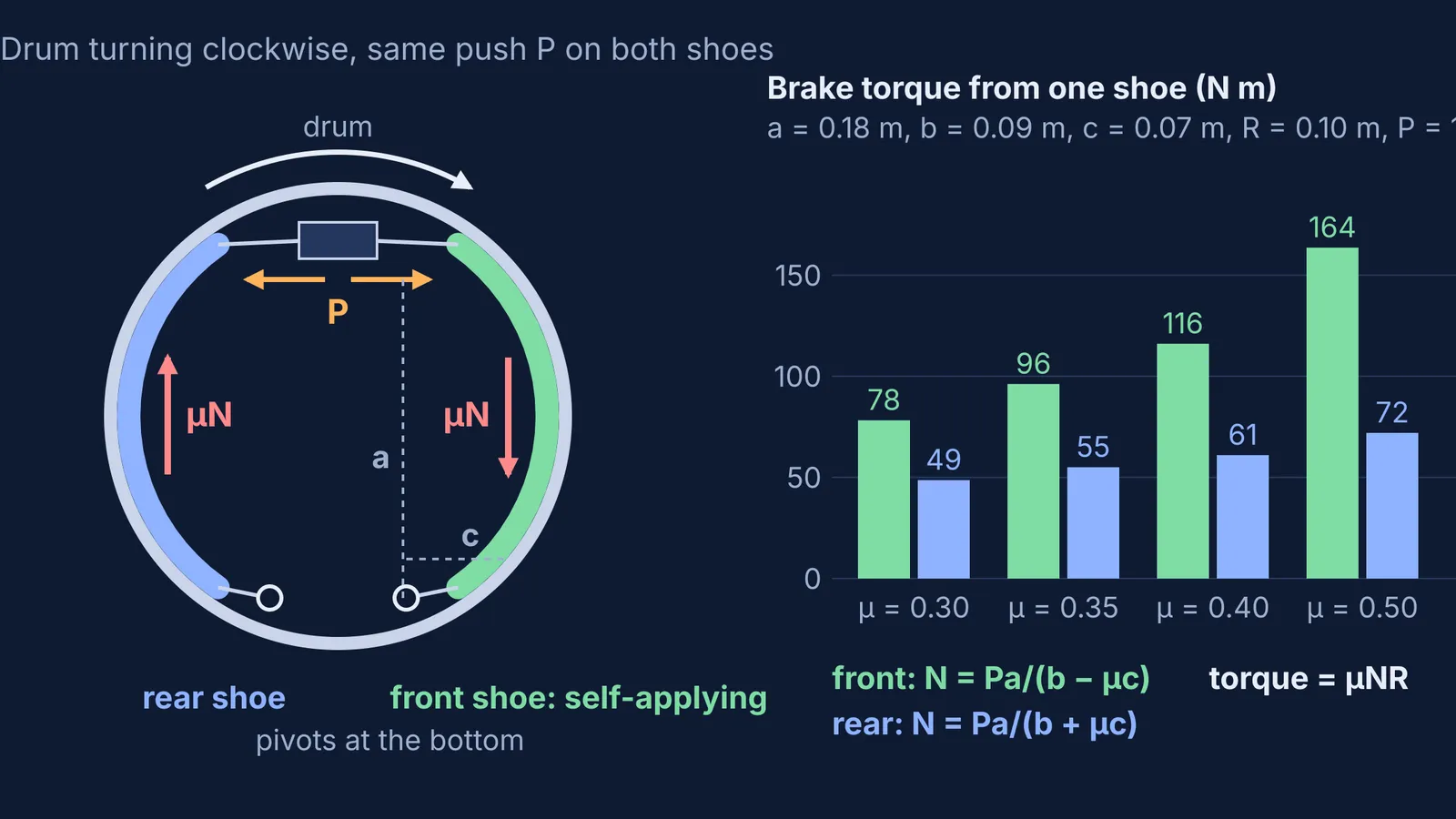
Each shoe is a curved arm lined with friction material. One end, the heel, sits on a fixed pivot. The other end, the toe, is pushed outward by the brake cylinder with a force P. The hydraulic side of this, how a light pedal push becomes a large force at the cylinder, is in Pascal's law in hydraulic machines.
When the lining touches the drum, the drum pushes back on the shoe with a normal force N, and friction μN acts along the drum's surface. The braking torque on the wheel is then μNR, where R is the drum radius. That part is the same as for a pad on a disc, worked in braking torque on a wheel from brake pads. What is new here is the pivot.
Why does one shoe press harder than the other?
The shoe is a rigid body on a pivot, so its moments about the pivot must balance. Three forces have moments:
the push P, at a perpendicular distance a from the pivot;
the normal force N from the drum, at a distance b;
the friction μN, at a distance c.
Friction always acts on the shoe in the direction the drum surface is moving. On one shoe that direction swings the shoe outward into the drum, the same way P does. On the other shoe it swings the shoe inward, away from the drum.
Front (self-applying) shoe. Friction's moment adds to the push:
P a + μN c = N b, so N = P a/(b − μc).
Rear (trailing) shoe. Friction's moment opposes the push:
P a = N b + μN c, so N = P a/(b + μc).
The front shoe is the one whose toe meets the drum surface first as it turns, so the drum drags it from the cylinder end towards the pivot. Machine-design texts call this a self-energising shoe. The IIT Madras Machine Design II notes on drum brakes by Gopinath and Mayuram, published on NPTEL, give the same moment balance with opposite signs for the two shoes. They also note that the trailing shoe presses less hard, because the moment of its friction force opposes the normal force.
Worked example: how much torque does each shoe give?
All dimensions here are illustrative round numbers, not any real brake: a = 0.18 m, b = 0.09 m, c = 0.07 m, drum radius R = 0.10 m and push P = 1,000 N on each shoe. Take μ = 0.35.
Moment of the push. P a = 1,000 × 0.18 = 180 N m.
Front shoe. b − μc = 0.09 − 0.35 × 0.07 = 0.0655 m. N = 180/0.0655 = 2,750 N.
Rear shoe. b + μc = 0.09 + 0.0245 = 0.1145 m. N = 180/0.1145 = 1,570 N.
Torques. Front: μNR = 0.35 × 2,750 × 0.10 = 96 N m. Rear: 0.35 × 1,570 × 0.10 = 55 N m.
Ratio. 96/55 = 1.75. The front shoe does 1.75 times the work of the rear one, from the same push.
Check the units: P a is in N m, b − μc is in m, so N comes out in newtons, and μNR is in N m, a torque.
Change μ and the ratio changes:
μ = 0.30: 78 N m and 49 N m, ratio 1.61.
μ = 0.40: 116 N m and 61 N m, ratio 1.90.
μ = 0.50: 164 N m and 72 N m, ratio 2.27.
These values come from lumping the shoe's pressure at single points. Real designs spread the pressure along the shoe and integrate it, as the NPTEL notes do, so treat these numbers as a model of the idea.
Why is a self-applying shoe strong but touchy?
Look at what a small change in friction does. Raise μ from 0.35 to 0.40, a rise of 14%:
The rear shoe's torque goes from 55 to 61 N m, up 11%.
The front shoe's torque goes from 96 to 116 N m, up 21%.
The front shoe magnifies any change in friction, because μ also shrinks the denominator b − μc. Lining that gets wet, hot or contaminated changes its μ, and a self-applying shoe passes that change on more than proportionally.
Push this further. If μc ever reached b, the denominator would be zero and the shoe would jam itself with no push at all. Here that would need μ = b/c = 1.29, far above real lining values, so designers keep b well clear of μc. A plain disc brake has no pivot of this kind, so its torque follows μ in simple proportion, which is one reason a disc brake's output changes less when friction changes.
What happens when the drum turns the other way?
The roles swap. Reverse the drum and the rear shoe becomes the self-applying one, as the NPTEL notes point out. A layout with one shoe of each kind gives the same total in both directions: 96 + 55 = 151 N m here.
Some brakes arrange both shoes to be self-applying going forward, a layout the NPTEL notes also describe. In this model that gives 2 × 96 = 192 N m forward, but only 2 × 55 = 110 N m when the vehicle rolls backwards. It is the same pivot and moment idea that drives the shoes of a centrifugal clutch, with a cylinder instead of spinning weights.
Brakes are safety parts. Inspection, adjustment and repair are work for a qualified mechanic.
How does this help with JEE problems?
JEE does not ask about brake shoes by name, but it can ask for the force needed to hold a rotating drum with a lever or block, which is exactly this moment balance. Practise writing the moment equation with friction's sign decided first. The Fermi Problem Library has a step-by-step solver that explains the reasoning, and Fermi Test Prep offers personalised preparation for JEE Main & Advanced with an AI tutor, live classes, adaptive mocks, mentorship and a study plan that updates based on mastery.
Quick checklist
Moments about the shoe's pivot: P a, N b and μN c.
Self-applying shoe: N = P a/(b − μc). Trailing shoe: N = P a/(b + μc).
Torque from each shoe = μNR.
Example at μ = 0.35: 96 N m against 55 N m, ratio 1.75.
The self-applying shoe is more sensitive to changes in μ.
Reverse the drum and the two shoes swap roles.