

On this page
A brake pad never touches the axle. It presses on the rim, and the friction there turns into a torque that slows the whole wheel. Once you see that step, every braking problem comes down to four lines.
What is the braking torque from a brake pad?
The pad pushes on the rim with a normal force N. Kinetic friction at the contact has magnitude f = μN and acts along the rim, against the rim's motion, as the OpenStax University Physics chapter on friction sets out.
Torque is the force times its lever arm, the perpendicular distance from the axis to the force's line of action: τ = r⊥F, as defined in OpenStax University Physics, section 10.6. Friction at the rim is tangent to the rim, so it is perpendicular to the radius and the lever arm is the full radius R.
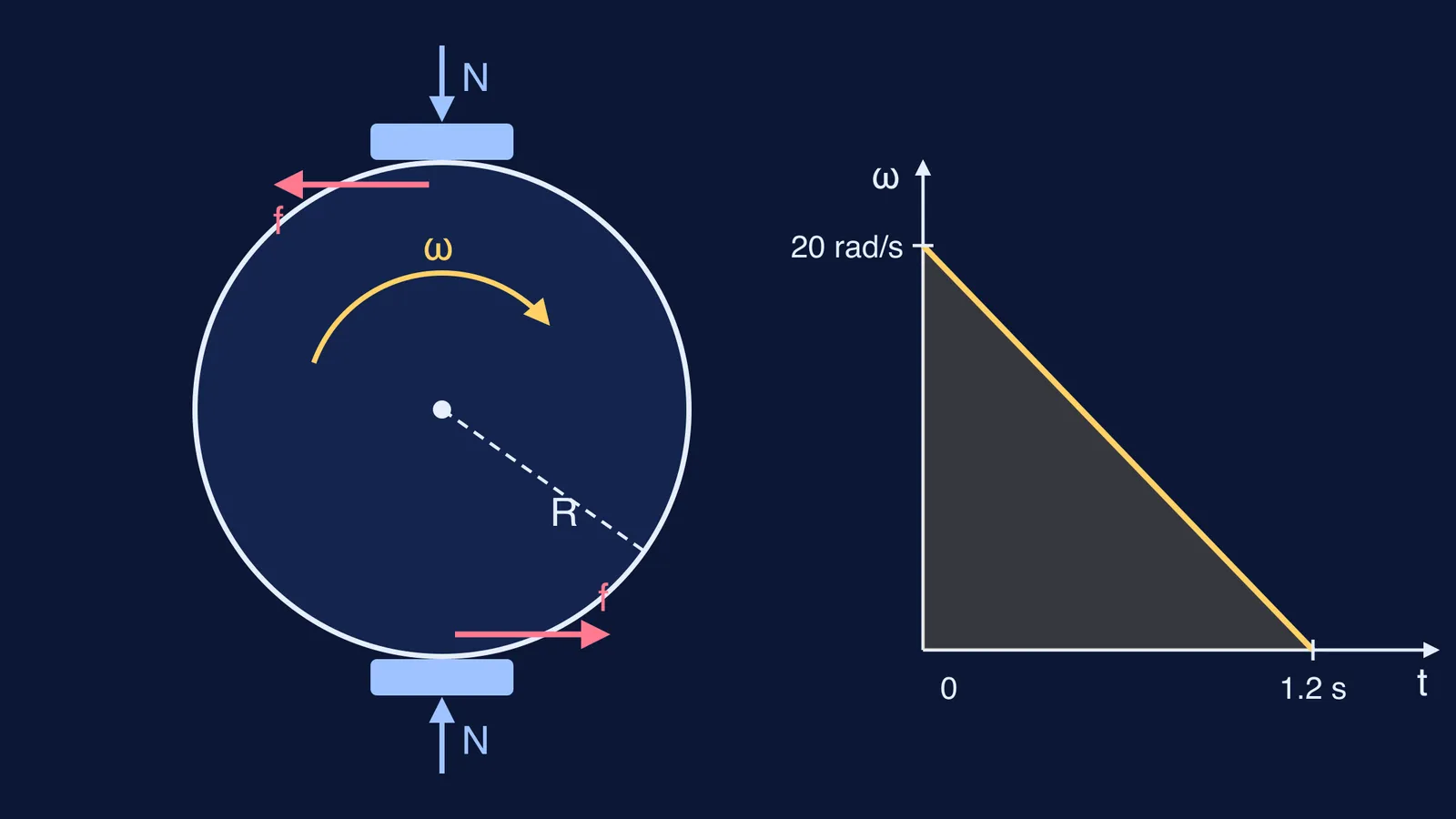
So the braking torque from one pad is τ = μNR. With two pads squeezing from opposite sides, as in the diagram above, both friction forces turn the wheel the same way, so the torques add: τ = 2μNR.
How do you find the stopping time from moment of inertia and initial speed?
Newton's second law for rotation says the net torque about a fixed axis equals the moment of inertia times the angular acceleration, τ = Iα (OpenStax University Physics, section 10.7). Friction torque is constant, so the deceleration is constant too.
For constant angular acceleration, ω = ω₀ + αt (OpenStax, section 10.2). Take α as the size of the deceleration, so ω = ω₀ − αt, and set ω = 0 to get the stopping time:
t = ω₀/α = Iω₀/τ
If the question gives the rim's linear speed instead, convert first with v = Rω (OpenStax, section 10.3). The section 10.2 equation ω² = ω₀² + 2αθ gives the angle turned before stopping, if that is asked as well. If the angular kinematics feel shaky, our guide to the rotational kinematics equations goes through all of them.
Worked example: a flywheel with two brake pads
A flywheel is a uniform solid disc of mass 40 kg and radius 0.30 m. Its rim moves at 6 m/s. Two brake pads press on the rim from opposite sides, each with a normal force of 100 N, and μ = 0.5. How long does it take to stop, and how many turns does it make?
Moment of inertia. For a uniform disc about its axis, I = ½MR² (OpenStax, section 10.5). I = ½ × 40 × 0.09 = 1.8 kg m².
Initial angular speed. ω₀ = v/R = 6/0.30 = 20 rad/s.
Friction. Each pad gives f = 0.5 × 100 = 50 N, so the total is 100 N.
Torque. τ = 100 × 0.30 = 30 N m.
Angular deceleration. α = τ/I = 30/1.8 ≈ 16.7 rad/s².
Stopping time. t = ω₀/α = 20 × 1.8/30 = 1.2 s.
Angle turned. θ = ω₀²/(2α) = 400 × 1.8/60 = 12 rad, which is 12/(2π) ≈ 1.9 turns.
The graph above shows this example: ω falls in a straight line to zero at 1.2 s, and the shaded area is the 12 rad turned.
Does a bigger wheel take longer to stop?
Put the disc's I = ½MR² (OpenStax, section 10.5) into t = Iω₀/τ. With ω₀ = v₀/R and τ = fR, you get t = Mv₀/(2f). For the example, 40 × 6/(2 × 100) = 1.2 s, the same answer.
The radius cancels. For the same mass, rim speed and pad friction, a uniform disc stops in the same time whatever its size: a larger R gives a larger torque, but it also raises I and lowers ω₀ by the same factors. A thin ring, with I = MR² (OpenStax, section 10.4), takes twice as long, t = Mv₀/f, because all its mass sits at the rim. That is the idea behind why flywheels put their mass at the rim.
What mistakes cost marks in braking-torque problems?
Using N instead of μN. The pad's push points at the axle or runs parallel to it, so it gives no torque about the axle. Only friction does.
Counting one pad when there are two.
Leaving speed in rpm. Multiply by 2π/60 to get rad/s.
Using I = MR² for a disc, or ½MR² for a ring.
Taking R as the tyre radius when the pads grip a smaller rotor.
Getting the sign of α wrong and finding a negative time.
For more practice, finding the angular acceleration of a flywheel uses the same τ = Iα step.
When your answer is off and you cannot see which step went wrong, the Fermi Problem Library has worked problems with a step-by-step solver that explains the reasoning rather than printing an answer. If the gap is in moment of inertia itself, the Fermi Concept Library gives each concept its own lesson.


