

On this page
Rotational dynamics often feels like learning a new language where all the symbols are Greek and the rules of motion have suddenly changed. But mathematically, rotational kinematics closely mirrors the linear motion you already know from Newton's laws. The real difficulty lies in picturing what the mathematics represents.
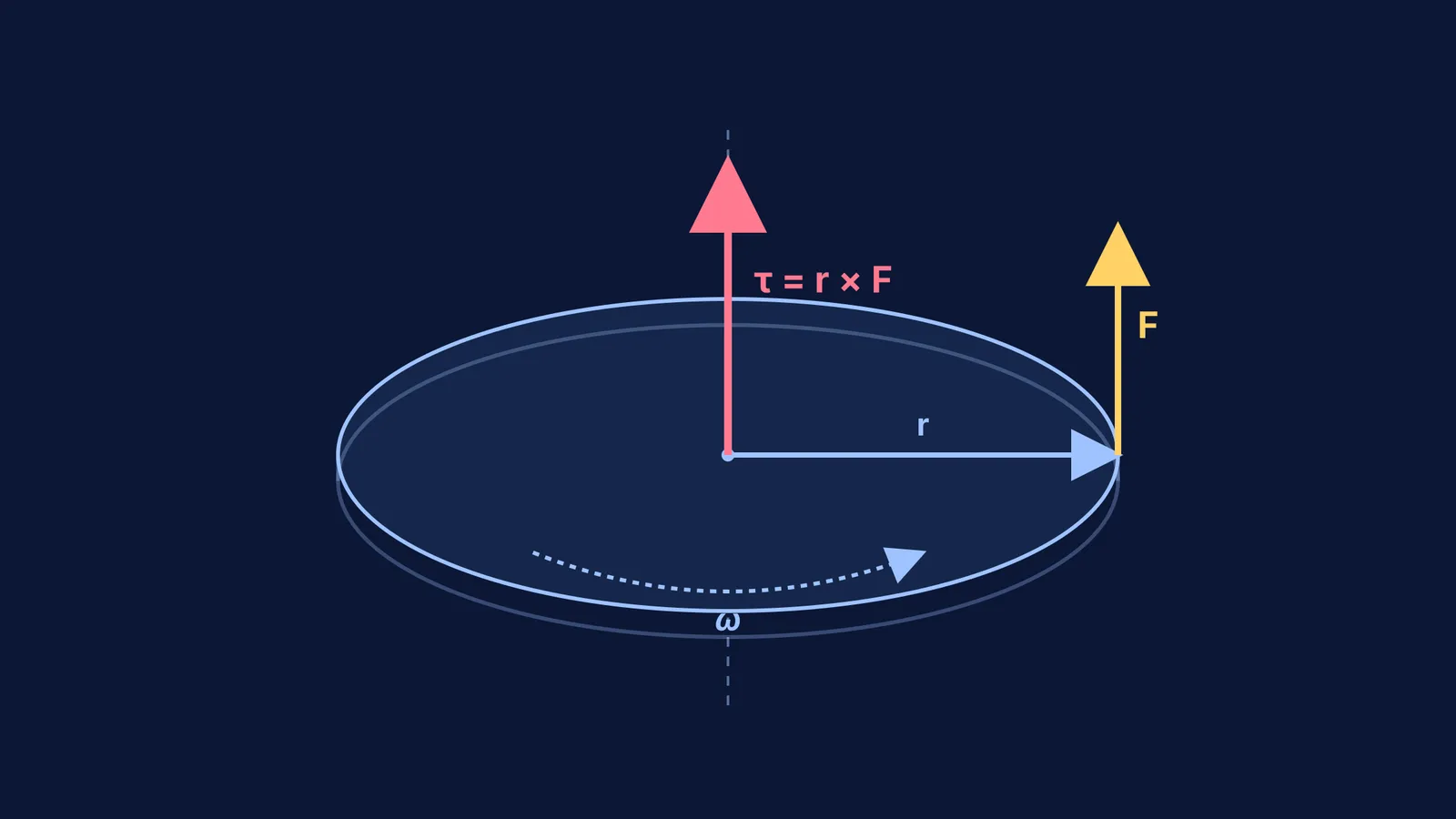
In a 2013 study published in the AIP Conference Proceedings, researchers at the Monterrey Institute of Technology in Mexico found that 18% of undergraduate physics students held the misconception that an object will physically move in the exact direction of the torque vector. Because the abstract mathematical torque vector actually points straight along the central axis of rotation (into or out of the page), students mistakenly thought the wheel would slide sideways rather than spin. Overcoming this visual hurdle and keeping track of vectors is the first step to reliably solving flywheel numericals.
What is the relation between linear and rotational motion?
Flywheels are heavy, spinning disks used in engines to store rotational energy and keep power delivery smooth. Because they resist changes to their rotational speed, understanding their motion is essential.
Every linear concept has a rotational twin. Where a linear force (F) pushes a mass (m) to create linear acceleration (a), a rotational torque (τ) twists a moment of inertia (I) to create angular acceleration (α). The moment of inertia depends on both the mass of the wheel and how far that mass is from the centre.
The linear rule F = ma becomes the rotational rule τ = Iα.
Similarly, the three standard equations of motion translate directly:
v = u + at becomes ω = ω₀ + αt
s = ut + 1/2 at² becomes θ = ω₀t + 1/2 αt²
v² = u² + 2as becomes ω² = ω₀² + 2αθ
If you struggle to picture how these vectors point perpendicular to the actual rotation, the Fermi Simulation Lab provides interactive simulations for the ideas that are easier to see than to read.
How many revolutions does a flywheel make?
Let us apply these equations to a standard physics problem. Suppose you have a solid disk flywheel with a mass of 10 kg and a radius of 0.2 m, initially at rest. A motor applies a constant torque of 1.0 N m. How many revolutions will the flywheel complete in 4.0 seconds?
Step 1: Find the moment of inertia (I) For a uniform solid disk, the formula is I = 1/2 mr². I = 1/2 × 10 × (0.2)² I = 0.5 × 10 × 0.04 = 0.2 kg m².
*(Note: If the shape changes to a hollow ring or a solid sphere, this formula changes. See our guide on radius of gyration problems for more details.)*
Step 2: Find the angular acceleration (α) Rearrange Newton's second law for rotation to isolate acceleration: α = τ / I α = 1.0 / 0.2 = 5.0 rad/s².
Step 3: Calculate the angular displacement (θ) Since the flywheel starts from rest, its initial angular velocity is zero (ω₀ = 0). We want to find how far it turns in time t = 4.0 s. θ = ω₀t + 1/2 αt² θ = 0 + 1/2 (5.0)(4.0)² θ = 2.5 × 16 = 40 radians.
Step 4: Convert radians to revolutions One full circle is 2π radians. To find the number of turns, divide the total radians by 2π. Revolutions = 40 / (2π) = 20 / π Using π ≈ 3.1416, this gives roughly 6.37 revolutions.
If you keep dropping a factor of a half or plugging the wrong values into these equations, the Fermi Problem Library features a step-by-step solver that explains the reasoning rather than printing an answer.
How do you build a reliable framework for rotational numericals?
When tackling a flywheel problem, whether for an engineering course or CBSE Class 11, stick to this routine:
Draw the wheel: Mark the axis of rotation and the point where force is applied. If you are given a force instead of a torque, use τ = r × F to find the twisting effort first (read more on finding torque with vectors).
List the givens: Write down m, r, τ, t, and ω₀. Pay close attention to their units, ensuring everything is in standard SI units (kg, metres, seconds).
Isolate the kinematics: Once you use τ = Iα to find acceleration, treat the rest of the problem exactly like finding distance in the nth second, substituting angles for distances and angular velocity for linear velocity.
By treating the moment of inertia as rotational mass and torque as a twisting force, the complex spinning motion of a flywheel simplifies back into the familiar equations you already know.


