

On this page
A flywheel is a mechanical device designed to store rotational kinetic energy and smooth out fluctuations in engine speed. If you have ever seen an antique steam engine, a potter's wheel, or an indoor exercise bike, you may have noticed that their spinning wheels are not solid discs. Instead, they feature a heavy outer rim connected to the central hub by thin spokes.
This structural choice comes down to the fundamental physics of rotational motion. Whether it is smoothing out the power strokes of a car engine or maintaining resistance on an indoor spin bike, its effectiveness depends on how well it resists changes to its rotational speed, a property called the moment of inertia.
What is the moment of inertia?
In linear motion, mass dictates how hard it is to accelerate an object. In rotational mechanics, the equivalent is the moment of inertia (I) HyperPhysics. It is a measure of an object's resistance to rotational acceleration. However, I depends not just on the total mass, but on how that mass is distributed around the axis of rotation.
For a single point mass, the formula is I = mr², where m is the mass and r is the distance from the centre. Because the distance r is squared, moving a kilogram of mass twice as far from the centre increases its contribution to the total moment of inertia by a factor of four. Mass placed further from the centre has a much greater impact than mass kept near the hub.
The kinetic energy a flywheel can store is given by E = ½Iω², where ω is the angular velocity. To store more energy without spinning the wheel dangerously fast, you need a higher moment of inertia.
Why do flywheels have most of their mass at the rim?
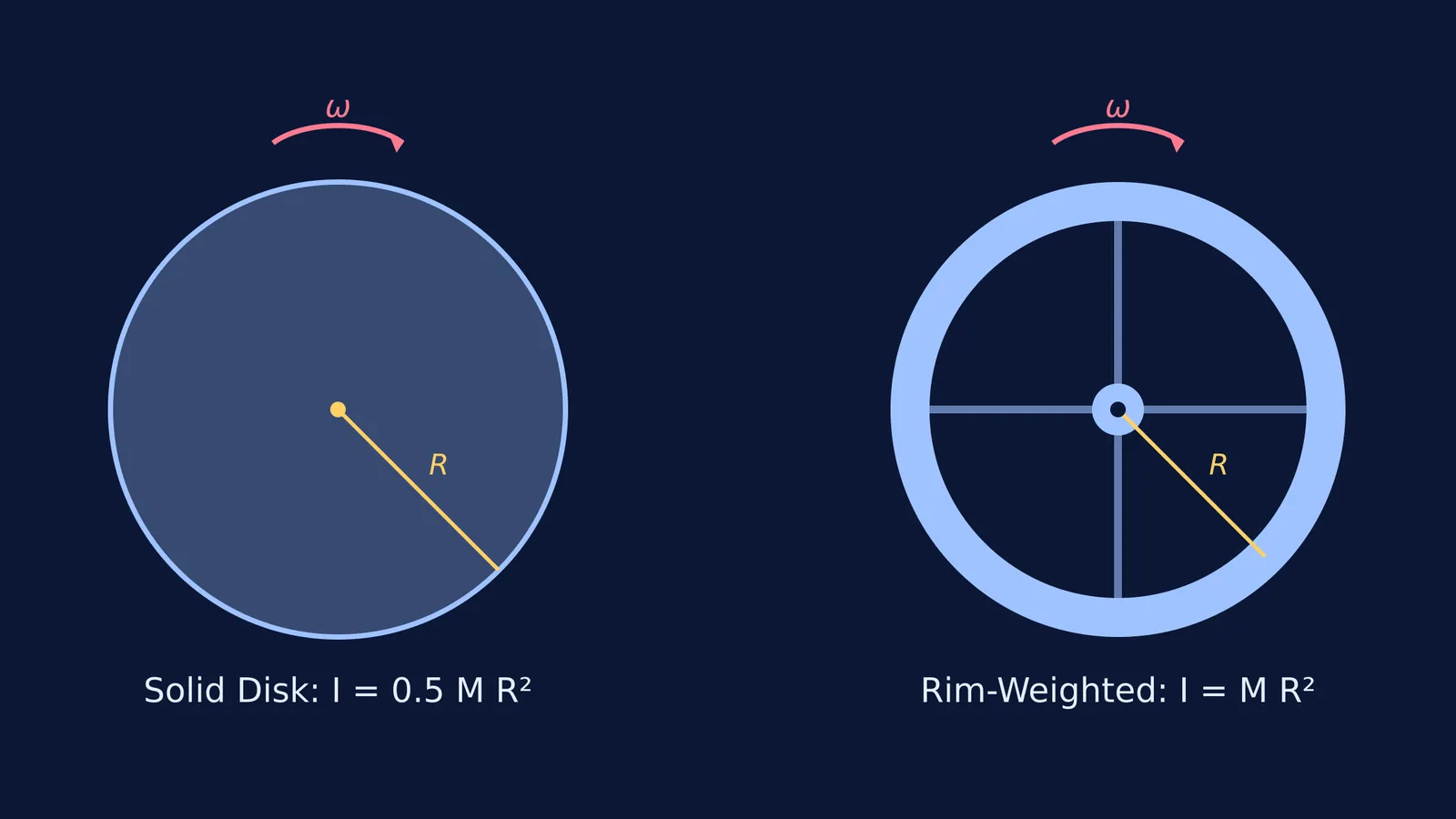
When designing a flywheel, engineers face a choice: they can make a solid disk, or they can concentrate the mass at the outer edge (the rim).
According to HyperPhysics, a solid cylinder of mass M and radius R has a moment of inertia of I = ½MR² HyperPhysics. In contrast, a thin hollow cylinder or hoop of the same mass and radius has a moment of inertia of I = MR². By concentrating the mass at the rim rather than spreading it evenly as a solid disc, engineers effectively double the moment of inertia without adding any extra weight.
This design delivers maximum rotational persistence and energy storage per kilogram. It saves material, reduces the load on the central bearings, and creates a more efficient machine.
How does a spin bike use a flywheel?
You can feel this physics in action at the gym. Indoor cycling bikes use heavy flywheels to simulate the momentum of riding on a road. A standard indoor spin bike flywheel, such as the one on an original Peloton, weighs 38 lbs (approximately 17.2 kg) LiveScience.
Let's apply the formulas to a concrete example to see why the mass distribution matters. Suppose we have a 17.2 kg flywheel with an outer radius of roughly 0.225 m, and we spin it to an angular velocity of 10 rad/s.
If it were a solid disk: I = ½ × 17.2 × 0.225² = 0.435 kg·m². The stored kinetic energy would be E = ½ × 0.435 × 10² = 21.75 Joules.
If all mass were at the rim: I = 17.2 × 0.225² = 0.87 kg·m². The stored kinetic energy would be E = ½ × 0.87 × 10² = 43.5 Joules.
By designing the wheel with a heavy outer ring, the high inertia bridges the "dead spots" in your pedal stroke, maintaining a steady and smooth ride even when you are tired. It stores exactly twice as much energy as a solid disc of the same mass and radius spinning at the same speed.
Exam strategy: mastering rotational mechanics
In physics exams, questions often test your ability to switch between formulas for rings, disks, solid spheres, and hollow cylinders. Remembering that r² is the dominant factor will help you intuitively check your answers. If a shape has its mass spread closer to the centre, its inertia multiplier is a fraction less than 1 (such as ½ for a disk or ⅖ for a solid sphere). If the mass is concentrated at the outer edge, the multiplier approaches 1.
You should also be comfortable linking the moment of inertia directly to rotational kinetic energy and angular momentum (L = Iω). When a problem asks how much energy is released when a flywheel slows down, you simply calculate the difference in energy: ΔE = ½I(ω₁² − ω₂²).
These principles of rotational dynamics appear repeatedly across the syllabus. Just as you must balance forces to find simple pendulum string tension or balance torques using the principle of moments, you must balance mass and distance to optimise a flywheel's momentum.
To build intuition for these equations and test your understanding of rotational mechanics, try the Fermi Problem Library. Working through different mass distribution scenarios will help you easily solve classic dynamics questions.


