On this page
On a warm afternoon your hatchback's boot lid swings up and stays there. On a cold winter morning in Delhi the same lid rises slowly, or drifts back down onto your head. The two gas struts holding the lid are pushing less, because the nitrogen inside them is colder. Two Class 11 ideas explain it: force = pressure × area, and the pressure law for a gas. The twist is which area you use.
How does a gas strut push if the gas presses on both sides of the piston?
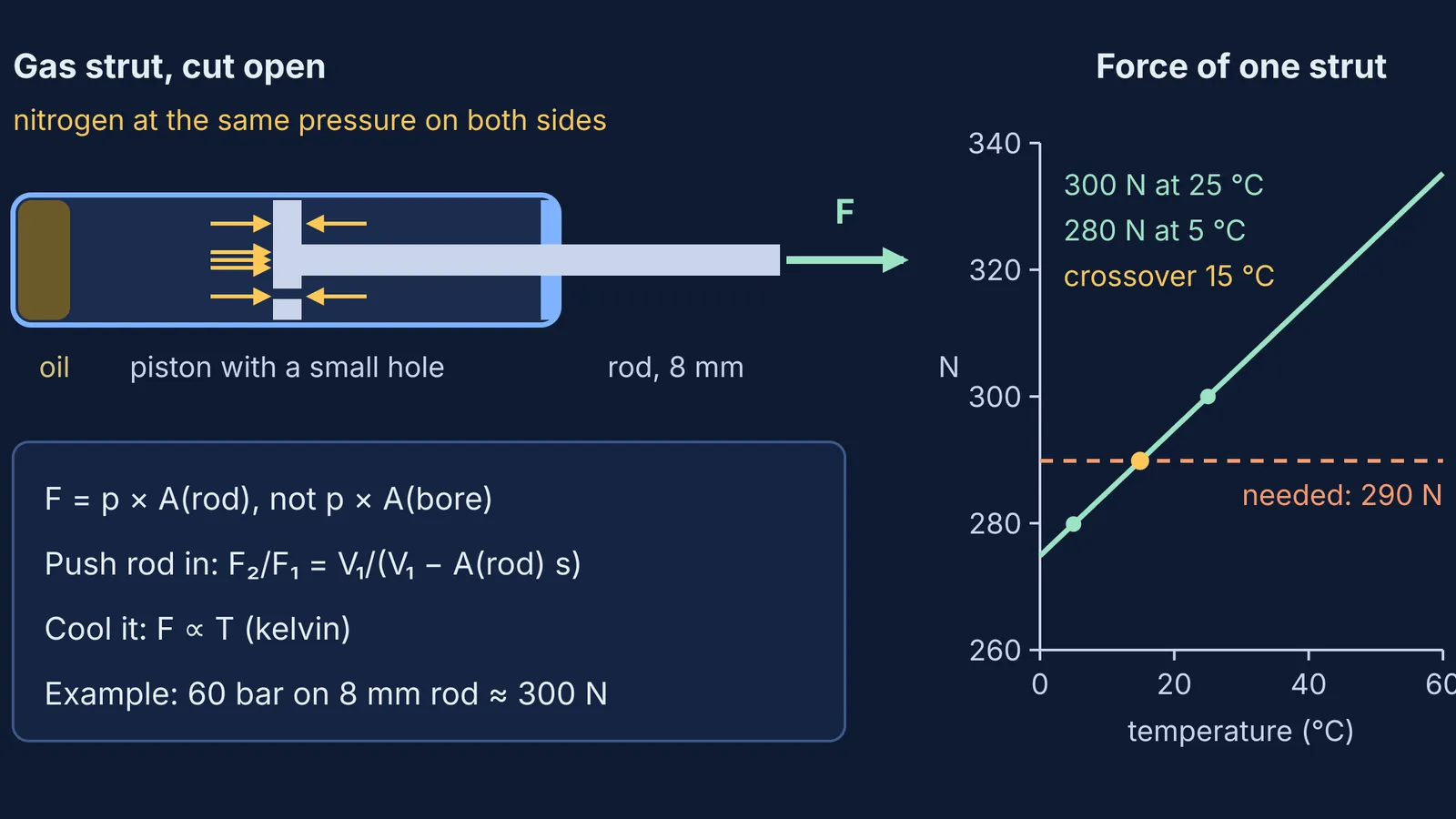
A gas strut (also called a gas spring) is a sealed steel tube filled with nitrogen at high pressure, plus a little oil. Inside is a piston fixed to a rod that comes out through a seal at one end. The piston has a small hole through it, so gas flows from one side to the other. The pressure is therefore the same on both faces of the piston.
Now count the area each face offers to the gas:
The back face is a full circle, the bore area A(bore).
The front face is a ring, because the rod covers its middle. Its area is A(bore) − A(rod).
The same pressure p pushes forward on A(bore) and backward on A(bore) − A(rod). Everything cancels except the part the rod covers, so the net outward push is
F = p × A(rod)
Strictly, the rod's outer end also feels the atmosphere, so p here is the pressure above atmospheric. For a strut at tens of bar that correction is only a few newtons.
The gas-spring maker Bansbach gives exactly this rule in its force diagram sheet: the theoretical extension force is the filling pressure times the cross-section of the piston rod.
Why does the rod area matter and not the tube size?
Take an illustrative strut with an 8 mm rod. Its area is π × (4 mm)² = 50.3 mm². To push with 300 N, the gas must be at
p = 300 N ÷ 50.3 × 10⁻⁶ m² = 5.97 × 10⁶ Pa, about 60 bar.
If the same gas pressed on the whole 19 mm piston from one side only, the force would be 5.97 × 10⁶ × 283.5 × 10⁻⁶ ≈ 1,700 N. That is not what happens, because the gas reaches both sides. A fatter tube with the same rod and pressure gives the same force. A bigger tube only holds more gas, so the force rises more gently with stroke.
Real struts run at higher pressures than this example. Bansbach's installation advice says its springs have internal pressures up to about 300 bar. The 60 bar here is a round illustrative value chosen to give a 300 N strut.
Why does the strut push harder as you close the lid?
Closing the lid pushes the rod into the tube. The rod takes up space, so the gas volume falls by A(rod) × stroke. With a 200 mm stroke, that is 50.3 mm² × 200 mm = 10.1 cm³.
Say the tube holds 85 cm³ of gas when the rod is out. Pushed slowly, the gas stays at room temperature and Boyle's law applies, as in Boyle's law with a syringe:
F₂ = 300 × 85 ÷ (85 − 10.1) = 340 N
Pushed quickly, the gas has no time to lose heat, so the change is close to adiabatic (γ = 1.4 for nitrogen):
F₂ = 300 × (85 ÷ 74.9)^1.4 = 358 N
So the push rises by about 13 to 19% over the stroke. The same "trapped gas as a spring" idea is worked as an oscillation in the time period of a piston on gas in a cylinder.
Why does a cold morning make the lid sag?
The nitrogen is sealed in, so its volume does not change with the weather. At fixed volume, the pressure law says p ∝ T, with T in kelvin. Since F = p × A(rod), the force is also proportional to kelvin temperature.
For our strut, 300 N at 25 °C (298 K) becomes:
300 × 278 ÷ 298 = 280 N at 5 °C
300 × 318 ÷ 298 = 320 N at 45 °C
300 × 333 ÷ 298 = 335 N at 60 °C, for example in a car parked in the sun
That is about 3.4% per 10 °C from the ideal-gas law. Bansbach's force diagram sheet gives about 3.3% per 10 °C for real springs, which agrees well. The same sheet quotes a factory tolerance on force of +40 N/−20 N, or about ±5 to 7%. So two struts that are both within specification can differ by as much as a cold morning does.
Worked example: will the lid stay up at 5 °C?
Question. A boot lid has a mass of 13 kg. Its centre of mass is 0.5 m from the hinge, measured horizontally when open. Two struts each act with a lever arm of 0.11 m about the hinge. Each strut gives 300 N at 25 °C. Does the lid stay open at 25 °C and at 5 °C? Ignore friction. All values are illustrative.
Weight. W = 13 × 9.81 = 127.5 N.
Torque of the weight about the hinge. τ = 127.5 × 0.5 = 63.8 N m.
Force each strut must give. 2 × F × 0.11 = 63.8, so F = 63.8 ÷ 0.22 = 290 N. This is the same balance Bansbach's sheet uses to size struts: force = weight × lever arm of the weight ÷ (strut lever arm × number of struts).
At 25 °C. Each strut gives 300 N, which is more than 290 N. The lid holds.
At 5 °C. Each strut gives 300 × 278.15 ÷ 298.15 = 280 N, less than 290 N. The lid drifts down.
Crossover. Set 300 × T ÷ 298.15 = 290: T = 288 K, about 15 °C.
In a real car, friction in the rod seal helps hold the lid a little below the calculated force. That is why a cold lid often sags slowly instead of dropping. Gas slowly leaking past the seal over the years lowers p for good, which is the usual reason old struts stop holding.
Is it safe to repair or open a gas strut?
No. Never puncture, heat, cut or dismantle a gas strut. Even a small one holds gas at high pressure, and Bansbach's installation advice warns its springs are labelled "Do Not Open – High Pressure" and must not be overheated or put in a fire. A weak strut is replaced as a whole unit by a mechanic, not refilled at home.
To see how pressure, volume and temperature trade off before you work these numbers, the gas-law entries in the Concept Library go through each law step by step.
Quick checklist
Net push of a gas strut: F = p × A(rod), because the holed piston has gas on both sides.
Pushing the rod in shrinks the gas by A(rod) × stroke, so the force rises (Boyle's law if slow, adiabatic if fast).
At fixed volume, F ∝ T in kelvin: about 3.3 to 3.4% per 10 °C.
Lid balance: number of struts × F × strut lever arm = weight × its lever arm.
Never open, heat or puncture a strut.