On this page
Most flowmeters measure how fast a liquid moves. Multiply that speed by the pipe's area and you get volume per second. But a buyer of oil, milk or a chemical usually pays by mass, and the mass in a litre changes when the liquid warms up. A Coriolis flowmeter skips that problem. It shakes the tube the liquid runs through and reads the mass flow rate directly from the sideways push the moving liquid gives back.
How does a Coriolis flowmeter work?
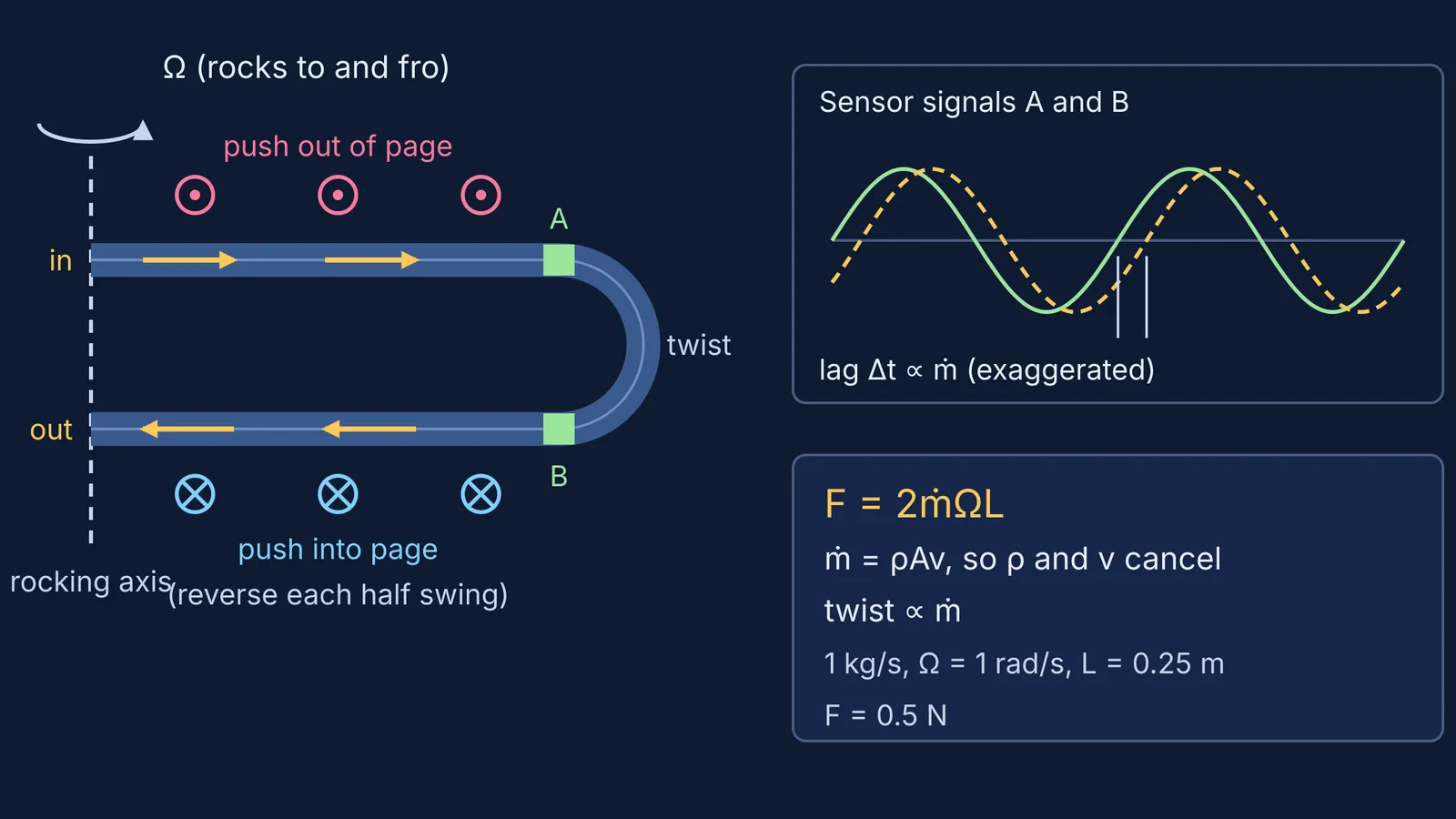
Inside the meter the liquid runs through one or two bent tubes, often U-shaped. A small drive coil rocks each tube to and fro about its fixed root, like a tuning fork, at the tube's natural frequency. With no flow, both legs of the U swing together. With flow, the outgoing leg and the returning leg get pushed in opposite directions, so the U twists a little in time with its rocking. Sensors on the two legs then see their sine-wave signals slightly out of step.
Emerson's explanation of Coriolis theory for its Micro Motion meters describes this time delay, which it calls Delta T, as measured in microseconds and directly proportional to the mass flow rate. Endress+Hauser's note on how Coriolis flowmeters work adds that the same vibration gives density too: a heavier liquid makes the tube vibrate at a lower frequency. A 2006 review by Anklin, Drahm and Rieder in Flow Measurement and Instrumentation covers the designs.
How fast-moving bodies seem to swerve on a turntable is covered in the path of a ball rolled on a rotating merry-go-round, and the history of the force in Gustave Coriolis: the engineer behind the sideways force. Here we use that force to build a meter.
Why does liquid in a turning tube push sideways?
You do not need a rotating frame. Stay on the ground and follow one small piece of liquid of mass dm. It moves outward along the tube at speed v while the tube turns at angular speed Ω about its root.
Its sideways speed must grow. At distance r from the axis, the tube carries it sideways at Ωr. As it moves out, r grows at rate v, so its sideways speed grows at rate Ωv.
Its outward velocity keeps turning. The direction of the tube turns at rate Ω, so the velocity v along the tube is being rotated, which needs another sideways acceleration Ωv.
Add them. The total sideways acceleration is 2Ωv, and the tube wall must supply a force 2(dm)vΩ. By Newton's third law the liquid pushes back on the tube with the same force.
That is the Coriolis force, seen from outside. It is beyond the Class 11 syllabus, but each step above uses only circular motion.
Why do density and speed cancel out?
Now add up the pushes along one straight leg of length L. A slice of length dx holds dm = ρA dx, where ρ is the density and A the bore area. So
dm × v = ρAv dx = ṁ dx,
because ρAv is exactly the mass flow rate ṁ in kg/s. Adding 2ṁΩ dx along the whole leg gives
F = 2ṁΩL
Neither ρ nor v appears on its own. A light liquid moving fast and a heavy liquid moving slowly give the same force if they carry the same kilograms per second. A volume meter cannot do that.
On the returning leg the liquid moves inward, so v changes sign and so does the force. The two legs are pushed opposite ways and the tube twists. The tube does not spin; it rocks. So Ω reverses every half swing, and the push and the twist reverse with it. The twist is largest when the tube swings fastest through its middle position, not at the ends of its swing. That timing is why the sensors see a time lag instead of a fixed bend.
How big is the force? A worked example
Take an illustrative tube, not a real product: each leg is L = 0.25 m long, it rocks at f = 80 Hz, and its tip moves 0.5 mm either side.
Angle of swing. θ₀ = 0.5 mm ÷ 250 mm = 0.002 rad.
Peak angular speed. For a sinusoidal swing, Ω_peak = 2πf θ₀ = 2π × 80 × 0.002 = 1.005 rad/s, so about 1.0 rad/s.
Mass flow of 0.1 kg/s. F = 2 × 0.1 × 1.0 × 0.25 = 0.05 N.
Mass flow of 1 kg/s (3.6 tonnes an hour, or a tonne every 1000 s, about 17 minutes). F = 0.50 N.
Mass flow of 5 kg/s. F = 2.5 N.
Check the units. kg/s × rad/s × m = kg m/s² = N.
The force is linear in ṁ, which is why the time lag is too. The real lags are tiny and depend on how stiff the tube is, which is why makers calibrate each meter.
Now change the liquid. At 1 kg/s, water (ρ = 1000 kg/m³) in a 15 mm bore has A = π × (0.0075 m)² = 1.77 × 10⁻⁴ m², so v = 1 ÷ (1000 × 1.77 × 10⁻⁴) = 5.7 m/s. An oil of density 850 kg/m³ must move faster, at 6.7 m/s, to carry the same 1 kg/s. The force is still 0.50 N.
Why does mass flow beat volume flow?
A fixed mass of liquid takes up more space when it is warm. Suppose, as an illustrative round value, a liquid expands by about 1 part in 1000 for each kelvin. A 20 K rise then makes each kilogram take up about 2% more volume. A meter that reads volume would count about 2% more litres for the same kilograms, unless someone corrects for temperature. The Coriolis meter reads kilograms per second, so the warming does not change its reading. Real expansion coefficients differ from liquid to liquid; the point is that the Coriolis reading does not need one.
The same rule explains a JEE-style twist question. Double the rocking amplitude and Ω_peak doubles, so F doubles at the same ṁ. Double the leg length at the same frequency and tip movement and θ₀ halves, so Ω_peak halves, but L doubles, so F stays the same.
If you want to picture why a body moving outward on a turning arm needs a sideways push, the Concept Library explains circular motion and rotating frames step by step.
How is this different from other flowmeters?
The electromagnetic flowmeter reads the average speed of a conducting liquid from a motional emf. An ultrasonic meter reads speed from the timing of sound pulses. Both give volume per second, and you need the density to convert to mass. The Coriolis meter gives mass per second straight away, and density as a bonus from the vibration frequency.
Quick checklist
The tube rocks; it does not spin. Ω and the push reverse every half swing.
Each slice needs a sideways force 2(dm)vΩ: half from growing sideways speed, half from turning velocity.
dm × v = ṁ dx, so F = 2ṁΩL with no density and no speed.
Opposite legs are pushed opposite ways, so the U twists and the sensors see a lag proportional to ṁ.
Density comes separately, from the tube's vibration frequency.
Check units: kg/s × rad/s × m gives N.