On this page
At a container port, a trolley runs along the boom of a ship-to-shore crane with a box hanging from it on long ropes. Speed the trolley up and the box falls behind. Stop speeding up and the box does not simply settle under the trolley: it keeps swinging, sometimes by metres, while the driver waits. The swing is a pendulum problem you can solve with Class 11 physics, and the same physics tells you how to time the push so that no swing is left at all.
Why does a hanging load lean back when the trolley speeds up?
Sit in the trolley's frame. While it accelerates at a, everything in that frame feels a pseudo force ma backwards. Together with gravity, this gives an apparent gravity tilted back by an angle θ with tan θ = a/g. That is the steady tilt worked out in the angle of a hanging bob in an accelerating train.
For small angles, the load's new resting angle is θ₀ = a/g radians, measured backwards from vertical.
Why does the load keep swinging after the trolley stops accelerating?
The load does not jump to its new resting angle. At the start it hangs straight down, at rest, so it is displaced from the new rest position by θ₀. A pendulum let go from a displacement swings about its rest position. So while the trolley accelerates, the load swings between 0 and 2θ₀, about θ₀.
Now the push ends. The resting angle jumps back to zero, but the load is wherever its swing has taken it, moving at whatever speed it had. It goes on swinging about the vertical. How big that swing is depends on where in its cycle the push ended:
residual swing amplitude = 2(a/g) × |sin(ωt_a/2)|
Here t_a is how long the push lasted and ω = √(g/L) for a rope of length L, so the period is T = 2π√(L/g). Note that g here is ordinary g: during the push the apparent gravity is a little larger, as in a pendulum in an accelerating lift or car, but for the accelerations used here that changes the period by less than 0.3%.
Two cases stand out:
If the push lasts half a period, the load is at the far end of its swing, 2θ₀ back, when the push stops. The residual swing is the largest possible, 2a/g.
If the push lasts exactly one period, the load has swung out and come back to vertical at rest just as the push ends. Nothing is left.
Worked example: a container on 25 m of rope
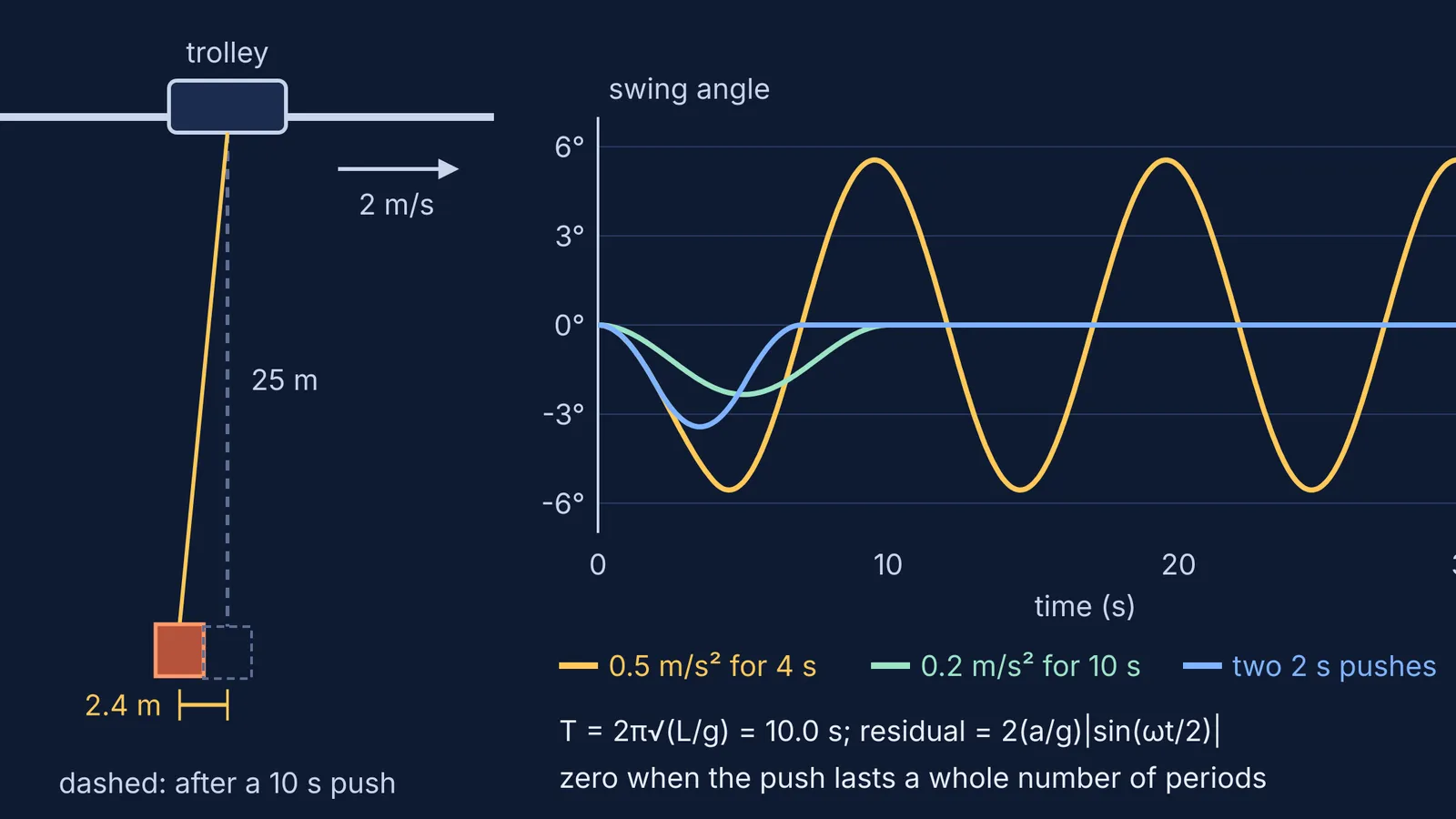
Question. A container hangs 25 m below the trolley. The trolley must reach 2 m/s. Find the swing left behind for different pushes. Take g = 9.8 m/s². The rope length and speeds are illustrative round values.
Period. T = 2π√(25/9.8) = 10.04 s, and ω = 2π/10.04 = 0.626 rad/s.
Push at 0.5 m/s² for 4 s. θ₀ = 0.5/9.8 = 0.0510 rad. ωt_a/2 = 0.626 × 4/2 = 1.252 rad, and sin 1.252 = 0.950. Residual amplitude = 2 × 0.0510 × 0.950 = 0.0969 rad = 5.55°.
Sideways swing at the container. 25 × sin 5.55° = 2.42 m each way. A step-by-step numerical solution of the full pendulum equation, without the small-angle shortcut, gives 5.55° too.
Push at 1.0 m/s² for 2 s. The amplitude is 6.85°, or 2.98 m.
Push at 0.25 m/s² for 8 s. The amplitude is 1.74°, or 0.76 m.
Push at 0.2 m/s² for one period, 10.04 s. sin(π) = 0, so the residual swing is zero. The trolley reaches 2.0 m/s with the container hanging still.
Gentler is not the whole story. The 8 s push still leaves a swing, while the 10.04 s push leaves none. What matters is how the push time compares with the period.
Can you get there faster without leaving a swing?
Yes, by splitting the push in two. Push at 0.5 m/s² for 2 s, reaching 1 m/s. That alone would leave a swing of 3.43°. Now coast, and start a second identical 2 s push exactly half a period (5.02 s) after the first one began. The second push starts a swing of the same size but exactly out of step with the first, and the two cancel.
The trolley reaches 2 m/s at 5.02 + 2 = 7.02 s.
The numerical solution leaves a swing of 0.002°, about 1 mm at the container.
That is three seconds quicker than the single one-period push, with no swing at the end. Braking at the end of the move works the same way: time the slowing down in the same pattern and the container stops under the trolley.
This idea is called input shaping. Singer and Seering (Journal of Dynamic Systems, Measurement, and Control, 1990) showed that a command split into pulses timed by the vibration period removes the leftover vibration, at the cost of a delay of about one period, and that the method stays useful when the period is not known exactly. Engineers at the Savannah River Technology Center later fitted such a controller to a gantry crane so the load moved without residual sway, described in Singer, Singhose and Kriikku's 1997 report. A review of crane dynamics and control by Abdel-Rahman, Nayfeh and Masoud (2003) classifies the many control strategies proposed for cranes. A real container also twists and its ropes stretch, which simple timing cannot fix alone.
What changes when the load is hoisted?
The period depends on the rope length. Hoist the container until only 10 m of rope is out, and T = 2π√(10/9.8) = 6.35 s. A push timed for 25 m is now the wrong length, and the swing comes back. A crane that lifts while it moves must keep changing the timing.
Safety. A swinging container weighs many tonnes and can crush anyone in its path. Never stand under a suspended load, and keep clear of its swing.
To watch a pendulum's swing depend on length and push time, try a pendulum in the Fermi Simulation Lab. For a crane's other big problem, staying upright, see how tower cranes use counterweights and moments.
Quick checklist
During a push at a, the load's resting angle is a/g; it swings about it.
Residual swing = 2(a/g)|sin(ωt_a/2)|, with ω = √(g/L).
A push lasting a whole number of periods leaves no swing.
Two equal pushes half a period apart cancel each other's swing.
Change the rope length and the timing must change too.
Never stand under a suspended load.