

On this page
Push a piston a little way into a sealed cylinder of gas and let go. It springs back out, overshoots, and keeps bouncing. The trapped gas acts like a spring, and once you find that spring's stiffness, the time period follows in two lines. It is a standard oscillations problem because it joins two topics: simple harmonic motion and the gas laws.
Why does the piston oscillate at all?
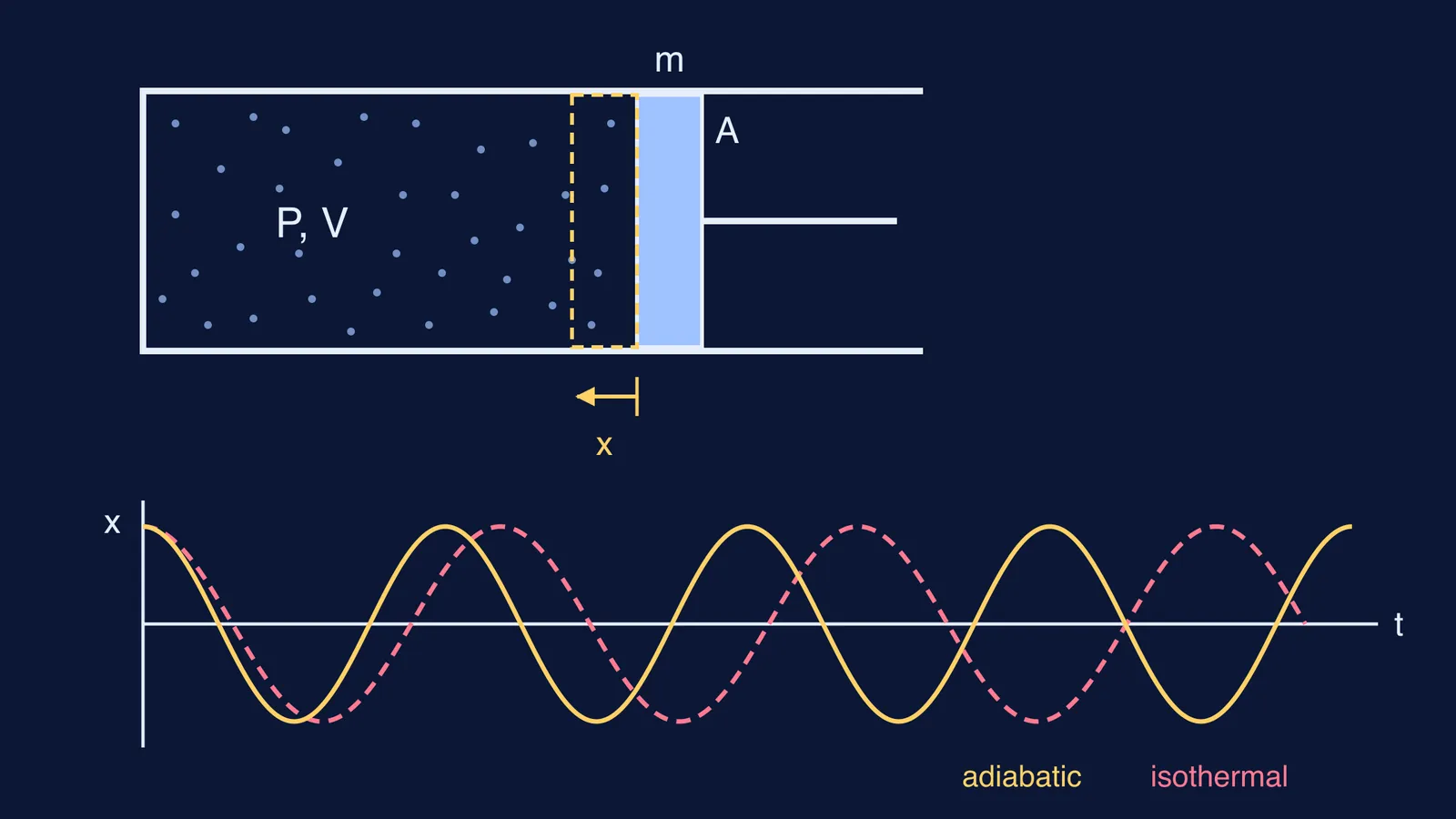
At equilibrium, the gas pressure P balances everything else pushing on the piston. Push the piston in by a small distance x and the gas volume drops by Ax, so the pressure rises. That extra pressure pushes the piston back out. Pull it out and the pressure falls, so the piston is pulled back in. The restoring force always points towards the equilibrium position.
In the NCERT Class 11 Oscillations chapter, a force of the form F = −kx gives simple harmonic motion with angular frequency ω = √(k/m), so the period is T = 2π/ω = 2π√(m/k). So the whole job is to show that the gas force has this form and to find k. If you want a refresher on that test, see our guide on checking whether a motion is SHM from its acceleration equation.
How do you derive T = 2π√(mV/γPA²)?
NCERT's Thermodynamics chapter (section 11.8.3) states that for an adiabatic process of an ideal gas, PV^γ = constant, where γ = Cp/Cv. Use it in five steps:
Start at equilibrium: pressure P, volume V.
Push the piston in by x. The new volume is V − Ax and the new pressure is P + ΔP.
Adiabatic: (P + ΔP)(V − Ax)^γ = PV^γ. Because Ax is much smaller than V, (1 − Ax/V)^γ ≈ 1 − γAx/V, which gives ΔP ≈ γPAx/V.
The extra force on the piston is ΔP × A, directed outwards, opposite to x: F = −(γPA²/V)x.
Compare with F = −kx: k = γPA²/V, so T = 2π√(mV/(γPA²)).
If the question says the gas is compressed slowly enough to stay at constant temperature, use PV = constant instead. The same steps give k = PA²/V and T = 2π√(mV/(PA²)). The only change is the missing γ.
That bulk-modulus view is explained in our post on why sound uses γP: isothermal and adiabatic bulk modulus of a gas.
Worked example: how long is one oscillation?
Take a horizontal cylinder holding 10 litres of air at 1.0 × 10^5 Pa, closed by a 2 kg piston of area 100 cm². Ignore friction.
Convert first: V = 0.01 m³, A = 0.01 m², so A² = 1 × 10^−4 m⁴.
Air is mostly diatomic, and the heat capacity ratio of dry air at 20 °C is 1.400, so take γ = 1.4.
Adiabatic stiffness: k = γPA²/V = (1.4 × 10^5 × 10^−4)/0.01 = 1400 N/m.
Period: T = 2π√(2/1400) ≈ 0.24 s, about 4 oscillations a second.
Isothermal check: k = 1000 N/m, so T = 2π√(2/1000) ≈ 0.28 s.
The adiabatic period is shorter by a factor of √1.4 ≈ 1.18, because the gas spring is stiffer when its temperature also rises on compression.
Adiabatic or isothermal: which should you use?
Follow the question's wording first. If it says nothing, think about speed. A piston bouncing several times a second gives heat little time to flow through the walls, so the adiabatic formula is the usual choice. Our explainer on why rapid processes are adiabatic and slow ones isothermal goes through this reasoning.
This setup is also a real laboratory method. In 1929 Eduard Rüchardt published an experiment in which a ball or piston oscillates in a tube on top of a trapped volume of air, and the measured period gives γ through T = 2π√(mV/(γPA²)), as the summary of the Rüchardt experiment sets out.
What traps do exam questions set?
Run this checklist before you write the final answer:
Vertical piston: P is the equilibrium gas pressure, P₀ + mg/A, not atmospheric pressure. Gravity moves the equilibrium point but does not change k.
Gas on both sides: if the piston divides a closed cylinder into volumes V₁ and V₂ at equal pressure P, both gases push back, so k = γPA²(1/V₁ + 1/V₂).
Units: area in m², volume in m³, pressure in Pa. Squaring a cm² value is an easy slip.
Small x only: the linear approximation needs Ax much smaller than V. Large swings are periodic but not simple harmonic.
Which γ: 5/3 for a monatomic gas, 7/5 for a diatomic one such as air.
If you set up the force correctly but still land on the wrong number, the Fermi Problem Library has worked problems with a step-by-step solver that explains the reasoning rather than printing an answer. If the adiabatic idea itself feels shaky, the Fermi Concept Library gives each concept its own lesson and its place in the map.


