On this page
Look at a bicycle wheel in any cycle repair shop. The hub sits in the middle of 36 thin steel wires, and a wire cannot push. So how does the hub stay up when you sit on the saddle? The usual answer is that it hangs from the top spokes. That answer is wrong. The hub is held up because the bottom spokes lose some of their tension, so the steady pull of the others wins. This post works out how big those changes are, and why rear wheels have crossed spokes.
Why can thin spokes hold up a rider at all?
Every spoke is tightened when the wheel is built. Park Tool, a bicycle tool maker, says in its guide to spoke tension measurement that most rims have suggested ranges of 100 to 120 kgf, or 980 to 1177 N. In this post we use a round 1000 N.
That pretension is the whole trick. A spoke pulled to 1000 N can act as if it carries a push, as long as the push is smaller than 1000 N: the push just shows up as a fall in tension. The spoke never actually goes into compression. In effect the wheel behaves like a wagon wheel with stiff spokes, with the pretension stopping the thin wires from buckling.
Jobst Brandt, author of the book The Bicycle Wheel, put it this way in a newsgroup answer archived on yarchive: the spoke under the hub is shortened by the load, "while the upper spokes remain unaffected", and the wheel "stands on the bottom spokes".
Do the top spokes carry the load? A rigid-rim estimate
Start with a model you can solve on paper. Imagine the rim cannot bend at all, and the hub sinks by a tiny distance δ under a load W.
A spoke at angle θ from the downward vertical shortens by δ cos θ. Spokes above the hub get longer by the same rule, since cos θ is negative for them.
Each spoke acts like a stiff spring of constant k, so its tension changes by k δ cos θ: up for top spokes, down for bottom ones.
Every change in tension gives the hub a vertical force k δ cos θ × cos θ. The total must balance the load: W = k δ Σcos² θ.
For N evenly spaced spokes, Σcos² θ = N/2. For 36 spokes that is 18.
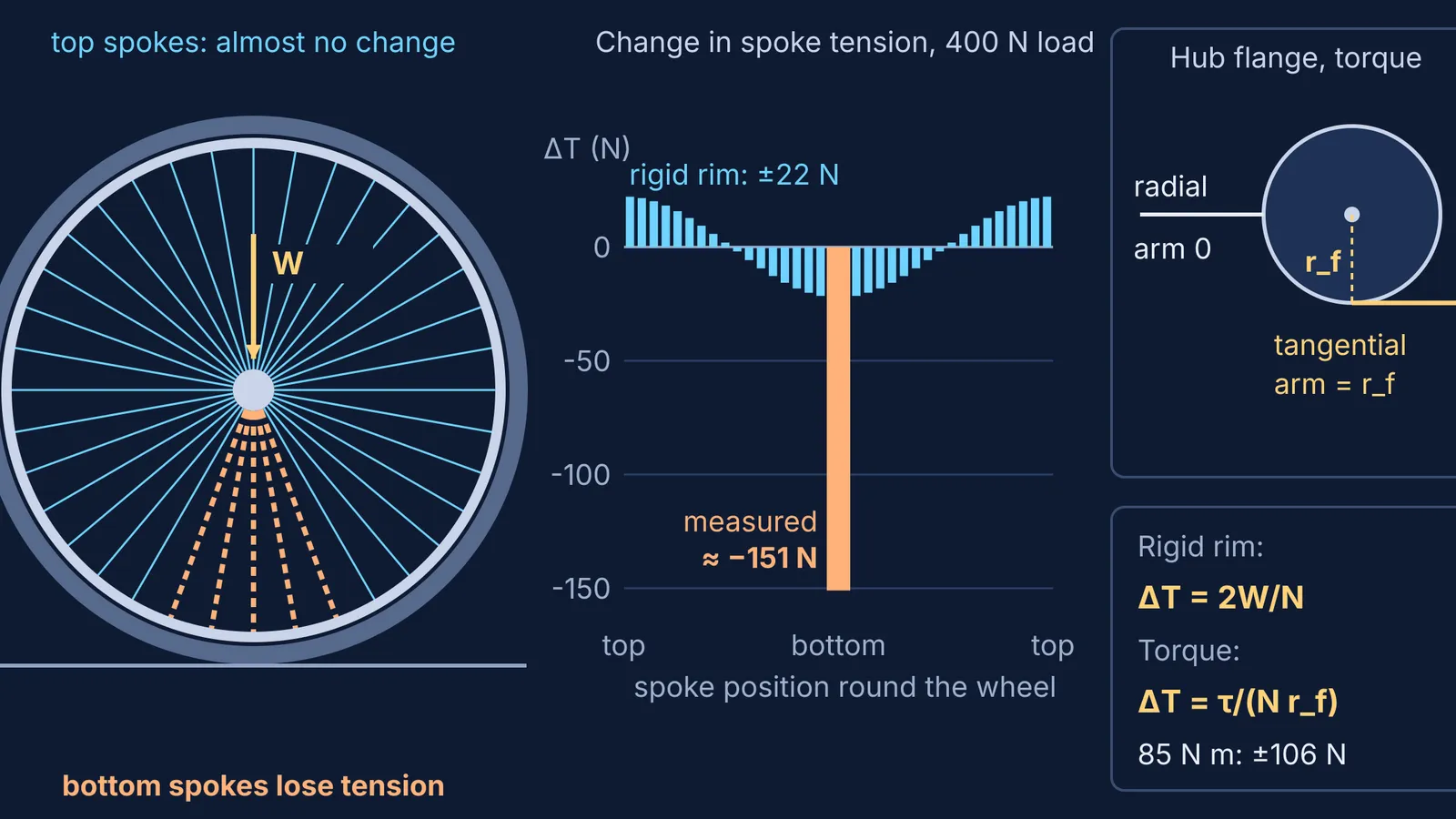
So the largest change is ΔT = W/(N/2) = 2W/N. With 400 N on the wheel (an illustrative share of a rider and bicycle), ΔT = 2 × 400/36 = 22.2 N. The top spoke would gain 22 N and the bottom spoke would lose 22 N. Even in this model the top spokes do only half the job, and 22 N is barely 2% of 1000 N.
What do measurements show about the bottom spokes?
Real rims bend. When the hub presses down, the rim flattens a little near the ground, so the spokes there shorten far more than the rigid model says, and the rest of the rim hardly moves.
Henri Gavin fitted strain gauges to the spokes of three 36-spoke rear wheels and published the results in the Journal of Engineering Mechanics in 1996. His wheels used 1.83 mm steel spokes with a Young's modulus of 206 GPa. For the spoke between the hub and the ground, he measured about 1 microstrain of change for every 1.44 N of load on the axle.
Worked example: how much does the bottom spoke lose?
Load W = 400 N, so the strain change is ε = 400/1.44 ≈ 278 × 10⁻⁶.
Spoke area A = π × (1.83 × 10⁻³ m)²/4 = 2.63 × 10⁻⁶ m².
Tension change ΔT = E A ε = 206 × 10⁹ × 2.63 × 10⁻⁶ × 278 × 10⁻⁶ ≈ 151 N.
Compare with the rigid-rim estimate: 151/22.2 ≈ 6.8.
So the bottom spoke loses about 150 N, nearly seven times the rigid-rim value. A few spokes near the ground take most of the load as lost tension, while the top spokes hardly change, as Brandt said. Units check: Pa × m² is N, and strain has no unit.
The bottom spoke still holds about 1000 − 151 ≈ 850 N, so it stays tight. A spoke goes slack only if its loss exceeds its pretension, and then the wheel can fold sideways. That is why wheels are tensioned well above any load they carry. If the strain-to-force step feels shaky, revise it in stress, strain and Young's modulus problems.
How do spokes pass pedal torque to the rim?
The load from the road is not the only job. On the rear wheel the chain turns the hub, and the spokes must pass that torque to the rim. How the chain gets the torque to the hub is covered in how bicycle brakes and chain drives work.
Worked example: torque in tangential spokes
Push of 500 N on a 170 mm crank: torque τ = 500 × 0.170 = 85 N m (illustrative push).
In a 1:1 gear (same teeth on chainring and sprocket), the rear hub also gets 85 N m.
A radial spoke points straight through the axle. Its lever arm is zero, so it can pass no torque at all.
A spoke leaving the hub flange along a tangent has a lever arm equal to the flange radius. Gavin's hubs had a flange radius of 22.2 mm.
Half the spokes pull forward and half trail behind. When the hub turns, the "pulling" spokes gain tension and the "pushing" spokes lose it, the terms Gavin uses. So τ = N × ΔT × r_f, which gives ΔT = 85/(36 × 0.0222) ≈ 106 N.
A real three-cross spoke is not quite tangent. From the geometry of Gavin's wheel, its lever arm is about 19.9 mm, giving about 119 N. Either way it is about ±10% of the pretension.
That is why rear wheels are laced with crossing spokes, and why some front wheels with rim brakes are laced radially: they carry almost no torque. A front wheel with a hub or disc brake carries braking torque and needs crossed spokes too.
Why is the rim not crushed by 36 spokes pulling inwards?
Thirty-six spokes at 1000 N pull the rim inwards with a large total force. The rim resists as a ring in compression, the opposite of a spinning ring in tension. The ring case is worked out in hoop stress in a grinder disc. This is why rim strength sets the limit on spoke tension.
Spoke tension is a job for a trained cycle mechanic. Do not try to tighten or loosen spokes yourself: uneven tension can bend the rim or make the wheel collapse.
To revise torque, lever arms and the stress-strain link, the Concept Library explains each idea step by step.
Quick checklist
Spokes are pretensioned, about 1000 N each.
Rigid rim: largest change 2W/N, 22 N for 400 N on 36 spokes.
Measured: the bottom spoke loses about 150 N; the top spokes barely change.
The wheel stands on its bottom spokes by reducing their pull.
Torque: ΔT = τ/(N r_f), about ±106 N for 85 N m.
Radial spokes have no lever arm, so rear wheels use crossed spokes.